Longest Portage: 1 kilometre (Donald Lake to Kukagami Lake)
Route: Kukagami Lake – Outlet Bay – Carafel Creek – Carafel Lake – Maskinonge Lake – Rice Lake – Lower Matagamasi Lake – Edna Lake – Karl Lake – McCarthy Bay – Gold Lake -Colin Scott Lake – Donald Lake – Kukagami Lake – Kondike Bay
Actual Route
Total Days: 2.5
Total Kilometres: Approx. 40 kilometres
Total Portages: 12
Total Portage Length: 2.625 kilometres
Longest Portage: 1 kilometre (Donald Lake to Kukagami Lake)
Average Daytime High: 20.3 Celsius
Average Nighttime Low: 17 Celsius
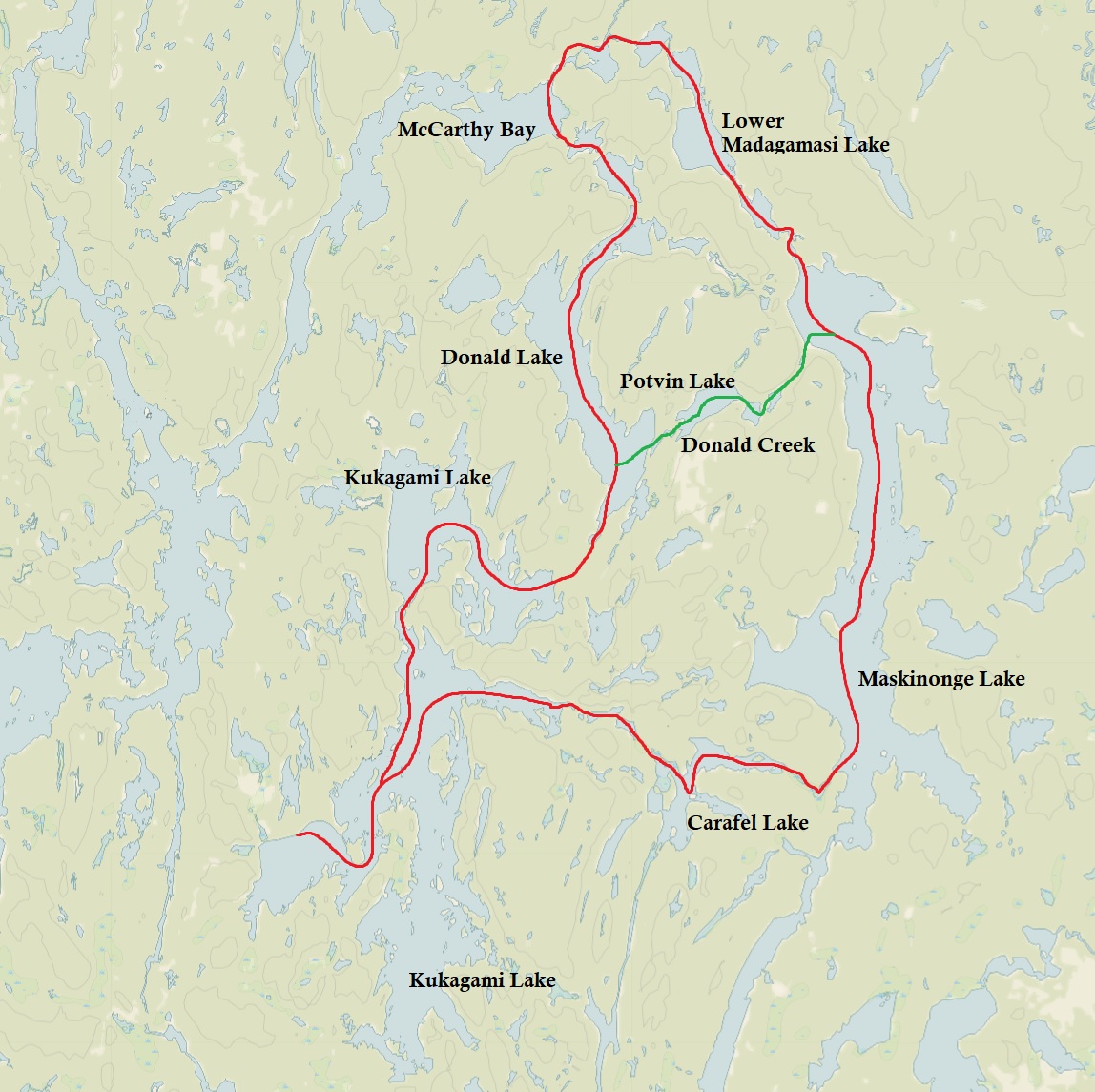
Route: Kukagami Lake – Outlet Bay – Carafel Creek – Carafel Lake – Maskinonge Lake – Donald Creek – Potvin Lake – Donald Creek – Donald Lake – Kukagami Lake
Maps Used: Map from “Top 50 Canoe Routes of Ontario” by Kevin Callan
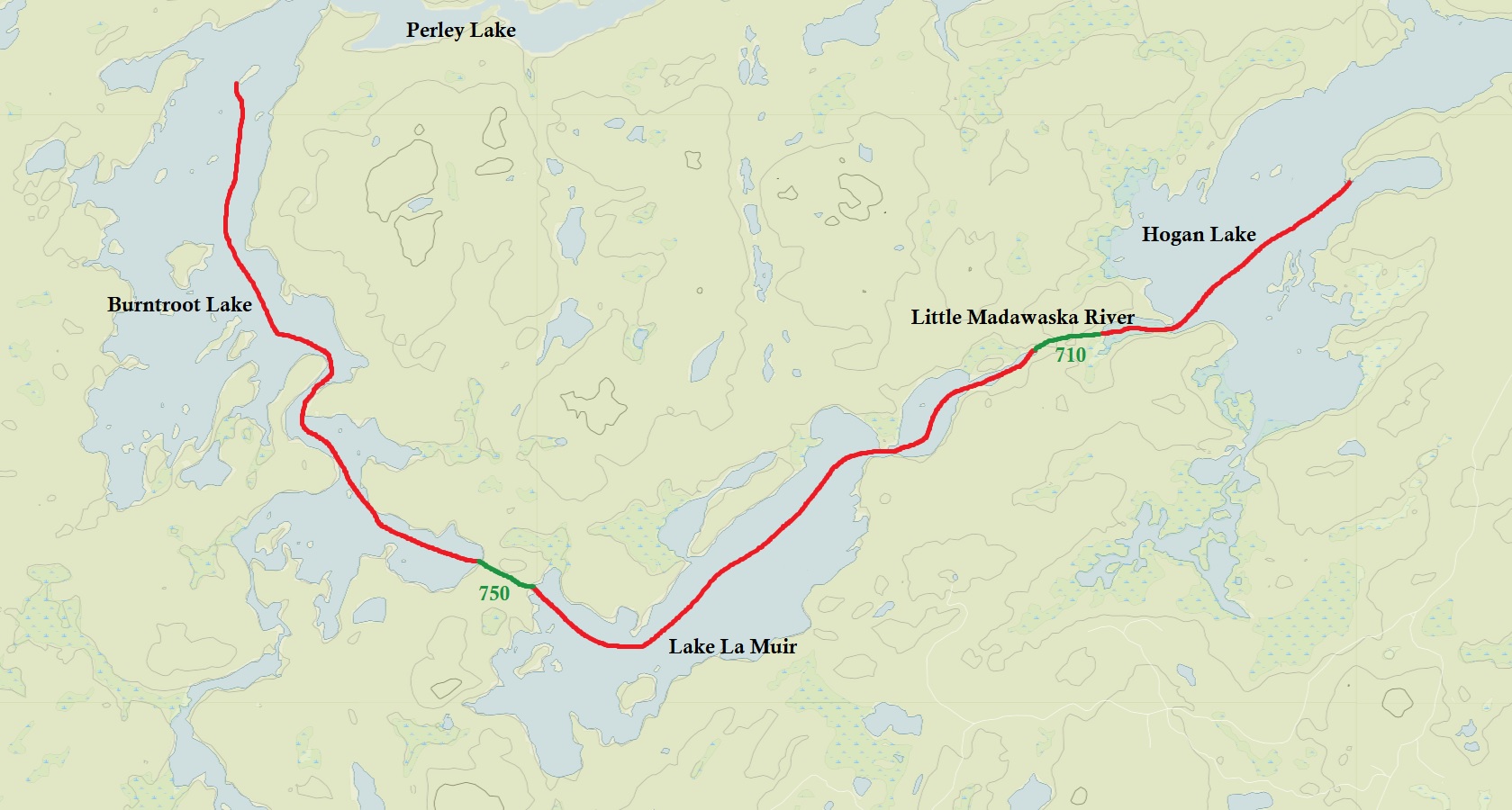
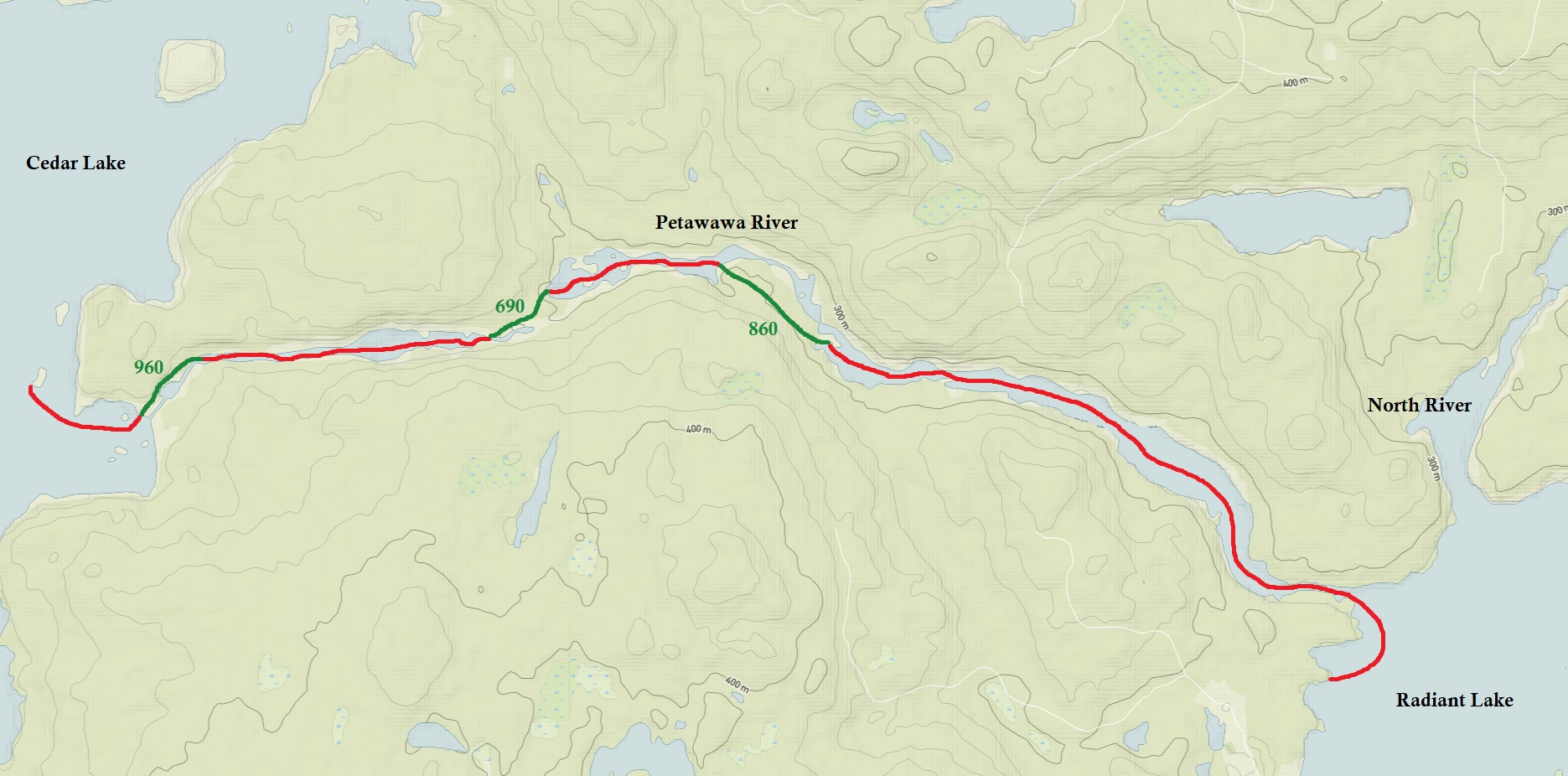
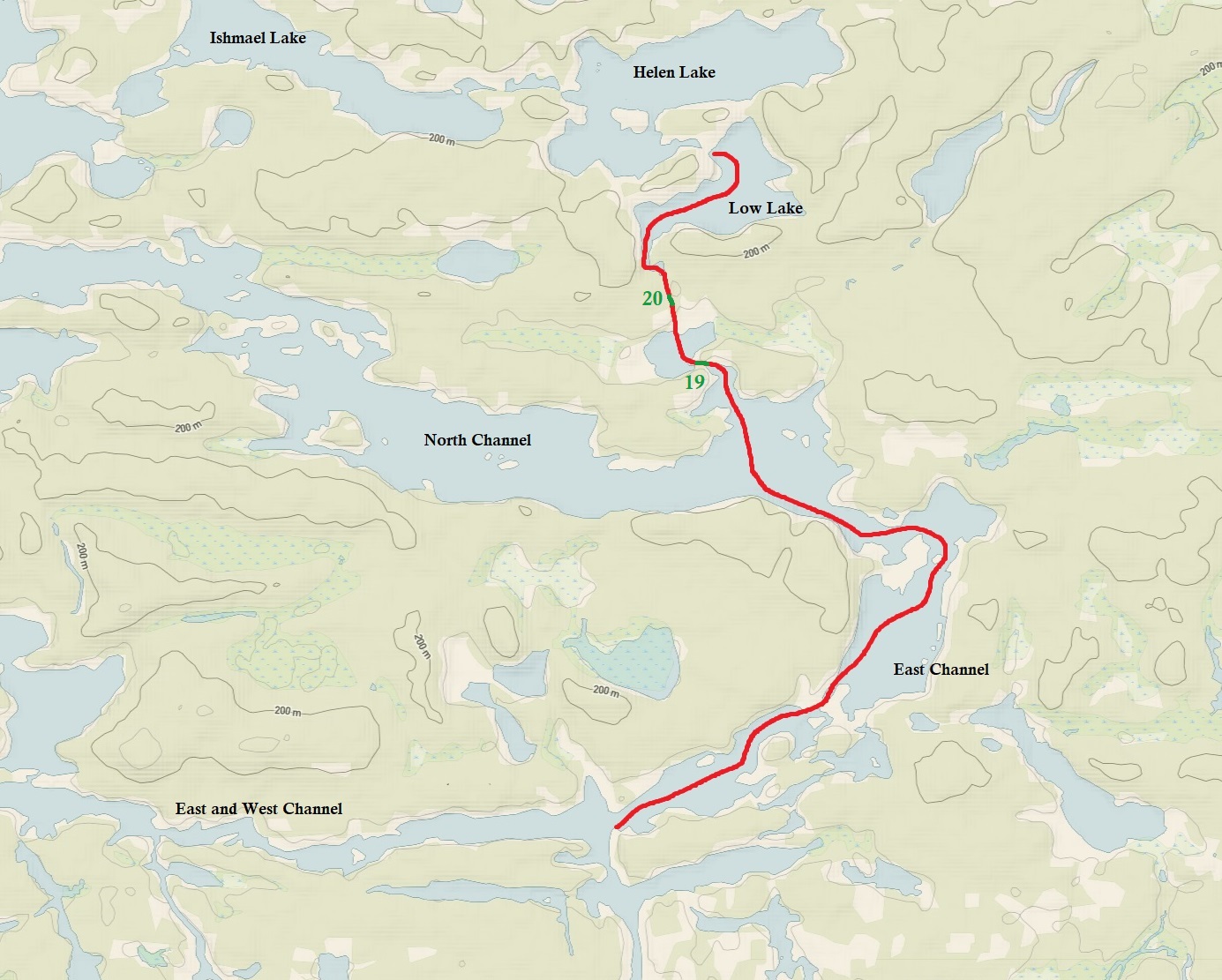
Our outline of our planned route in red with a green line showing where we cut the trip almost in half. (click image to enlarge) topoView USGS.
For the 2013 paddling season we decided to have a spring and fall trip since summer can get a little too hot and uncomfortable. As Killarney Provincial Park continues to get more and more popular, we felt a little over crowded there last year. For our spring trip we found a route in Kevin Callan’s book “Top 50 Canoe Routes of Ontario”. The route is in the Temagami region, one of the most popular paddling areas in the whole province. It was also on crown land so no backcountry fees apply. In the end we learned a very important lesson on this trip.
DAY # 1: Kukagami Lake to Carafel Lake
Weather: Sunny with a few clouds. High: 18 Celsius Low: N/A
After driving up to Muskoka from southwestern Ontario the night before, we were soon on our way to Sudbury on Highway #17. On our drive up we saw where there was a recent train derailment near the town of Wanup. We then turned north on the ever winding Kukagami Lake Road and the Sportsman’s Lodge where we parked our car and launched for a fee. As soon as we stepped out of the car the “Canadian Airforce” was upon us. (Mosquitoes and Blackflies). The mosquitoes in particular were thirsty for blood and surrounded us. The operators at the lodge said the bugs were particularly bad this year which didn’t surprise us as we had a cool and wet spring.
Once we launched from Klondike Bay and paddled into the breeze on Kukagami Lake the swarm subsided and we got to take in the scenery with our first pair of loons already spotted on Kukagami Lake. When we arrived at our first portage of 150 metres the bloodsuckers and biters were back and were so bad that we had to wear our bug nets over our heads. This was not fun while portaging because both our vision and balance were impaired.
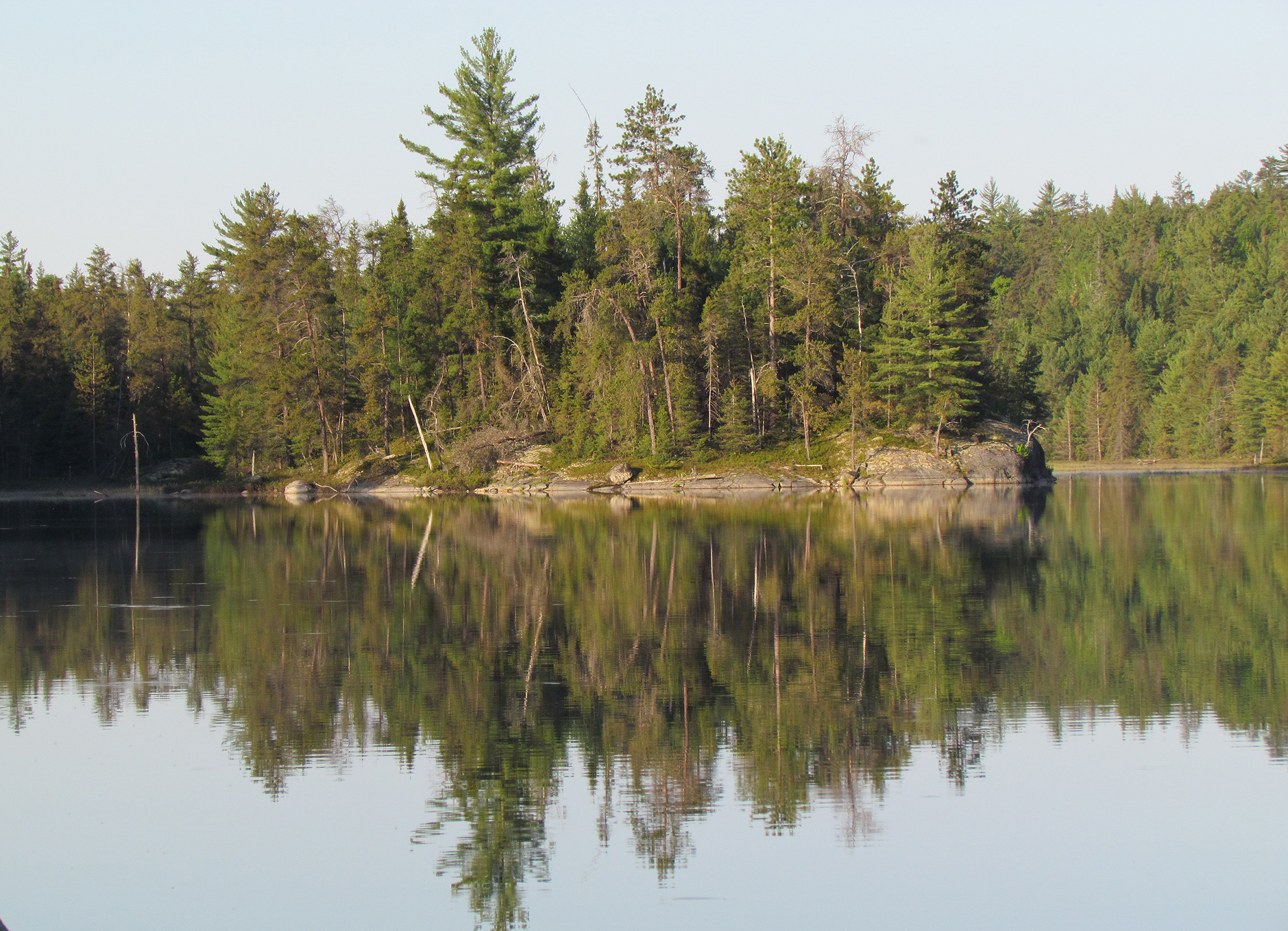
Typical beautiful Temagami scenery. (click image to enlarge)
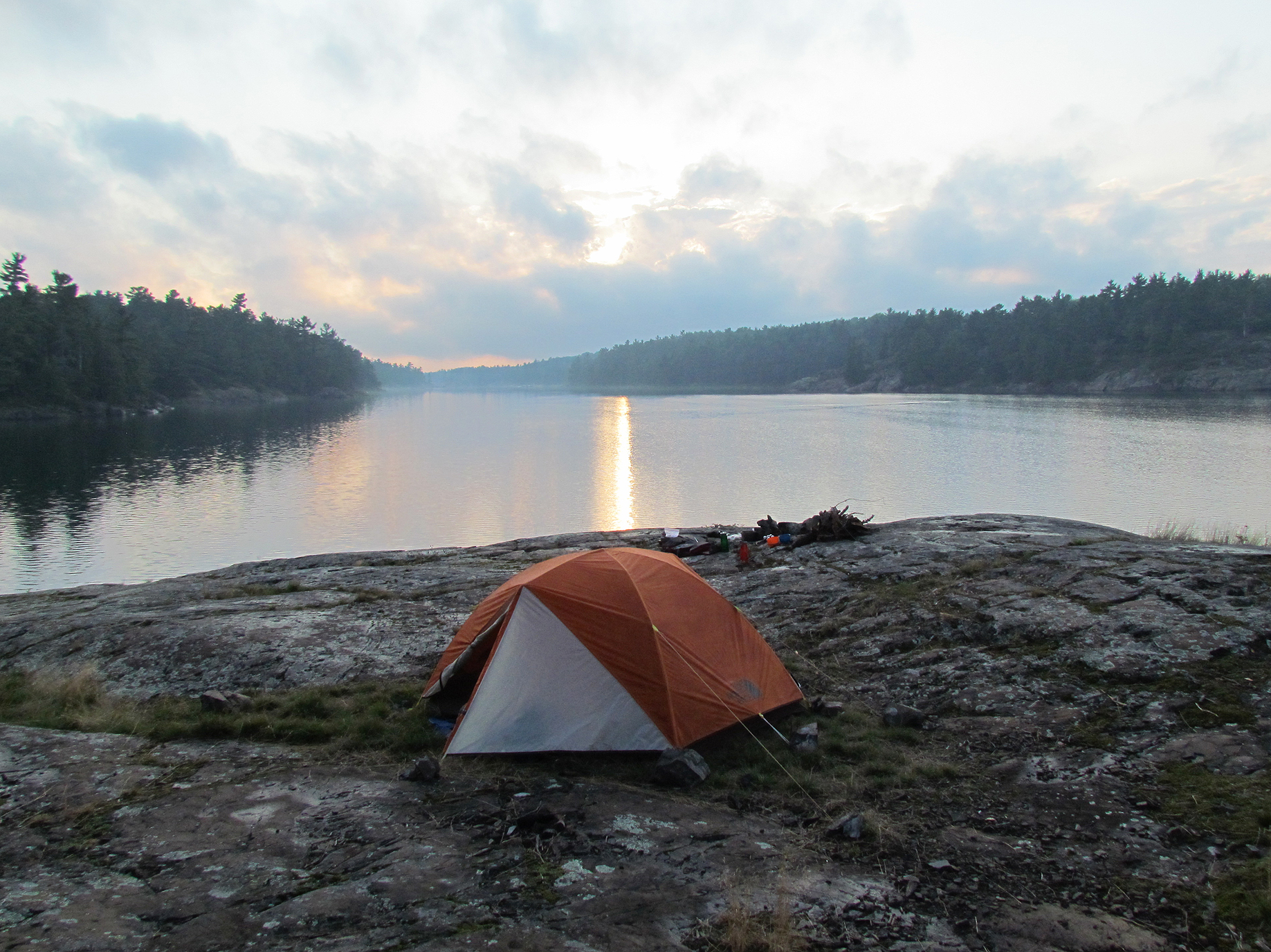
After a few more portages we arrived on Carafel Lake and chose an island site that had a breeze so the bugs were not that bad. The site was a little scruffy but there was a nice flat spot for a tent. After supper, which was our own homemade dehyde of Sheppard’s Pie, we relaxed and inspected our bodies for insect bites. In the distance the sky grew a little dark and we heard distant rumbles of thunder. Luckily for us it veered away and we had a calm night for our first sleep in Temagami.
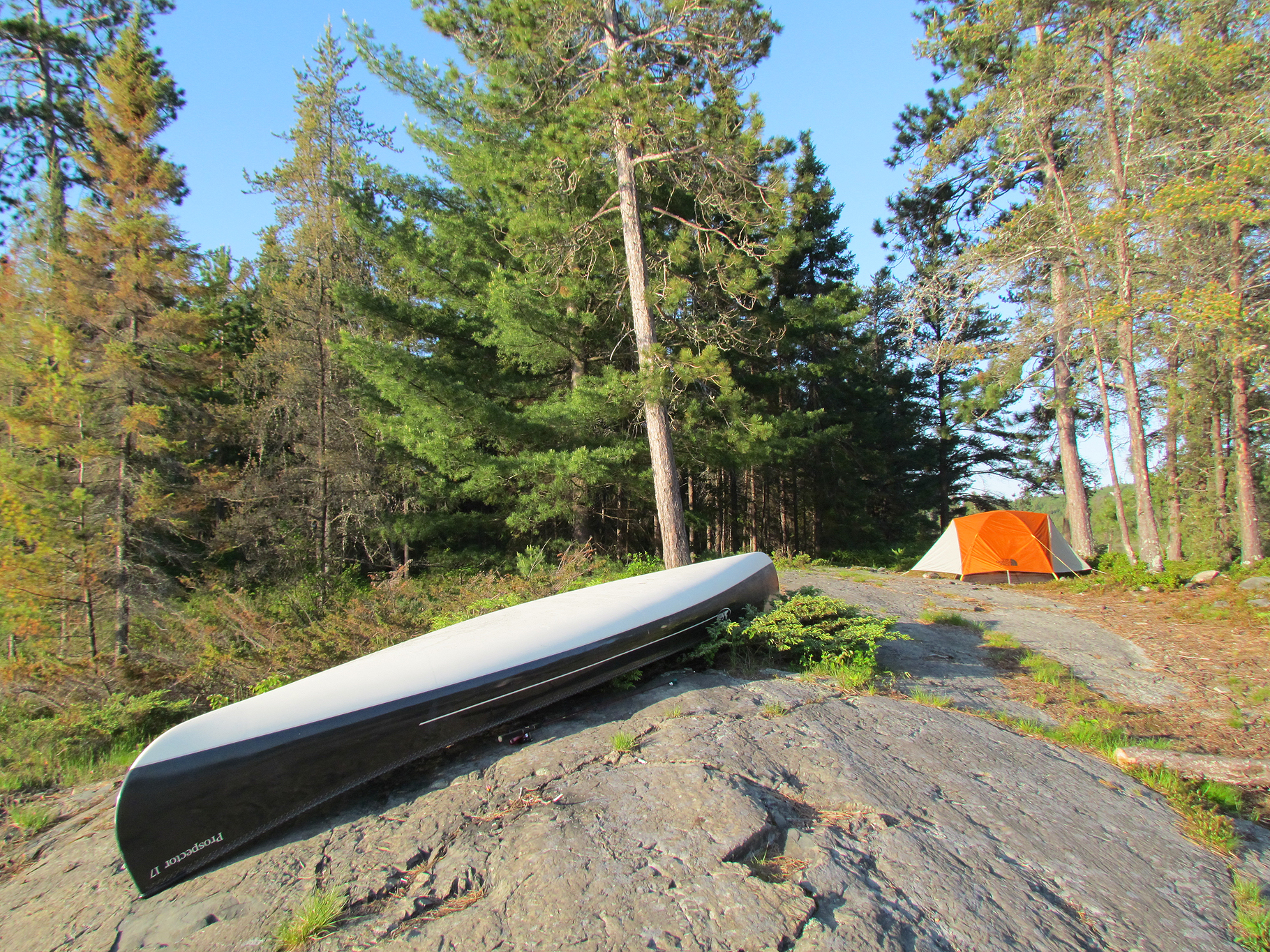
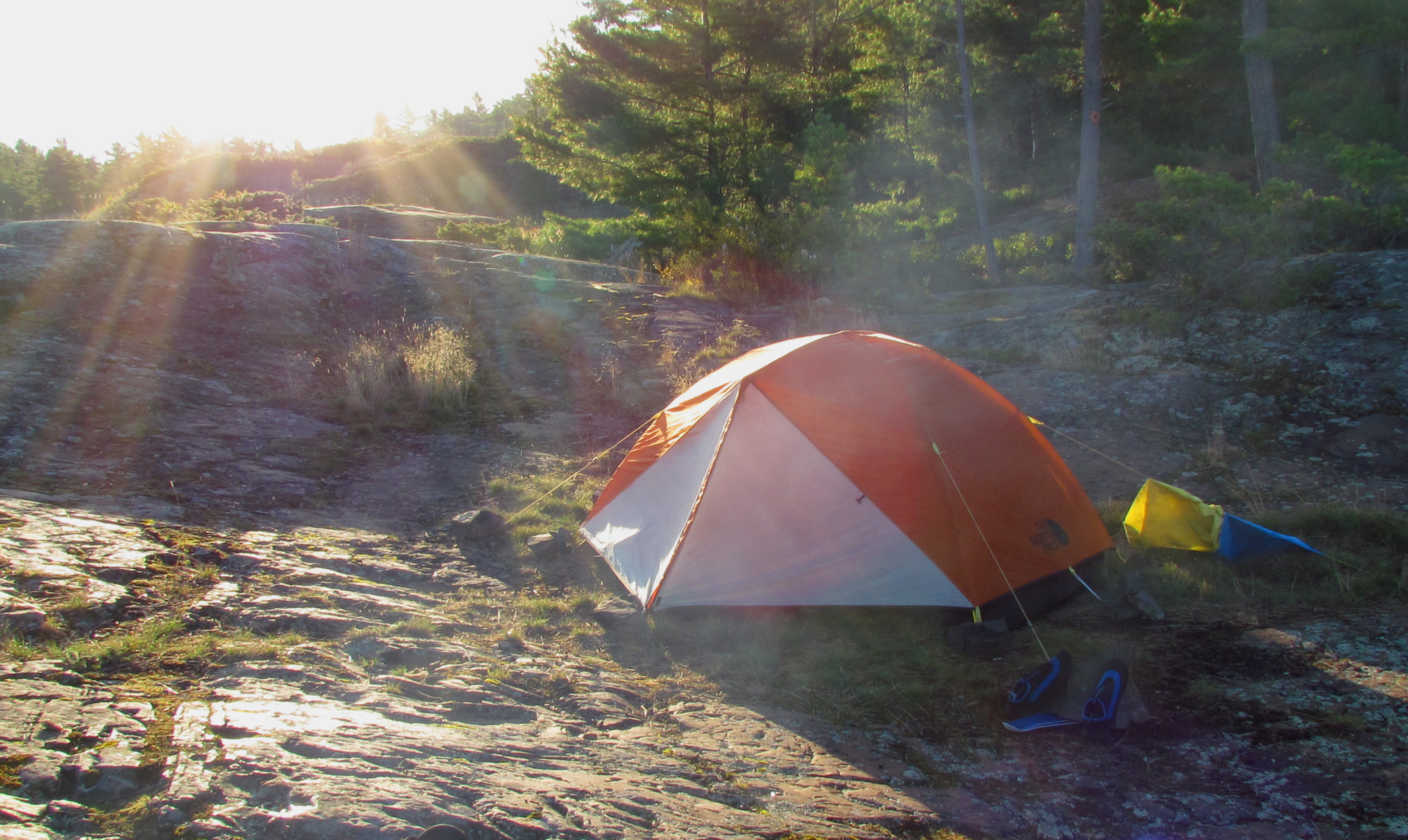
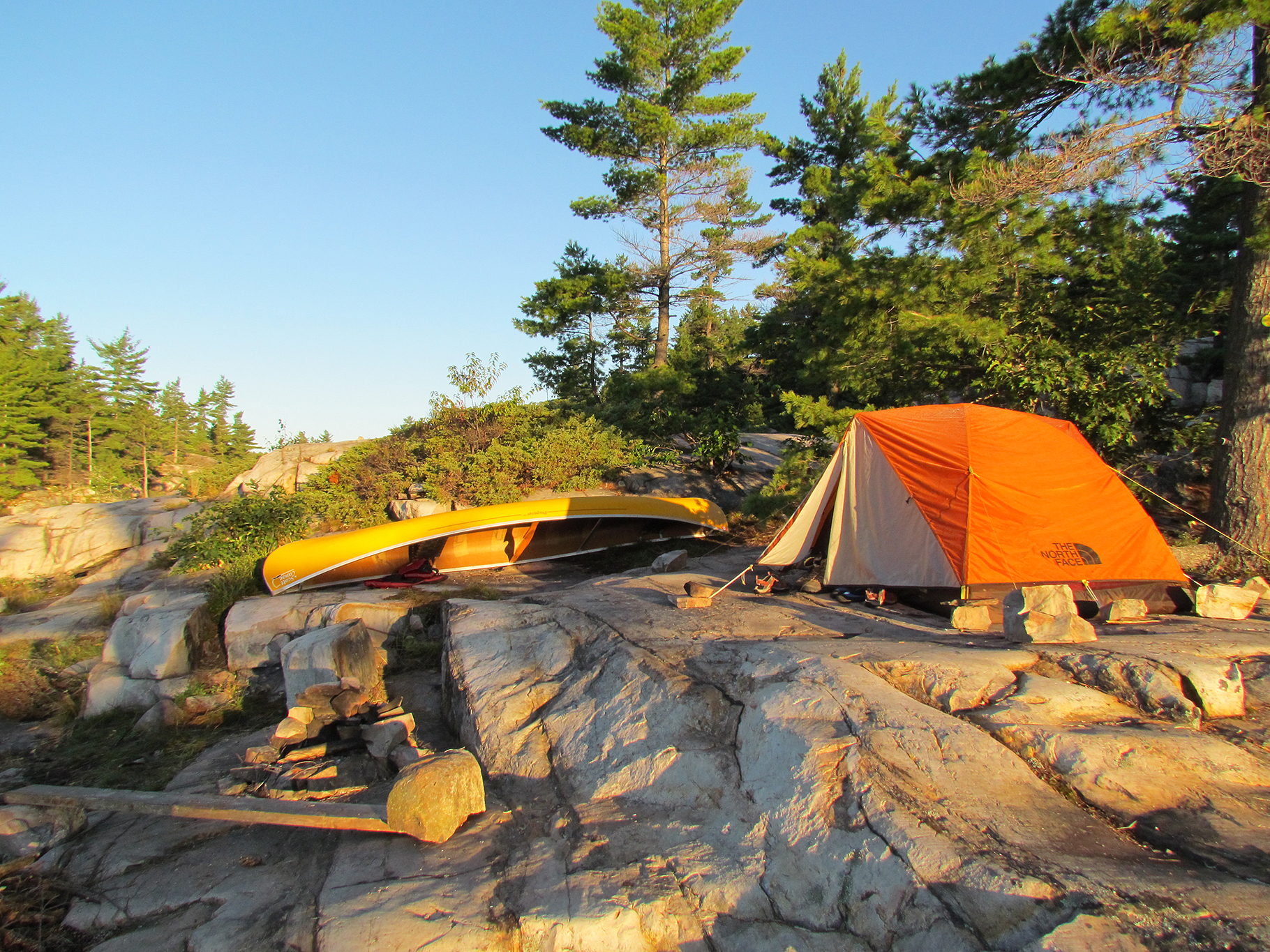
Our site on Carafel Lake. (click image to enlarge)
Wildlife Sightings: White-throated Sparrow, Black-capped Chickadee, Ovenbird, Nashville Warbler, White-tailed Deer, Tiger Swallowtail, Black-throated Green Warbler, Blackburnian Warbler, Red-eyed Vireo, Black-throated Blue Warbler, Pine Warbler, Hermit Thrush, Common Loon, Ruffed Grouse, Yellow-rumped Warbler, Pileated Woodpecker, Northern Flicker, Yellow-bellied Sapsucker, Common Merganser, Mallard, Snapping Turtle, Red Squirrel, Mosquitoes, Blackflies, People
Remember to: Don’t forget a watch. We have no idea what time it is out here.
DAY # 2: Carafel Lake to Maskinonge Lake
Weather: Sunny to partly cloudy. Breezy winds in the evening. High: 21 C Low: 19 C
The morning brought sunshine along with mosquitoes clinging to the inside of the fly of our tent. There seemed to be less insects as the sun came out, however as soon as you tried to squat in the woods it wasn’t long before they were all over you!
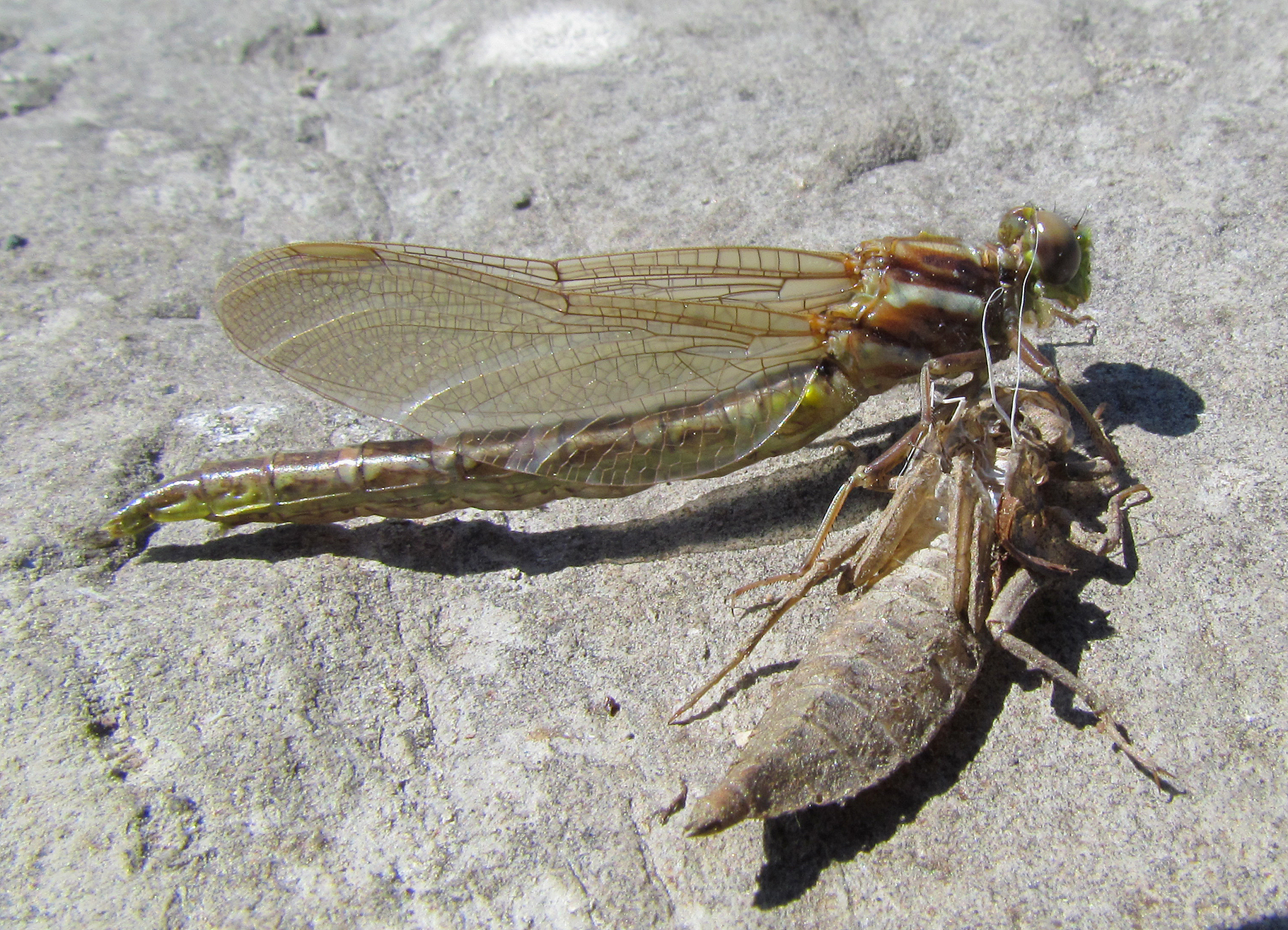
The morning was spent at and around our campsite. We hopped into the canoe and trolled for fish and got snagged. We also watched dragonfly larvae making their way to shore from the shallows and eventually emerge as adult dragonflies. The final act being the uncurling of their delicate wings. The water was quite cool which Marianne found out after she jumped in and then quickly clambered out!
A recently emerged adult dragonfly. Looks to be a species of clubtail. (click image to enlarge)
After a chili and egg noodle lunch it was time to head out to our next site which would only be a short paddle to Maskinonge Lake. We had a lift over that the canoe went over no problem, plus a lift over where an old road used to be. We also waded through another section to avoid some swifts, with the last swift being run no problem. During our paddle we spotted a Moose along the shoreline. We paddled slowly towards it until it decided to turn its head and walk back into the bush.
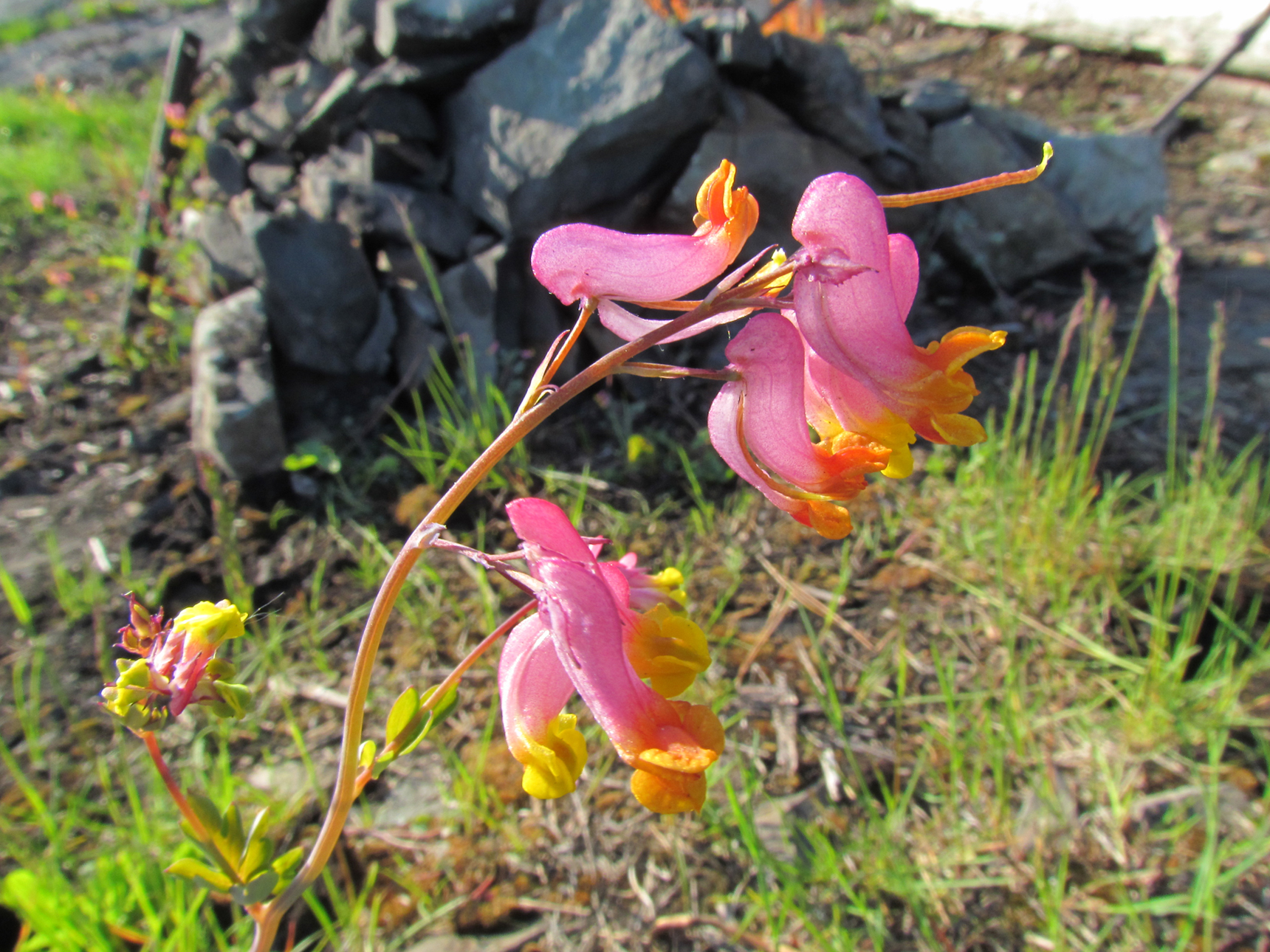
Maskinonge Lake had many islands, however quite a few of them had some marshy areas behind them which we wanted to strictly avoid due to the bugs. In the end it didn’t matter because as soon as we arrived on our island site we were attacked by mosquitoes and blackflies. We quickly put up the tent and spent the rest of our time killing the mosquitoes that made it inside with us. Trying to jump into the lake or squat in the bush was just horrendous as the insects would be all over you for your blood. For supper we just stayed in our tent eating beef jerky, as the blackflies and mosquitoes took turns clinging to the side of our tent hoping that one of us would come out.
Pale Corydalis. We saw a Ruby-throated Hummingbird frequent this flower at our site. (click image to enlarge)
Wildlife Sightings: Moose, Great Blue Heron, Common Loon, Ovenbird, Canada Goose, Tiger Swallowtail, Ruby-throated Hummingbird, Barred Owl, Dragonfly sp., People, Mosquitoes, Blackflies
Remember to: None today……..though a big one is coming up shortly.
DAY # 3: Maskinonge Lake to Kukagami Lake
Weather: Cloudy with light showers in the afternoon. High: 22 C Low: 16 C
After a miserable evening of just hiding in the tent, we were starting to contemplate what we should do. On the plus side we were on vacation and out in the woods which is what we love! On the other hand the bugs were to the point that we couldn’t enjoy having a campfire, or go the bathroom without getting bit around the….well you know.
In the end we decided to cut across Donald Creek to Donald Lake instead of paddling up to Edna Lake. Every portage west to Donald Lake presented a challenge (there were six of them), and to be honest, we vaguely remember any of them because the mosquitoes were relentless! Even with the bug jacket, bug net, and skin smothered in Deet the bugs did NOT care! All we remember of these portages were that they were a combination of bushwhacking, balancing on rocks and logs, and trying to balance along the side of a cliff, while dragging the canoe above a log jam 20 feet below you. Doing all this with a bug net on your head left us discombobulated. It was somewhere along here that we left our fishing rod back at one of these portages. We could care less!
Once we arrived and paddled out onto Donald Lake you would think being out in the middle of the lake would give you somewhat of a reprieve from the bugs, but the mosquitoes followed us into the canoe and bit our butts through the holes of the canoe seat!
After what felt like the longest 1,000 metre portage of our lives, we were back on Kukagami Lake and made the paddle back to the launch as it began to lightly rain. Returning to the launch, we grumbled as we threw our bags in the car and loaded the canoe on top. Down the ever winding road we drove until we reached the city of Sudbury and a Motel….that had no bugs! After a shower we got to take a real good look at the damage from the bug bites. YIKES! For the rest of our vacation we explored the city of Sudbury and chilled back at the cottage. Luckily we have another trip in the fall to make up for this one, though we really want to return to Temagami again. The region is really scenic and we never even explored half our route! For sure a fall trip is in order!
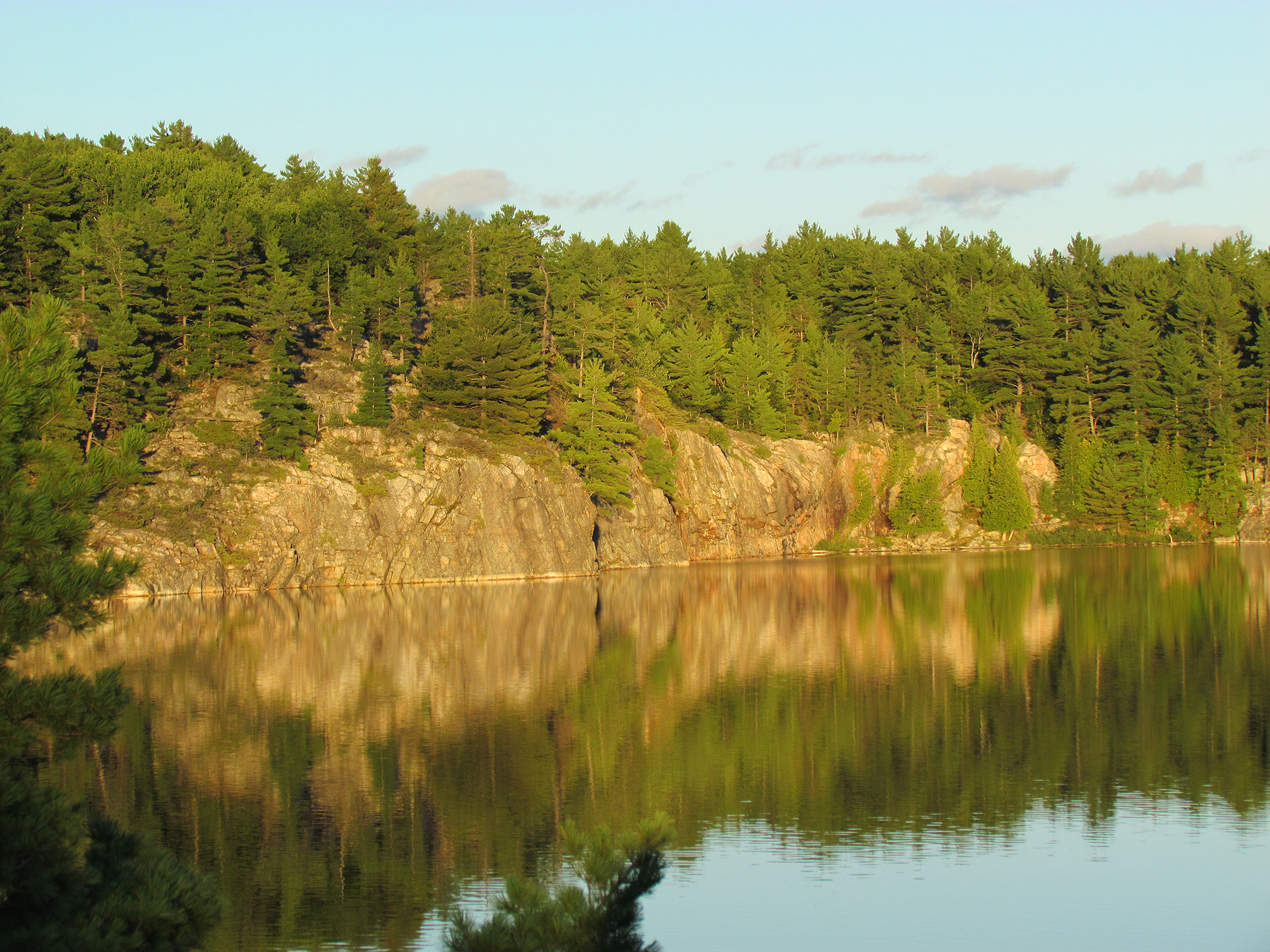
Cold waters of Carafel Lake. (click image to enlarge)
Wildlife Sightings: Common Loon, Common Raven, Swainson’s Thrush, Herring Gull, People, Mosquitoes, Blackflies
Remember to: NO MORE JUNE CAMPING IN NORTHERN ONTARIO!!
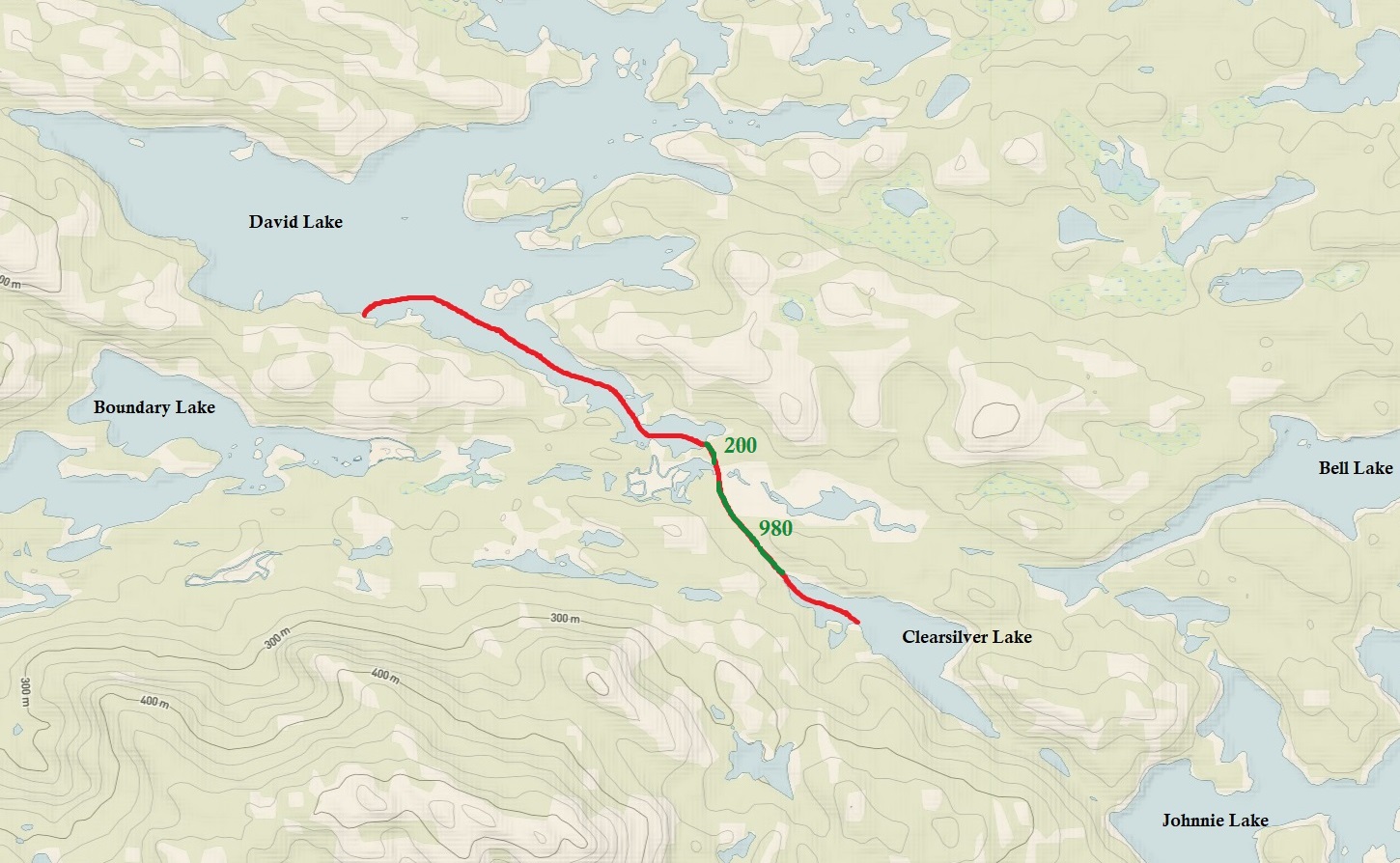
Longest Portage: 980 metres (David Lake to Clearsilver Lake)
Average Daytime High: 25.7 Celsius
Average Nighttime Low: N/A (but it was warm)
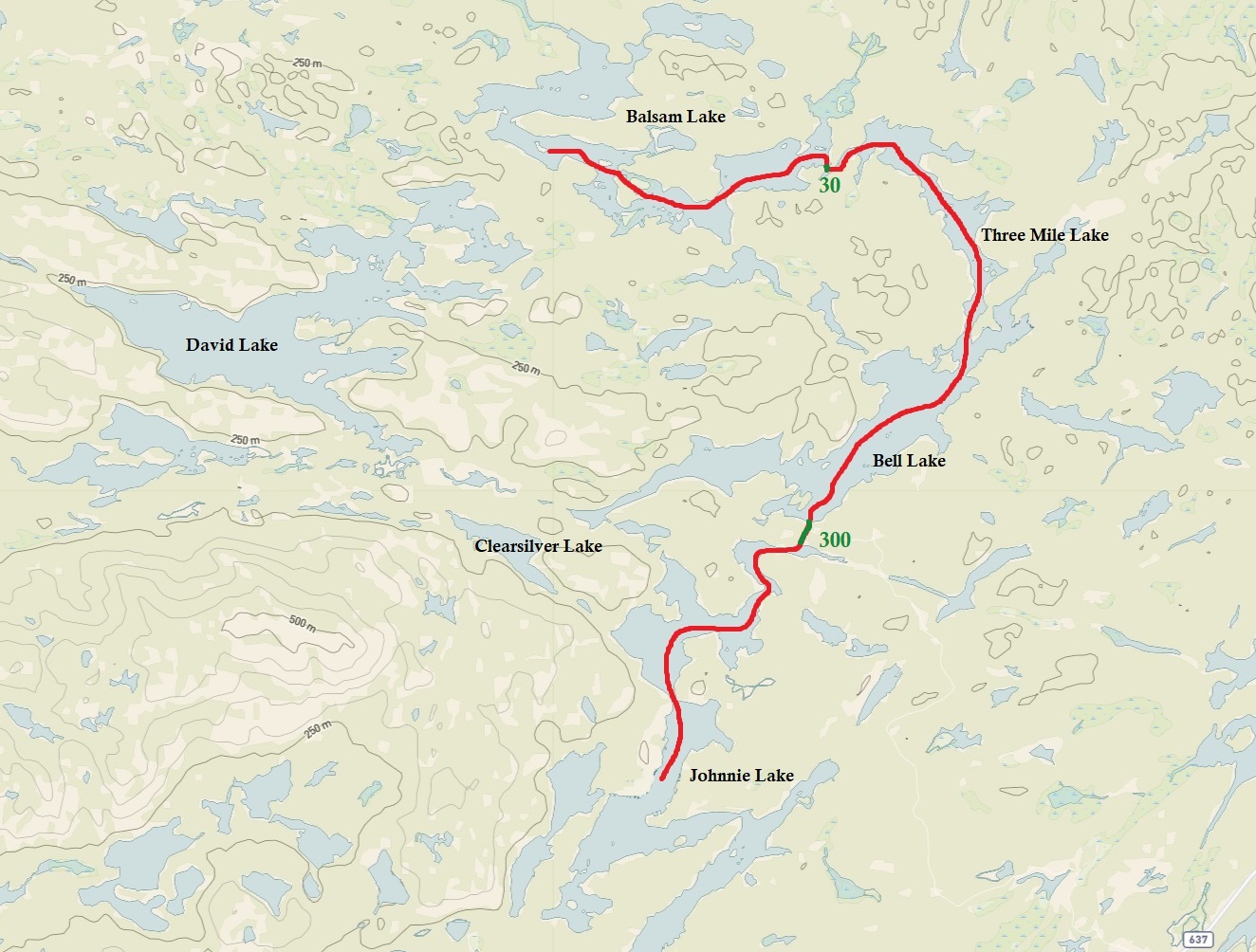
Route: Carlyle Lake – Johnnie Lake – Bell Lake – Three Mile Lake – Balsam Lake – David Lake – Clearsilver Lake – Johnnie Lake – Carlyle Lake
Maps Used: Friends of Killarney Map (version 2007)
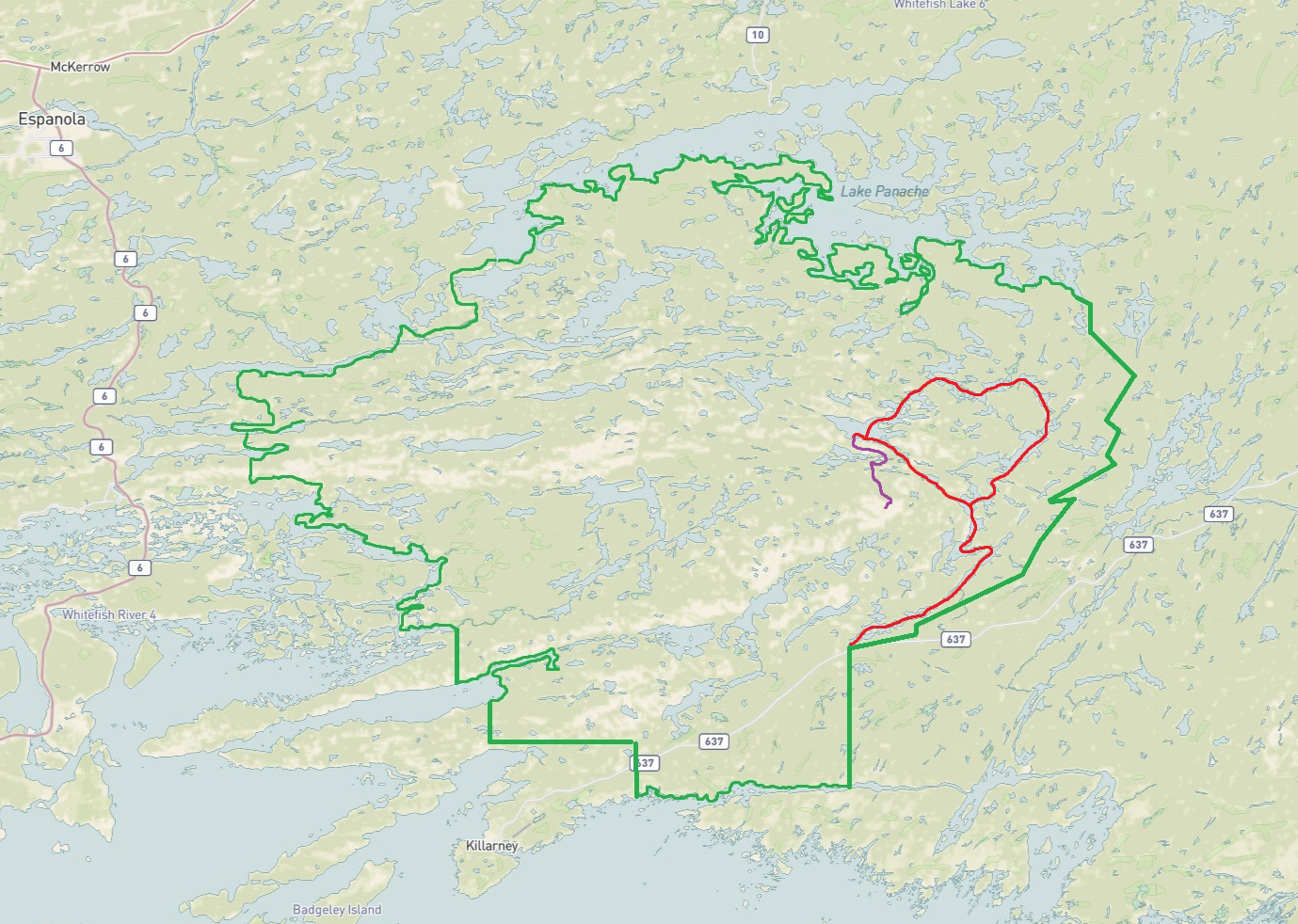
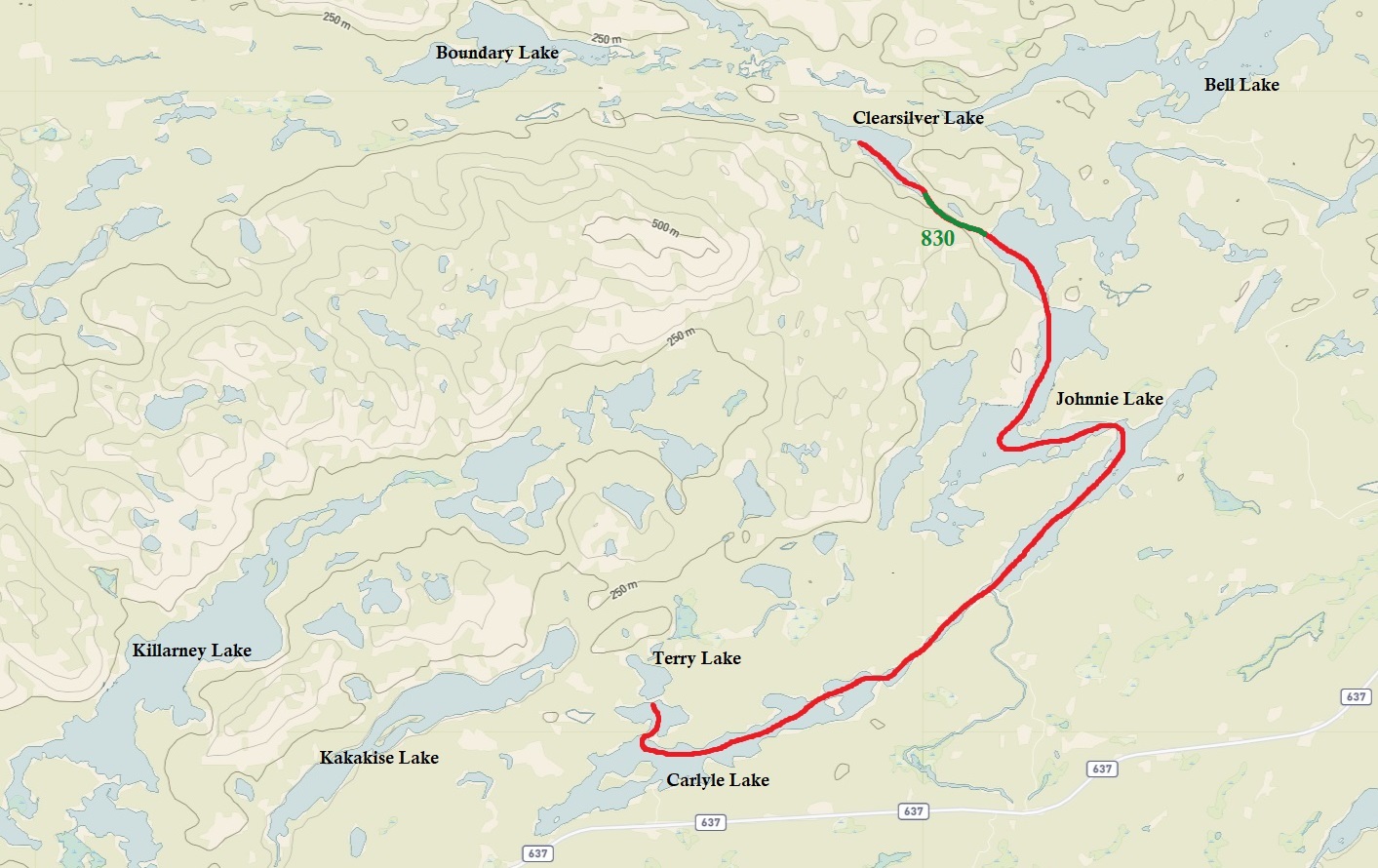
An outline of Killarney Provincial Park with our route in red, along with a hike up Silver Peak in purple. (click image to enlarge) topoView USGS.
We had such a great time in Killarney Provincial Park last year that we decided to return the following year to paddle/portage the eastern side of the park. We would launch from Carlyle Lake, travelling counter clockwise up to Balsam Lake, before turning back to complete the loop . This summer trip was also the inaugural voyage of our new canoe: a Swift Prospector 17 made of carbon fibre.
DAY # 1: Carlyle Lake to Johnnie Lake
Weather: Partly cloudy with clouds in the evening, a light breeze.High: 24 C Low: N/A
topoView USGS. (click image to enlarge)
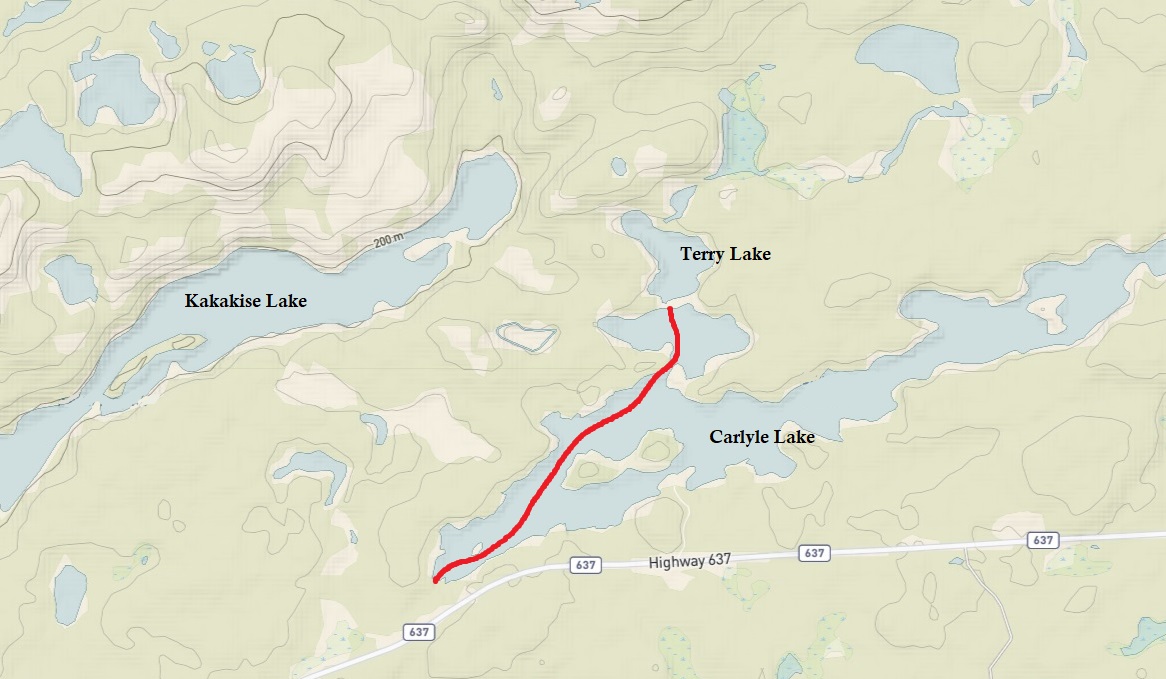
After leaving the family cottage in the Muskoka area we arrived at the George Lake campground to pick up our permit. Back tracking on highway 637 we arrived at the Carlyle Lake launch after 2pm to have a quick lunch before we floated our new canoe into the lake. We were on our way again into the backcountry of Killarney Provincial Park!
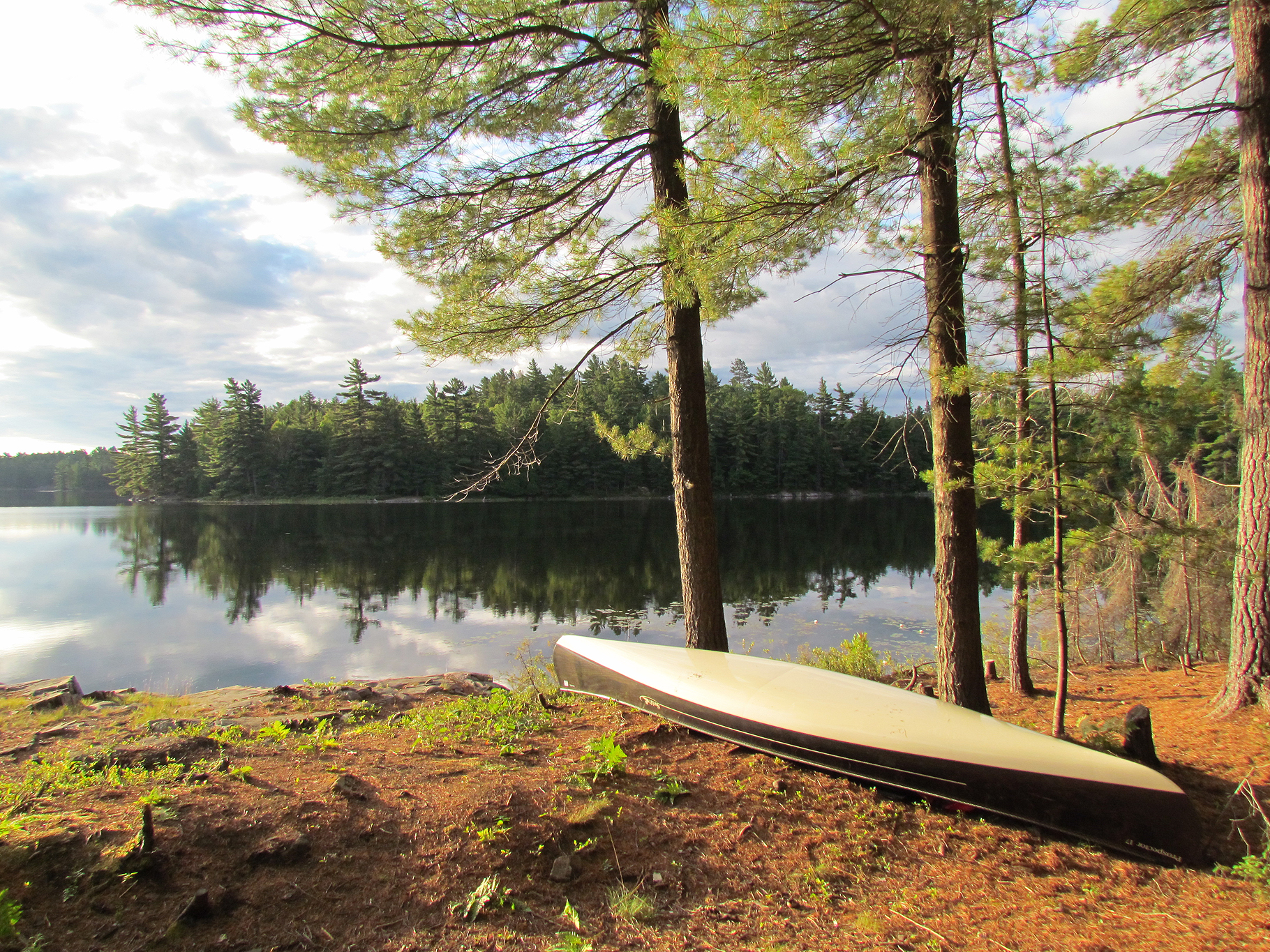
Our new swift canoe at the Carlyle Lake launch. (click image to enlarge)
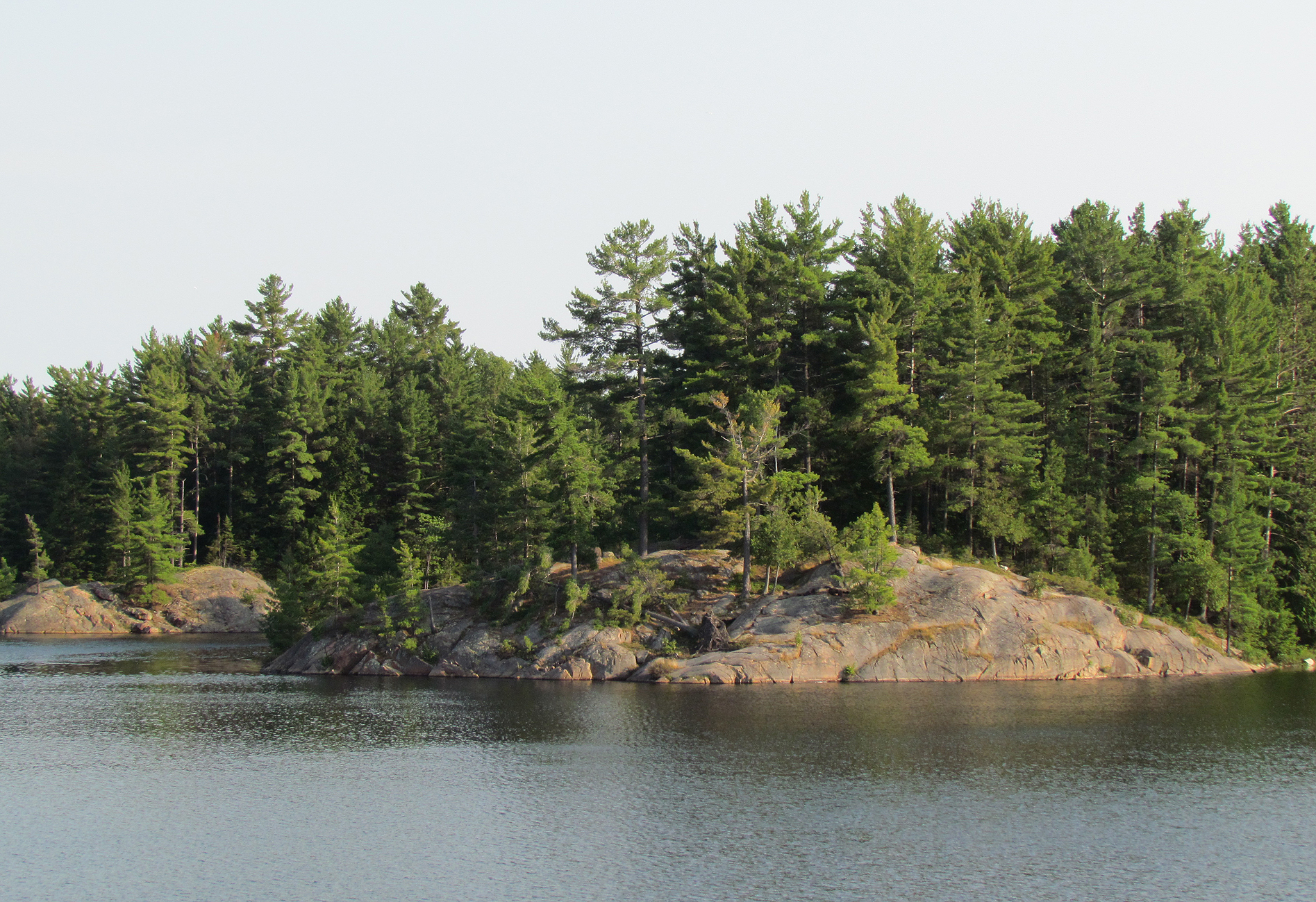
Carlyle Lake has quite a few cottages on it and we observed a few people out enjoying the beautiful summer day. As we entered Johnnie Lake we started to see more white quartzite of the Killarney Ridge, while the shoreline also had some cottages. Sticking our hands into the water we were happy that the lake was not that cold and hoped that other lakes in the interior would be similar. As evening approached and we were nearing the end of the lake we noticed that all the campsites appeared to be occupied! We began to wonder that with so many people out today that perhaps squatters were on a site without reserving it through Ontario Parks. Turning around we tried to find an island to camp on and located one in the middle of Johnnie Lake with a nice smooth flat rock. Thank you glacier!
After paddling in the heat we decided to strip down and take a swim in the water. It felt great though three times we had to clamber up the rocks and crouch down in the blueberry bushes as motorboats approached. After rinsing the body odor out of our polyester shirts we tied our rope between a couple of trees as a clothesline to dry them.
A nice flat spot for the tent on our tiny island in Carlyle Lake. (click image to enlarge)
We decided that tonight we were going to sleep under the stars in our sleeping bags as it was a calm warm night. This seemed like a good idea at the time until after the sun went down and the mosquitoes came out. Eventually we put on our headlamps and assembled the tent, minus the fly. We went to sleep that night serenaded by the mosquitoes.
Wildlife Sightings: American Redstart, Pine Warbler, Ovenbird, Caspian Tern, Black-and-white Warbler, Black-throated Blue Warbler, Black-throated Green Warbler, Swainson’s Thrush, Mosquitoes, Black-capped Chickadee, Common Loon, Ebony Jewelwing, Bullfrog, Common Nighthawk, People
Remember to:Not to camp under the stars in mosquito season.
DAY # 2: Johnnie Lake to Balsam Lake
Weather: Partly sunny. High: 23 C Low: N/A
topoView USGS. (click image to enlarge)Morning at our site on Carlyle Lake. (click image to enlarge)
This morning we awoke with the call of Sandhill Cranes in the distance. We got up very early in fear of a repeat event like yesterday in finding all sites occupied. Unfortunately, in the rush to get out on the water early, we did not check our campsite thoroughly enough and we forgot our rope that we used as a clothesline. We realized this around noon so it was too late to turn around and go back. Luckily we will be coming back through Johnnie Lake on our return so hopefully the rope is hidden enough that no one will find it. After a short portage of 300 metres into Bell Lake, followed by an even shorter 30 metre portage into Balsam Lake, we were greeted by a lot of canoeists!
We paddled full throttle towards an island campsite we had our eyes on with no idea whether the paddlers on this lake were coming or going. We arrived at an island that had two sites on it around noon (site #118). We observed people vacate the neighbouring site shortly after we arrived, and within the hour there were new occupants paddling in. Man this section of the park is busy! Our site was pretty nice, however the thunderbox was missing the bottom front piece of wood.
One of the views from our Balsam Lake site. (click image to enlarge)
The rest of the day was for relaxing in the sun. A pair of Ring-billed Gulls hung out near our site. Most likely they have been fed from this campsite or else there would be no other reason for their presence. A lot of songbirds, including warblers were singing.
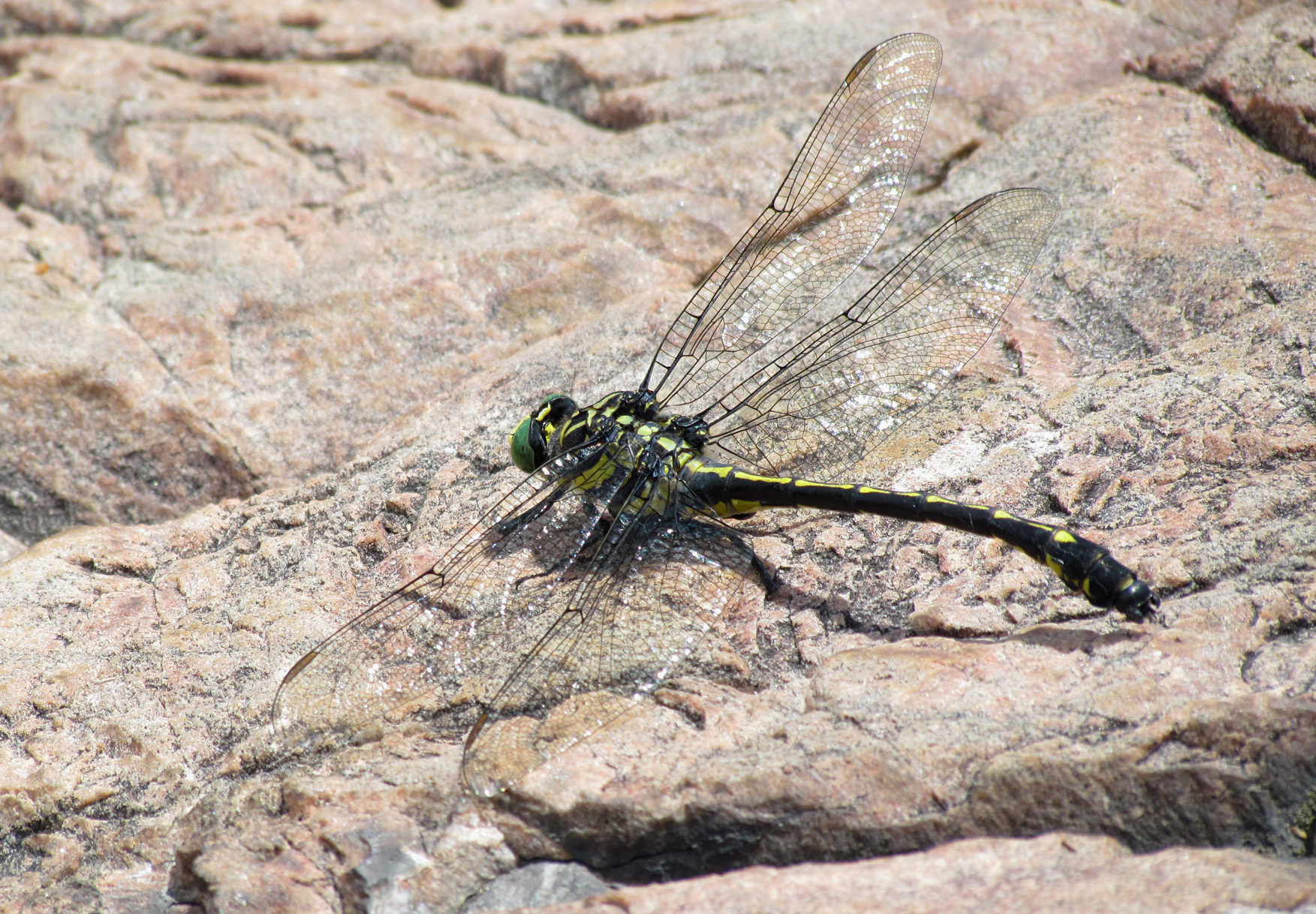
A large Dragonhunter dragonfly. (click image to enlarge)
Wildlife Sightings: Common Loon, White-tailed Deer, Great Blue Heron, Beaver, Magnolia Warbler, American Redstart, Black-throated Green Warbler, Black-throated Blue Warbler, Black-and-white Warbler, Pine Warbler, Yellow-bellied Sapsucker, Ring-billed Gull, Mink, Swainson’s Thrush, Red-eyed Vireo, Black-capped Chickadee, Dragonhunter, People
Remember to:Check over campsite thoroughly before departing. Purchase a new scrub pad for our water pump. Don’t camp around the long weekend in Killarney.
DAY # 3: Balsam Lake to David Lake
Weather: Sunny with clouds. High: 23 C Low: N/A
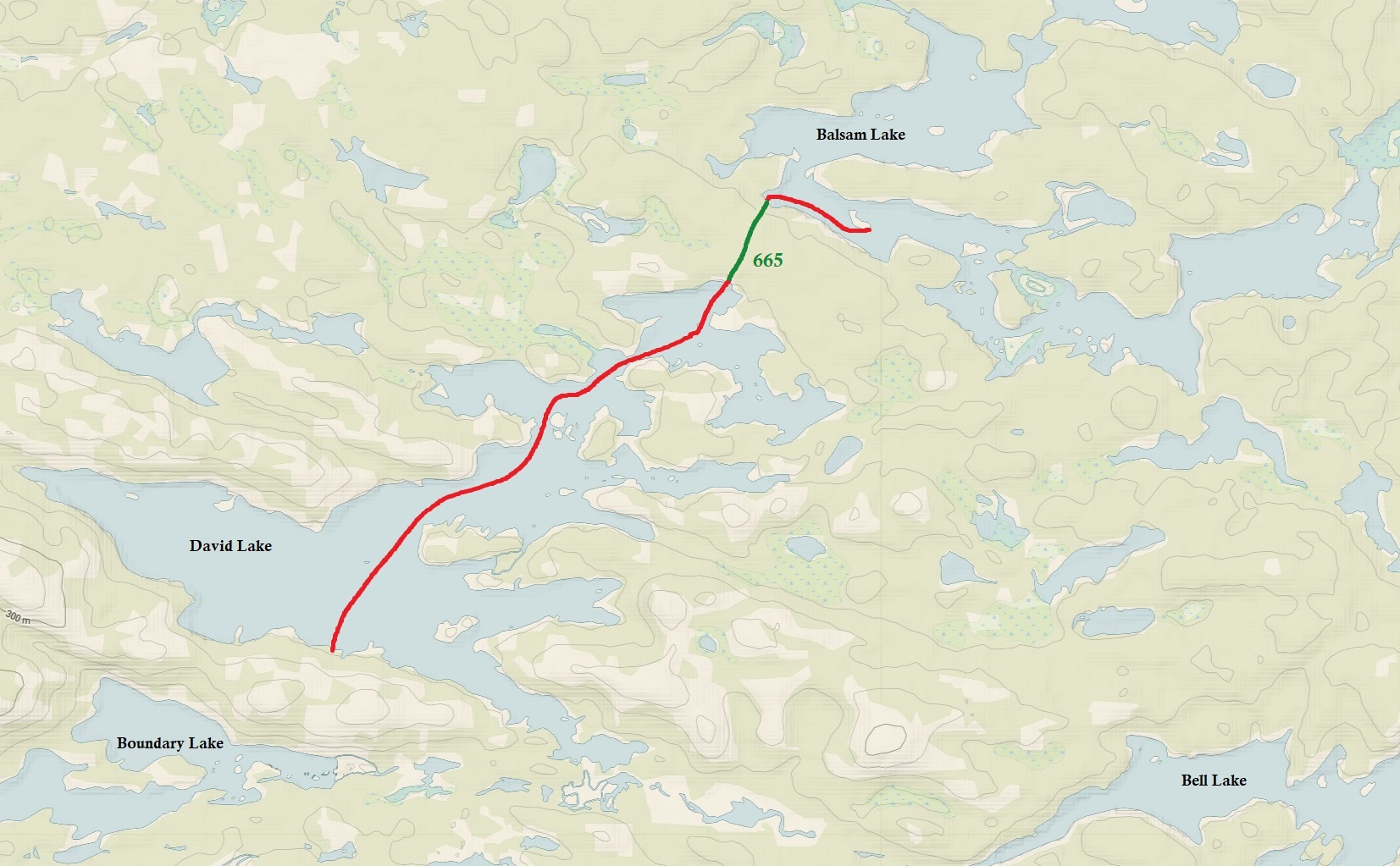
topoView USGS. (click image to enlarge)
Last night we slept a little better because we slept in our tent, though we did wake up in the middle of the night because we were hot. We slept in a little bit this morning and had a breakfast pancake on the frypan. For some reason pancakes always taste better out in the woods 🙂
Early morning Balsam Lake. (click image to enlarge)
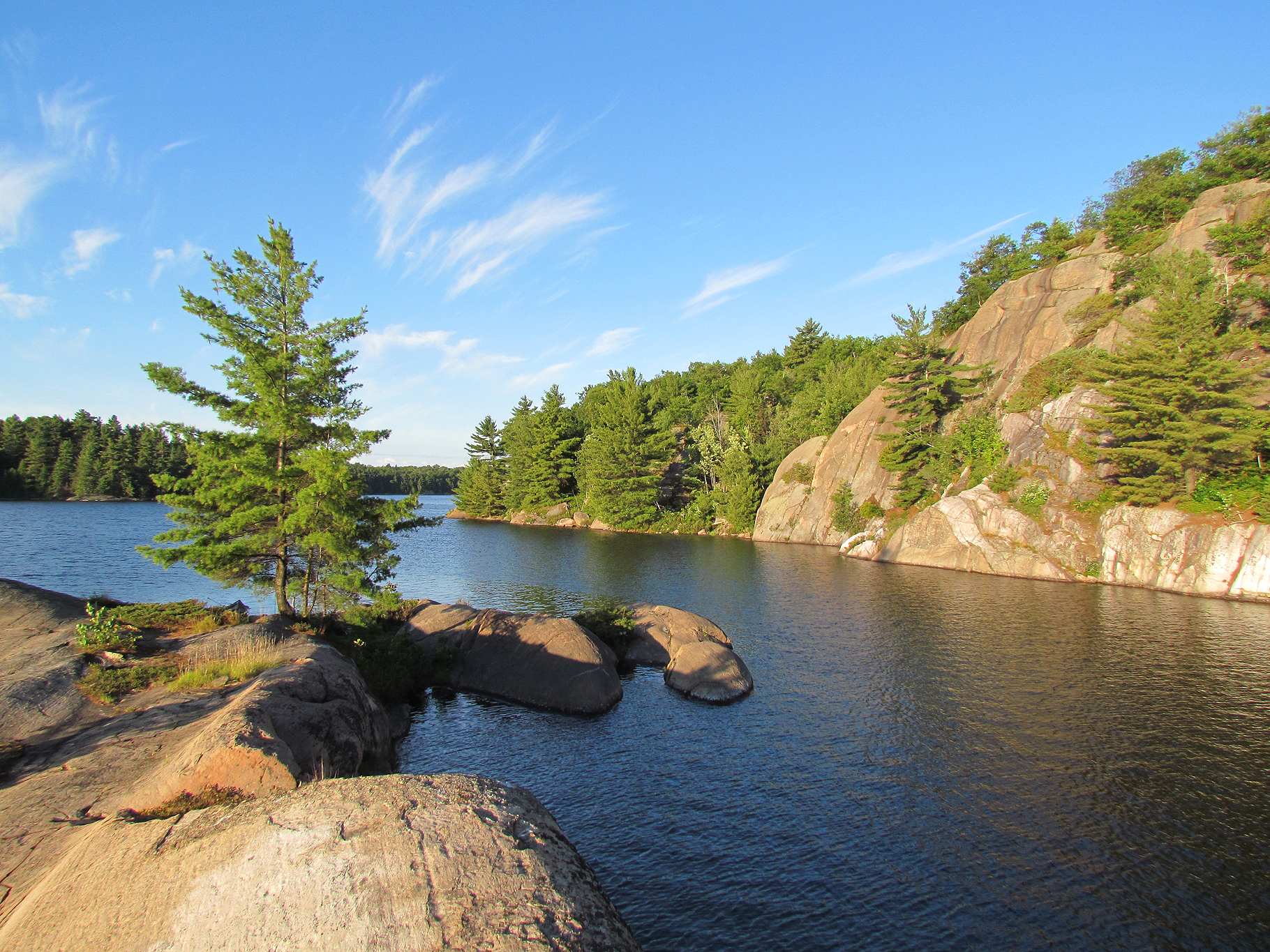
Eventually we hit the lake and paddled our way towards David Lake. After a 665 metre portage we entered David Lake. Though the water on this lake was pretty clear it was nothing compared to the windex clear blue waters of Nellie Lake. Our site (#103) was a nice little peninsula that included a smooth rock towards the shoreline to lay our clothes out to dry, as well as to chillax. Marianne went for a swim in the lake and swam up to a group of loons which she surprisingly got very close to! Exploring around our site she also discovered a Garter Snake.
Chillaxing at David Lake. (click image to enlarge)
While sitting on our flat rock we soon discovered a pair of Snapping Turtles approaching the shoreline. They looked very interested in us when we walked to the waters edge. Perhaps they get handouts from other campers.
After supper we went for a evening paddle to pump some water and we decided to check out an island that had a Herring Gull nest on it. Though the gulls protested our presence, there were no eggs or chicks to be found. We fell asleep that night listening to the “Who Cooks For You” call of a distant Barred Owl.
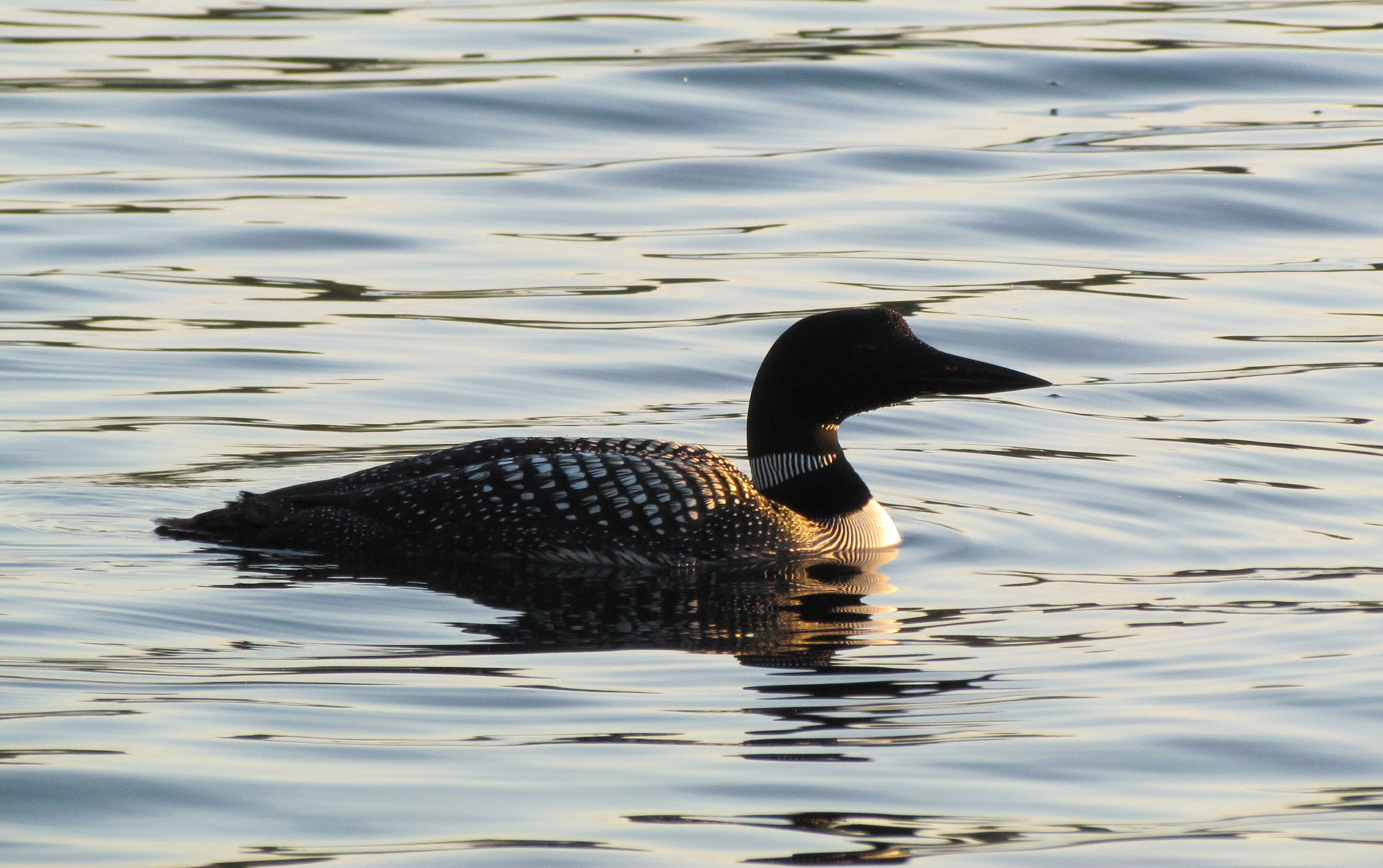
Common Loons frequented our David Lake site. (click image to enlarge)
Wildlife Sightings: Common Loon, Bald Eagle, Pine Warbler, Black-capped Chickadee, American Redstart, Black-throated Green Warbler, Yellow-bellied Sapsucker, Hairy Woodpecker, Mourning Cloak, Compton Tortoiseshell, Garter Snake, Swainson’s Thrush, Snapping Turtle, Ovenbird, White-throated Sparrow, People
Remember to: Bring the thermometer next trip so we can accurately record temperatures.
DAY # 4: David Lake (Climbing Silver Peak)
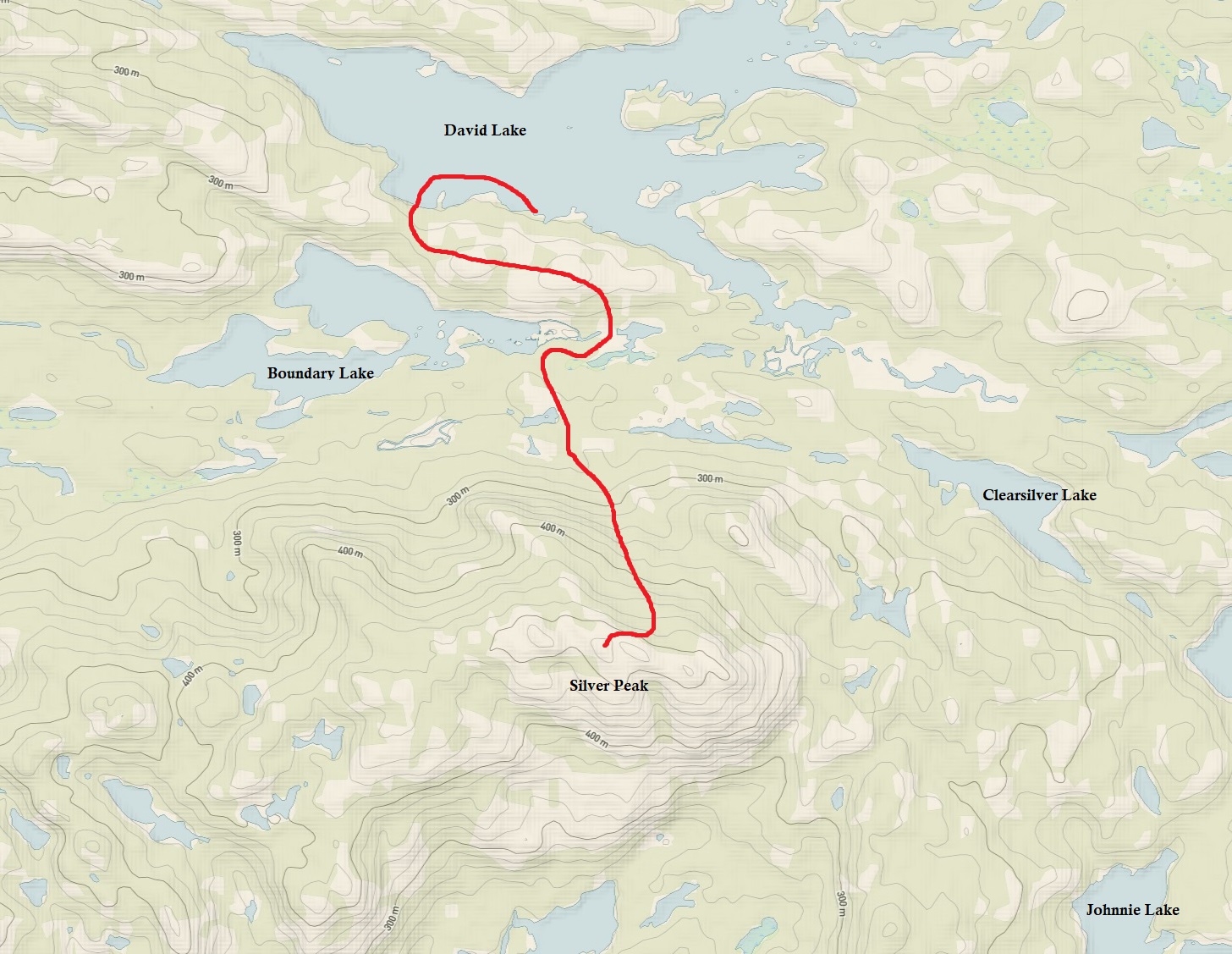
topoView USGS. (click image to enlarge)
Today is a big day as we were going to climb Silver Peak, the highest summit in the park at 2,100 feet! We had a big breakfast, some tea, and packed a lunch.
We paddled west on David Lake to the portage/trail head. This trail is part of the La Cloche Silhouette Trail, a near 80 kilometre loop that traverses through various terrain in the park.
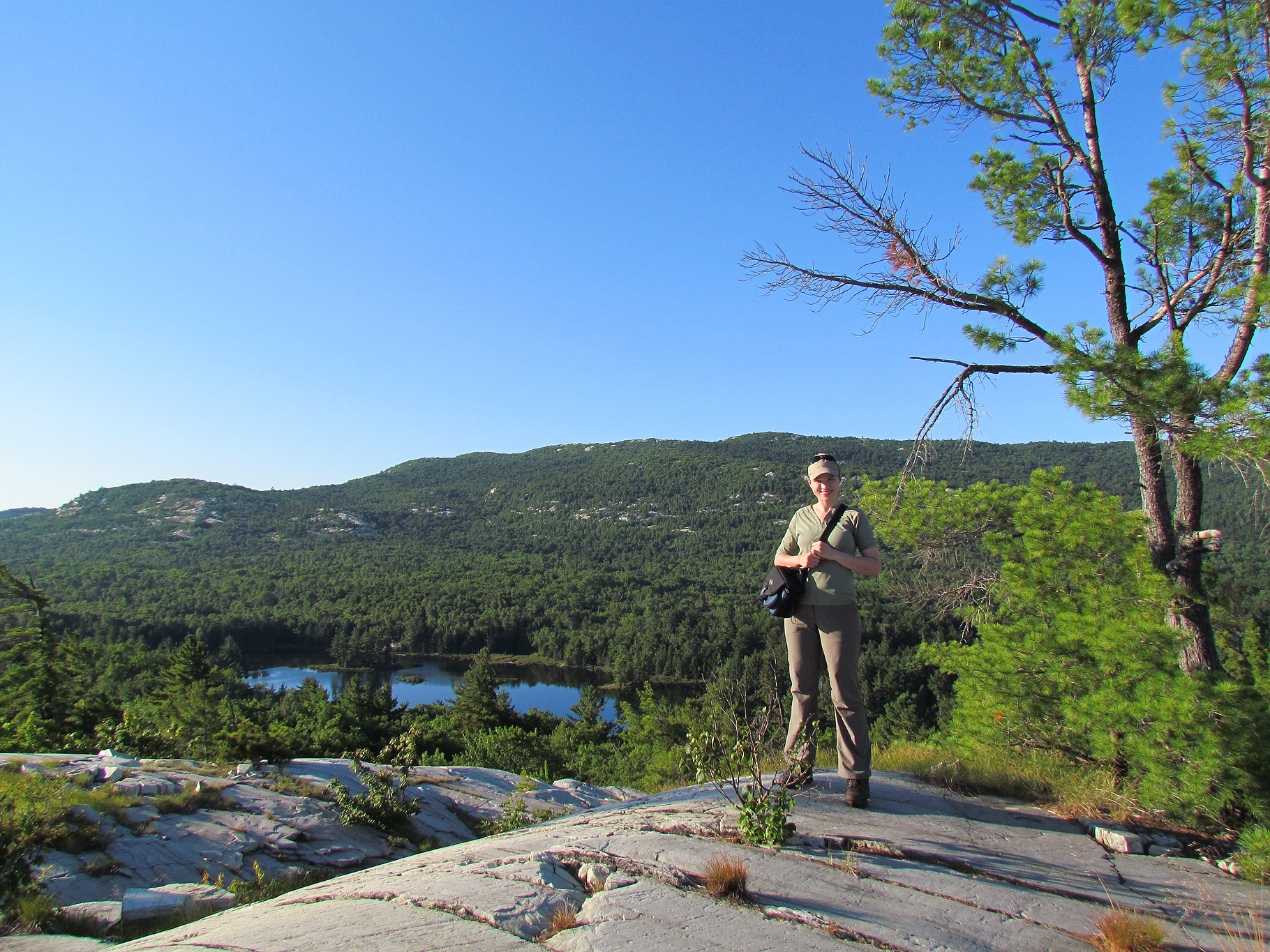
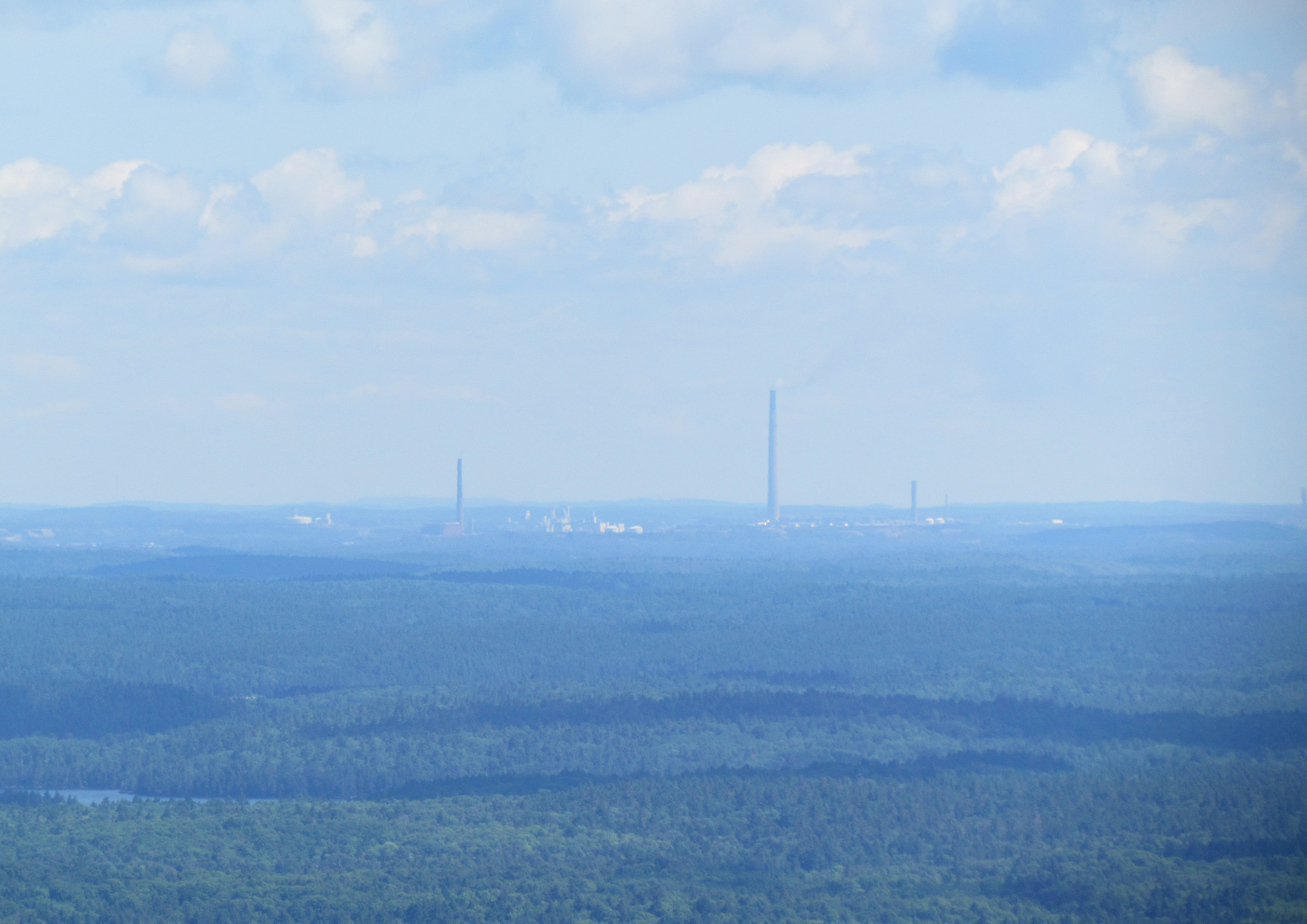
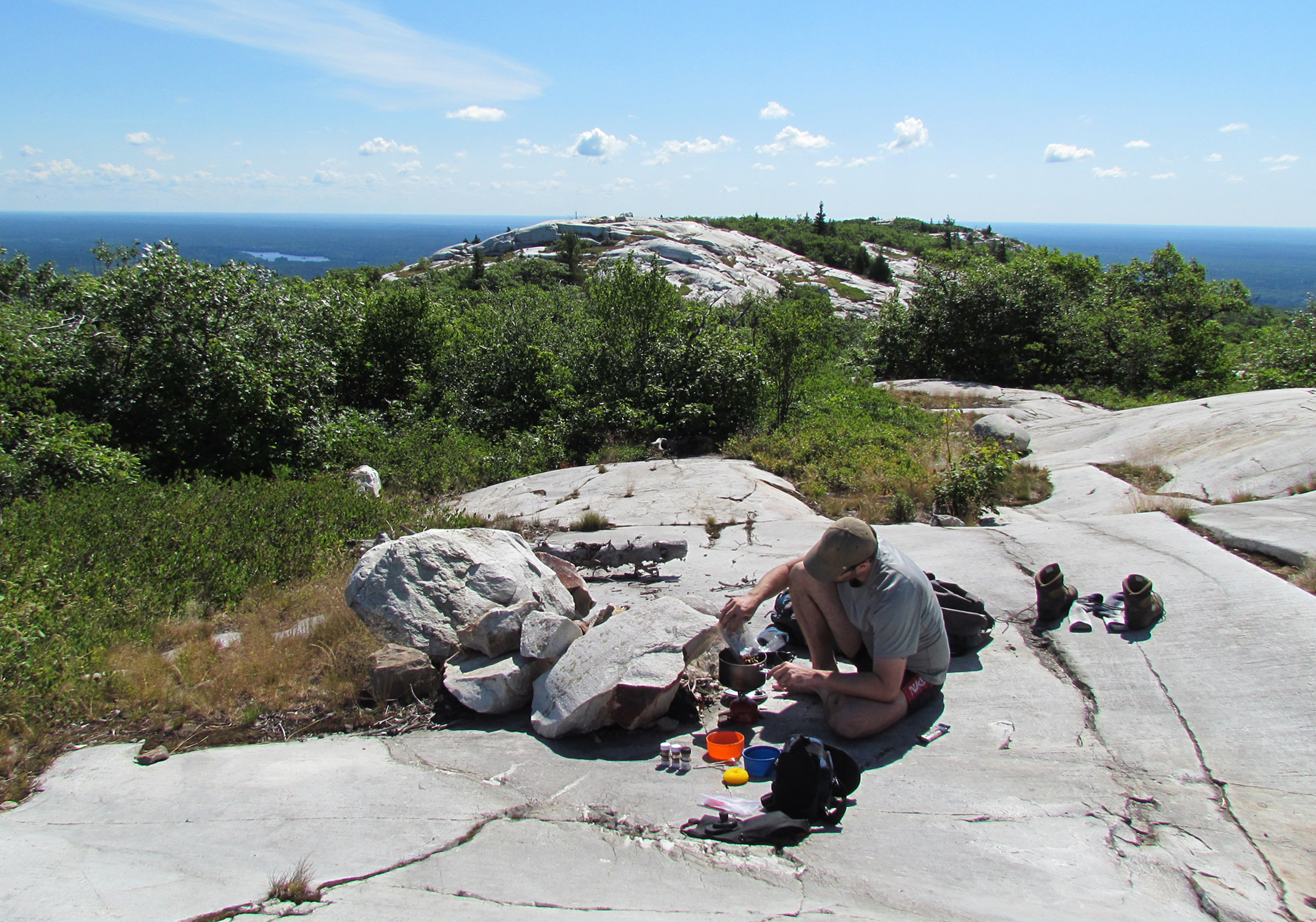
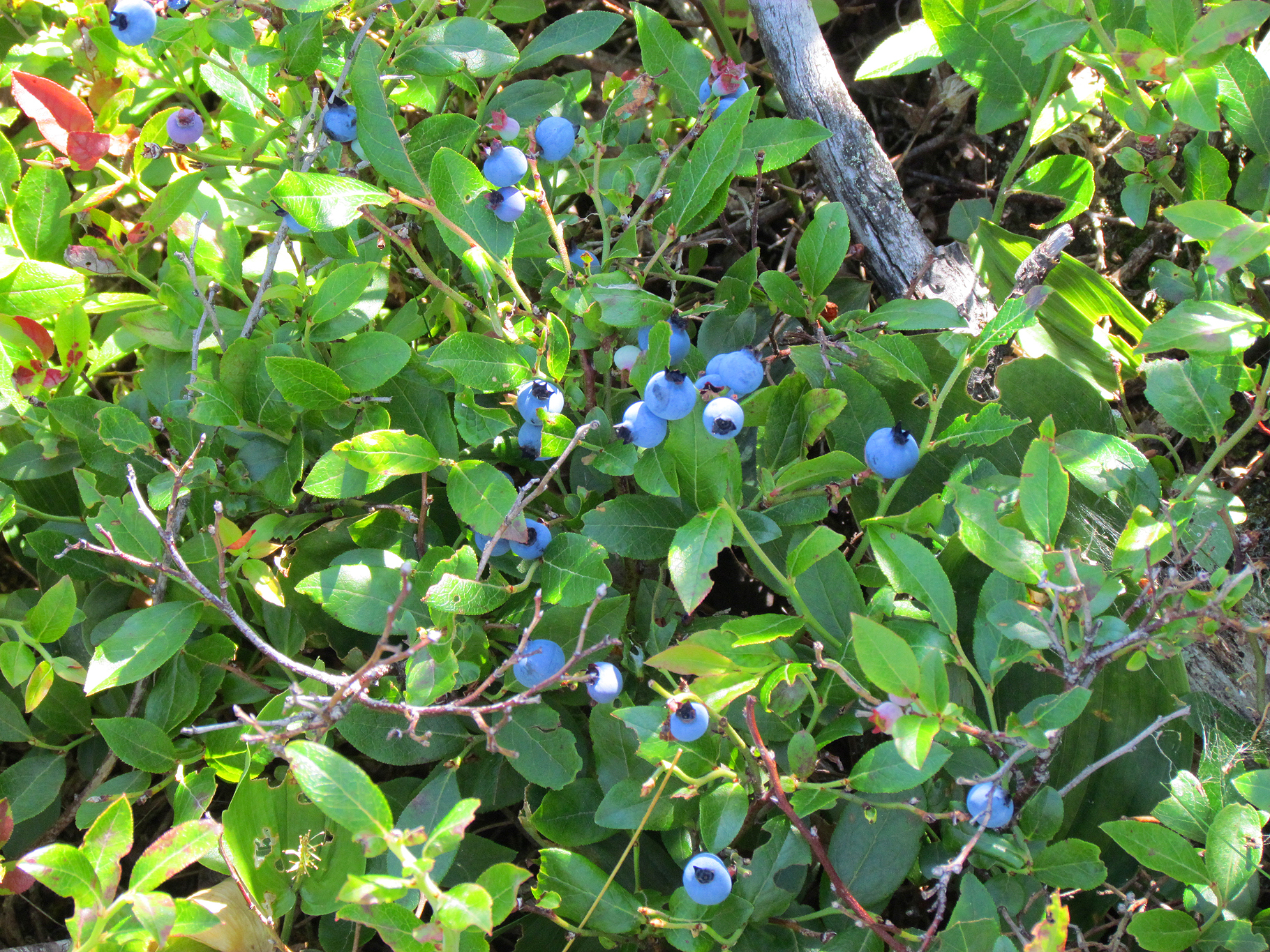
Slowly we began our hike up to the top of the mountain with white quartzite becoming more and more visible as we continued to ascend. We took quite a few water breaks as it was hot and we were drenched in sweat! It is more than worth it once you clamber up that last boulder to get to the top. The summit of Silver Peak is incredible and by far the most scenic view both of us have ever had! Lucky for us it was sunny with no haze and we observed the shadows of a few clouds below us as they slowly rolled over the land. Looking down we viewed a few lakes that we have paddled on previous trips, as well as Georgian Bay to the south, and Sudbury and Espanola to the north. While walking on the summit we found a lot of blueberries and we gorged on them. We also discovered that we were not the only ones that loved the blueberries with blueberry bear scat found as well.
Only halfway up Silver Peak and the view is already spectacular! (click image to enlarge)Silver Peak summit. (click image to enlarge)The city of Sudbury zoomed in with the camera from Silver Peak. (click image to enlarge)Lunch on Silver Peak. (click image to enlarge)
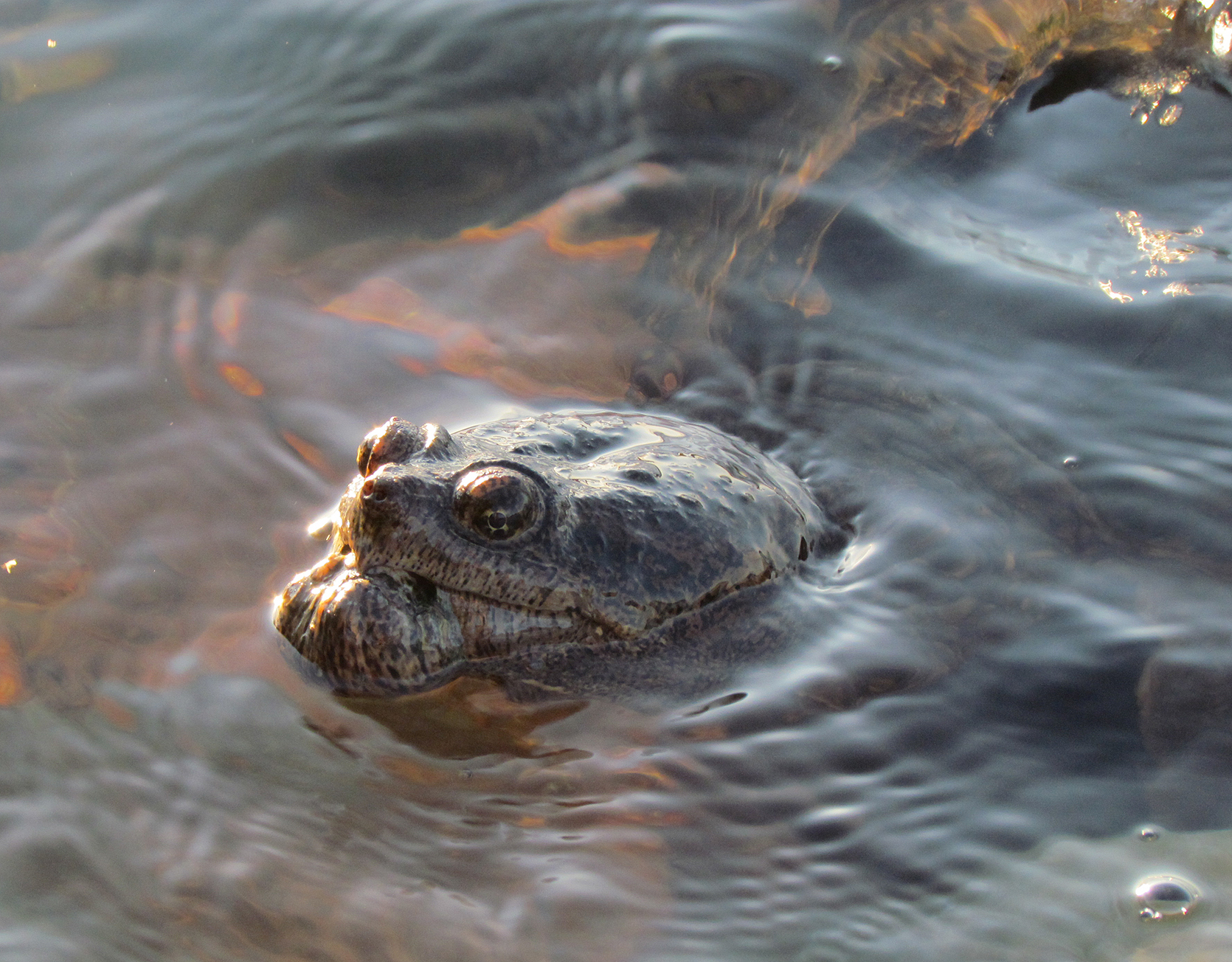
After lunch we hiked back down the trail which we found was a lot easier going down than the climb up. Eventually we retuned to our site and jumped into the lake for a swim. After drying off we hung out with our Snapping Turtle that we discovered had a tumor on its lower jaw.
Our Snapping Turtle friend. (click image to enlarge)
Wildlife Sightings: Ruffed Grouse, Eastern Chipmunk, Red Squirrel, Black-throated Green Warbler, Black-throated Blue Warbler, Black-and-white Warbler, Common Loon, Veery, Hermit Thrush, Turkey Vulture, American Redstart, Red-eyed Vireo, Black-capped Chickadee, Snapping Turtle, Ruby-throated Hummingbird, White-throated Sparrow, Ovenbird, People.
Remember to: Never hike the La Cloche Silhouette Trail in the heat of the summeragain.
DAY # 5: David Lake to Clearsilver Lake
Weather: Sunny. High: 26 C Low: N/A
topoView USGS. (click image to enlarge)
This morning we decided to sleep in as the lake we booked for tonight had only the one campsite on it and we sincerely HOPED it would not be hijacked by squatters. When we finally got on the lake we realized it was going to be another hot one. Paddling down the southeast corner of David Lake we came to our longest portage of the whole trip, a 980 metre into Clearsilver Lake, a lake we thought we viewed yesterday from the top of Silver Peak. Along the portage, which was also part of the La Cloche Silhouette Trail, we ran into some hikers. Clearsilver Lake is yet another lake that is trying to recuperate from a low pH level as the lake had very little vegetation in it. The campsite itself (#70) was average for Killarney and was quite dusty, though still better than any campsite we have close to home! After a lunch of chili we decided to just relax for the rest of the day which, unlike other trips, was something we discovered we did a lot on this trip. A chipmunk decided to check out the interior of our tent while we were sitting at the fire pit. Tonight we stayed up late at the campfire. Later we sat out near the lake and gazed up at the stars while the toads and frogs serenaded us. “Sha-la-la-la-la-la Kiss The Girl!”
Wildlife Sightings: Hairy Woodpecker, Eastern Chipmunk, Red Squirrel, Eastern Phoebe, Common Raven, Broad-winged Hawk, Black-capped Chickadee, Least Flycatcher, Common Loon, Veery.
Remember to: Put a whistle in Aaron’s PFD. Bring ingredients for bannock to have with our chili next trip.
DAY # 6: Clearsilver Lake to Carlyle Lake
Weather: Sunny and breezy. High: 30 C Low: N/A
topoView USGS. (click image to enlarge)
After a pancake breakfast we returned to Johnnie Lake via the 830 metre portage and made our way back to the island “campsite”. Even though it was a non designated campsite someone did in fact take our rope that we left hanging a few days prior. We chowed down on a few more blueberries and soon we were on our way again. As we paddled away from the island we noticed that it was once graffitied with the added attempt to cover it up with rock coloured paint. This really pissed us off in that not only did someone steal our rope, but graffiti on a rock in Killarney Provincial Park?! C’mon!!!
Paddling past the cottages on Johnnie Lake we entered Carlyle Lake and site #55 which was in a mouse hole. The campsite itself was up pretty high from the water with Terry Lake just behind our site. A nice breeze was also appreciated because it was still quite warm out. A little stream nearby sets the tune as Swainson’s Thushes and frogs began their evening serenade. A couple with a young kid came into the mouse hole to try some fishing from their boat.
The view from our site on Carlyle Lake. (click image to enlarge)
Remember to:Start mixing up our own dehydrated foods with store bought freeze dried meals so we can have more of a variety. Buy a new rope to replace our old rope.
DAY # 7: Carlyle Lake to the launch at Carlyle Lake
Weather: Sunny. Morning temperature of 17 C and calm.
topoView USGS. (click to enlarge)
As with every single camping trip we have ever been on, the night before we have to go home is always the most sleepless night of the trip. It must be something that sparks in the back of your mind. You know you don’t want to go home from vacation yet but there is a weird anticipation to get back to your car and real food again. We were clearly not out for enough days on this trip.
Sitting awake in the dark in the tent during the predawn we heard the frogs and toads calling. After they retired it was the Swainson’s Thrush and Veery to sing at dawn’s first light. It was then that we came out of our tent, shared a Kind Bar, and cleaned up camp.
The morning paddle was so peaceful as it was just after sunrise and the warm light created a surreal glow on the rocks while we paddled through a veil of mist. The reflection of the land on the lake was a perfect mirror image and unfortunately the camera was buried in the pack. What was also really nice was that we appeared to be out before any of the cottagers were. This added even more to the serenity of an early morning.
After retuning to the launch we loaded our gear in the car, strapped down the canoe, and took one last long look at Carlyle Lake. We drove to the town of Killarney for lunch at a local diner.
We have now covered almost all of Killarney Provincial Park after three separate trips. We will say goodbye for awhile as we explore other areas in Ontario, though the beauty of Killarney Provincial Park will be hard to match!
Remember to: Buy a new camping book soon 🙂
Wild blueberries at Silver Peak. (click image to enlarge)
Longest Portage: 2.525 kilometres (Helen Lake to Nellie Lake)
Average Daytime High: 22.6 Celsius
Average Nighttime Low: 18.0 Celsius
Route: Charlton Lake – Howry Creek – Murray Lake – Leech Lake – Hanwood Lake – Van Winkle Lake – Rocky Channel – Bear Lake – Goose Lake – Bear Lake – Rocky Channel – Van Winkle Lake – Cat Lake – Howry Lake – Gem Lake – Fish Lake – Great Mountain Lake – Little Mountain Lake – Kirk Creek – Three Narrows Lake – Kirk Creek -McGregor Bay – East Channel – North Channel – Low Lake – Helen Lake – Nellie Lake – Carmichael Lake – Grace Lake – Cranberry Bay – Frood Lake – Charlton Lake
Maps Used: Friends of Killarney Provincial Park map (2007 version)
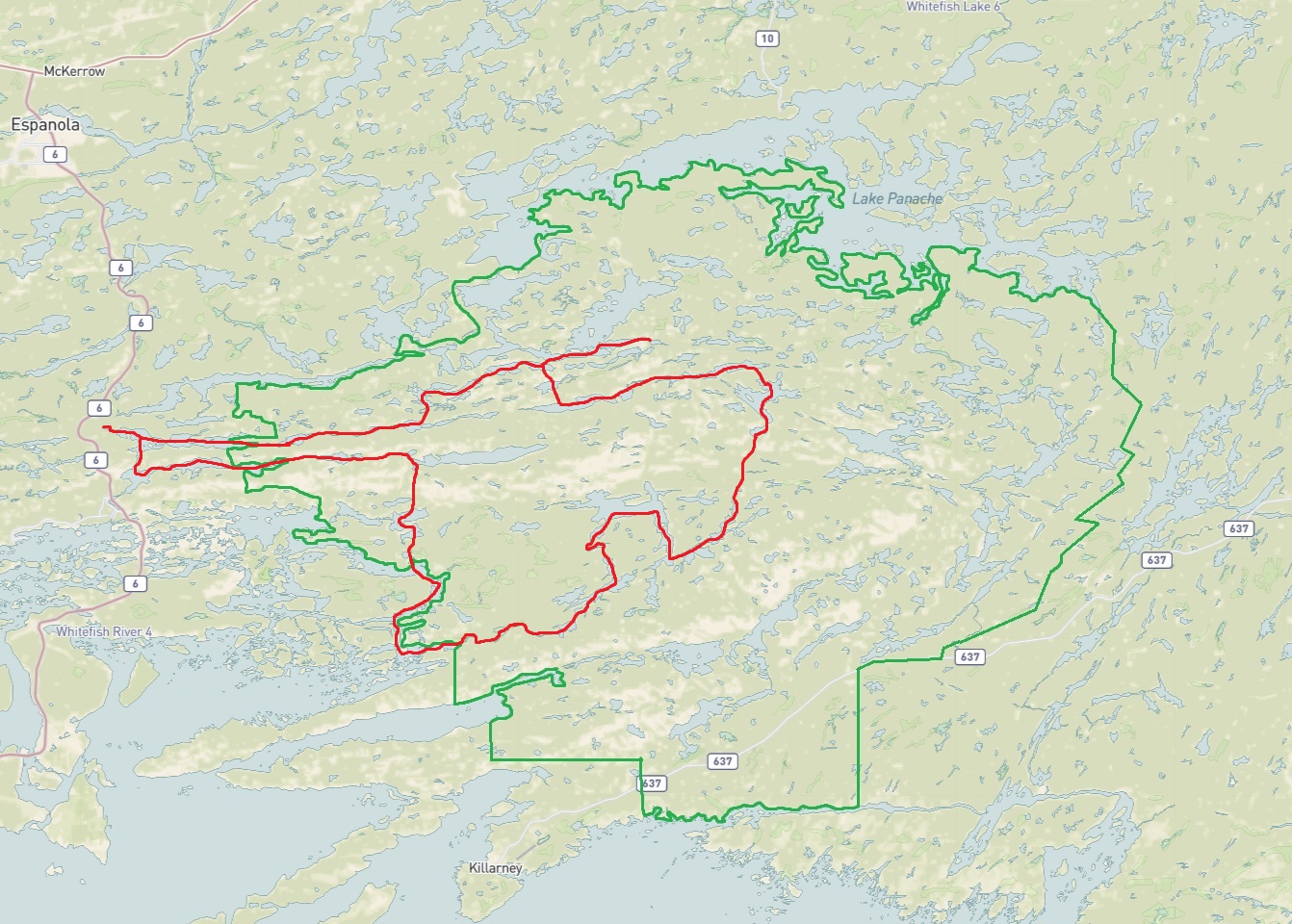
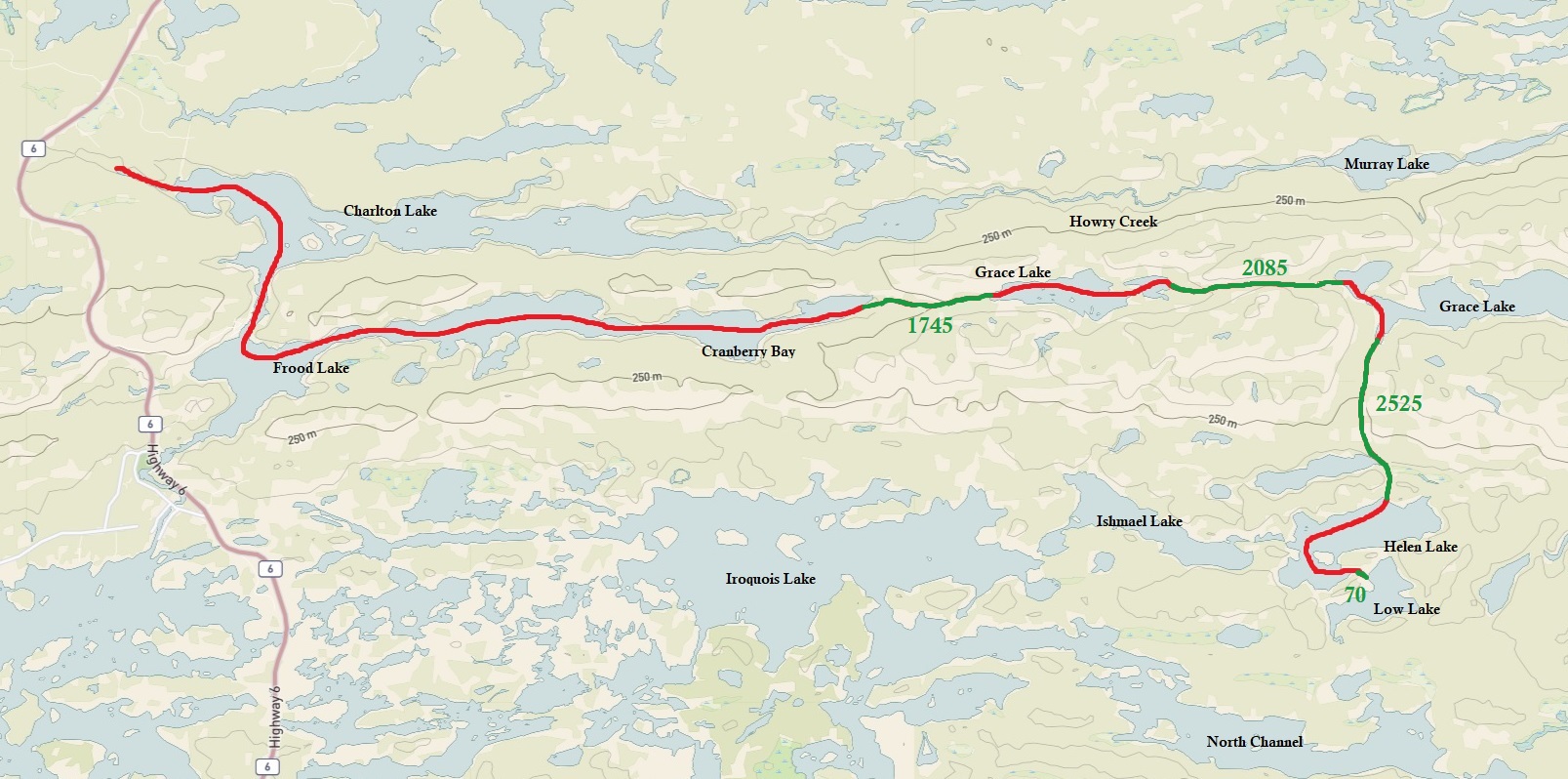
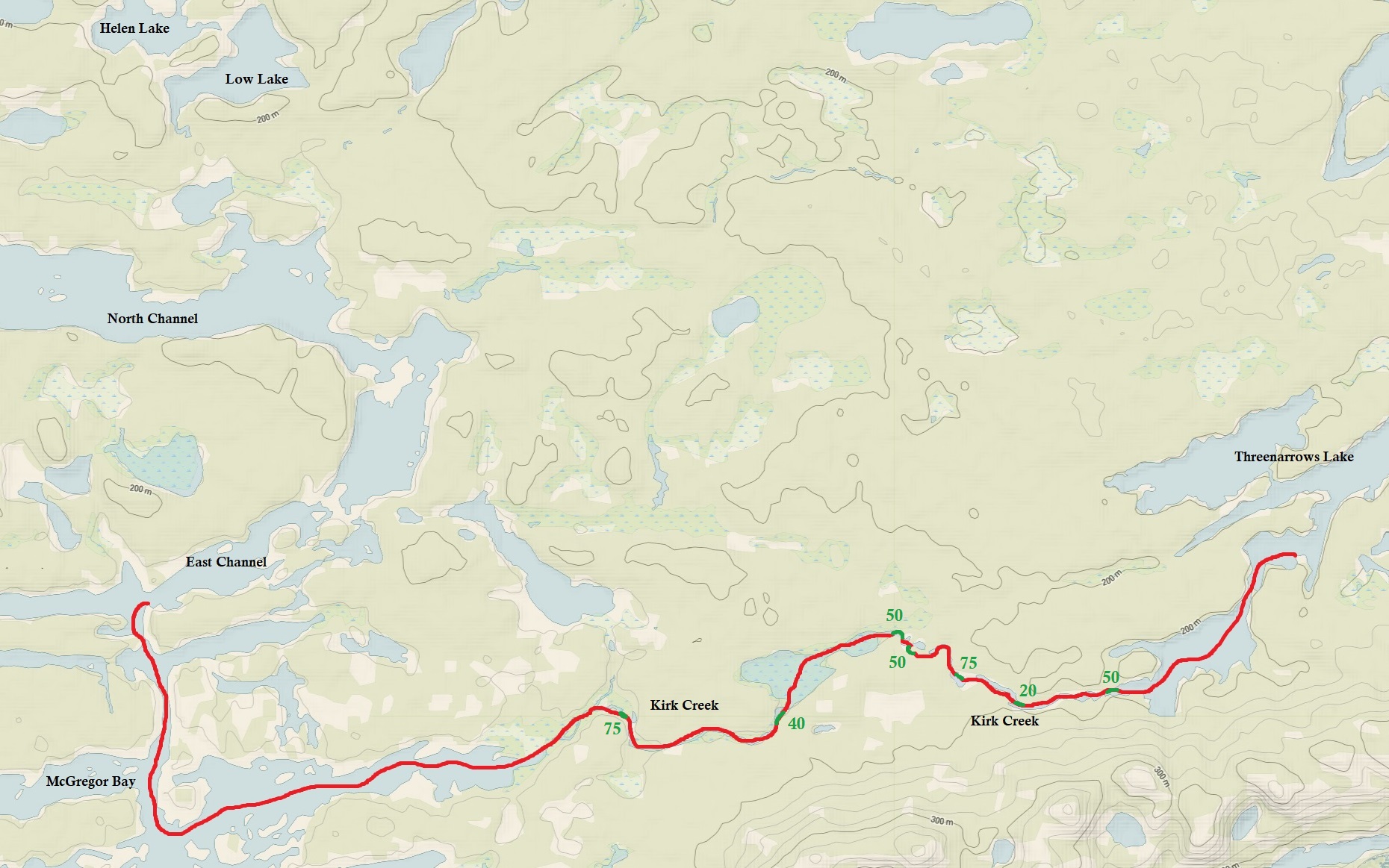
Outline of Killarney Provincial Park, including the New Killarney Lakelands and Headwaters, with our loop outlined in red. (click image to enlarge) topoView USGS.
For the backcountry camper, Killarney Provincial Park evokes images of white quartzite mountains, crystal clear lakes, and falling asleep to the echo of a wailing loon in what appears to be a pristine wilderness. If you dig a little deeper into the history of the area you will learn that Killarney’s wilderness has had its share of trials and tribulations. Some of those crystal clear lakes, some as clear as a swimming pool, are mainly located in the area of the park that consists of the white quartzite mountain ranges. A lake with a quartzite bottom aided in the acidification of some lakes from acid rain produced from nearby smelting emissions in the Sudbury area. Lakes such as Nellie, Topaz, and O.S.A. continue to be a present reminder of how industry can devastate the aquatic ecosystem with crystal clear waters yielding very little vegetation, and little to no aquatic life. Back in the early 1980s the pH was measured in many lakes with Nellie Lake having as low as a pH of 4.4 being found (tomato juice is 4.1 – 4.6). Paddling in some of these lakes today is like paddling in a swimming pool, and as you look over the side of your canoe you can see over 20 feet down to the bottom. Logs that fell years ago now stripped of their bark, look like bones from some kind of prehistoric beast. It actually leaves you with an eerie uncomfortable feeling at times when you learn the reason behind these lakes becoming so “beautifully clear”. Thankfully humanity is capable of learning from their mistakes and recovery efforts, including local emission controls, have resulted in increasing pH levels in many of Killarney’s lakes. Other historical human practices in the park included logging and more recently, expanding the park’s boundaries to the north, now known as “The Killarney Lakelands and Headwaters”.
Whether you are hiking the challenging La Cloche Silhouette Trail, backcountry camping on Grace Lake, or even just parking your trailer at the main George Lake Campground, Killarney seems to have something for everyone who enjoys the outdoors!
We chose to camp the last week of August and paddle/portage 8 days on a loop known as the “Great Mountain Loop”. This loop takes you through different habitats and terrain that include marsh, clear lakes, creeks, and McGregor Bay.
DAY # 1: Charlton Lake to Van Winkle Lake
Weather: Sunny. High: 23 C Low: 17 C
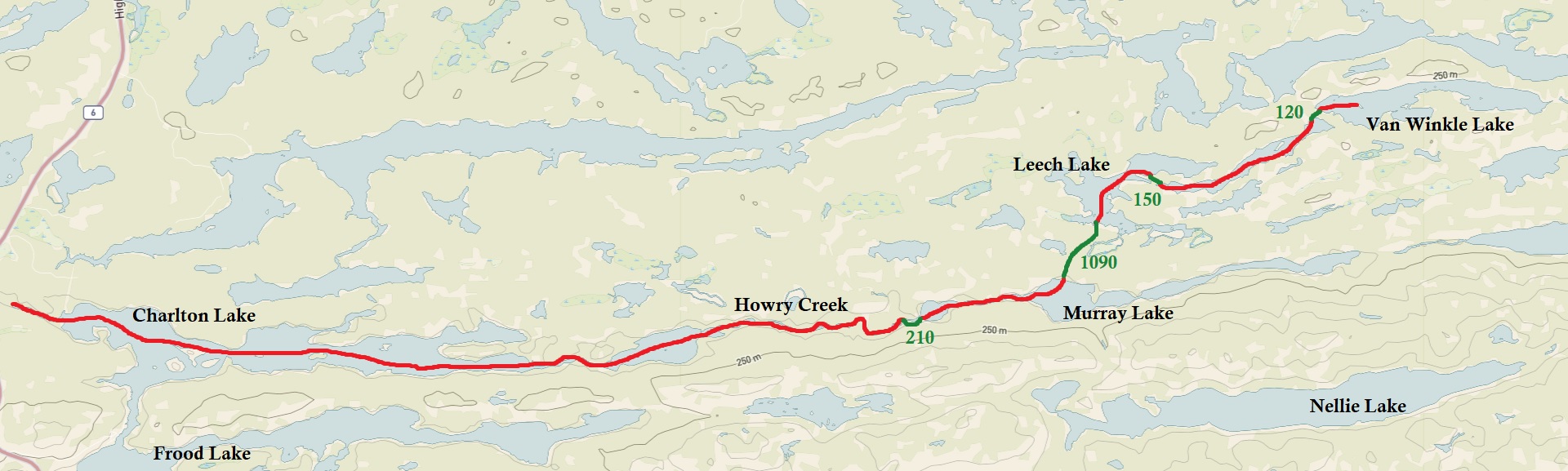
topoView USGS. (click image to enlarge)
On August 20th, we woke up at the Pinewood Inn in the town of Espanola (highly recommended) and drove to the Widgawa Lodge located near the town of Willisville to pick up our rental canoe and park permit. We left the access point located here around 9:30 am and paddled our way into the park via Charlton Lake. We saw many cottages along the shore before entering the park proper, and while rounding a corner we surprised a Great Blue Heron which squawked loudly at us for interrupting his calm morning. We had a few portages today that included a 1,090 metre from Murray Lake to Leech Lake. A portage of this length was not a nice way to begin our trip because you realize how out of shape you are! Our last portage of the day, an easy 120 metre, brought us into Van Winkle Lake. We have an island campsite tonight (site #162). After a supper of homemade rehydrated Sheppard’s Pie, a pair of Whip-poor-wills called nearby as we settled into our sleeping bags on our first night in the Killarney wilderness.
Wildlife Sightings: Ruffed Grouse, Broad-winged Hawk, Belted Kingfisher, Pileated Woodpecker, Common Loon, Eastern Chipmunk, American Redstart, Black-capped Chickadee, Blue Jay, Great Blue Heron, Yellow-rumped Warbler, Whip-poor-will, People
Remember to: Fill water bottles before heading out so you don’t have to pump water on your first day.
DAY # 2: Van Winkle Lake to Fish Lake
Weather:Showers to sunny skies. Cloudy by the end of the day. High: 21C Low: 16C
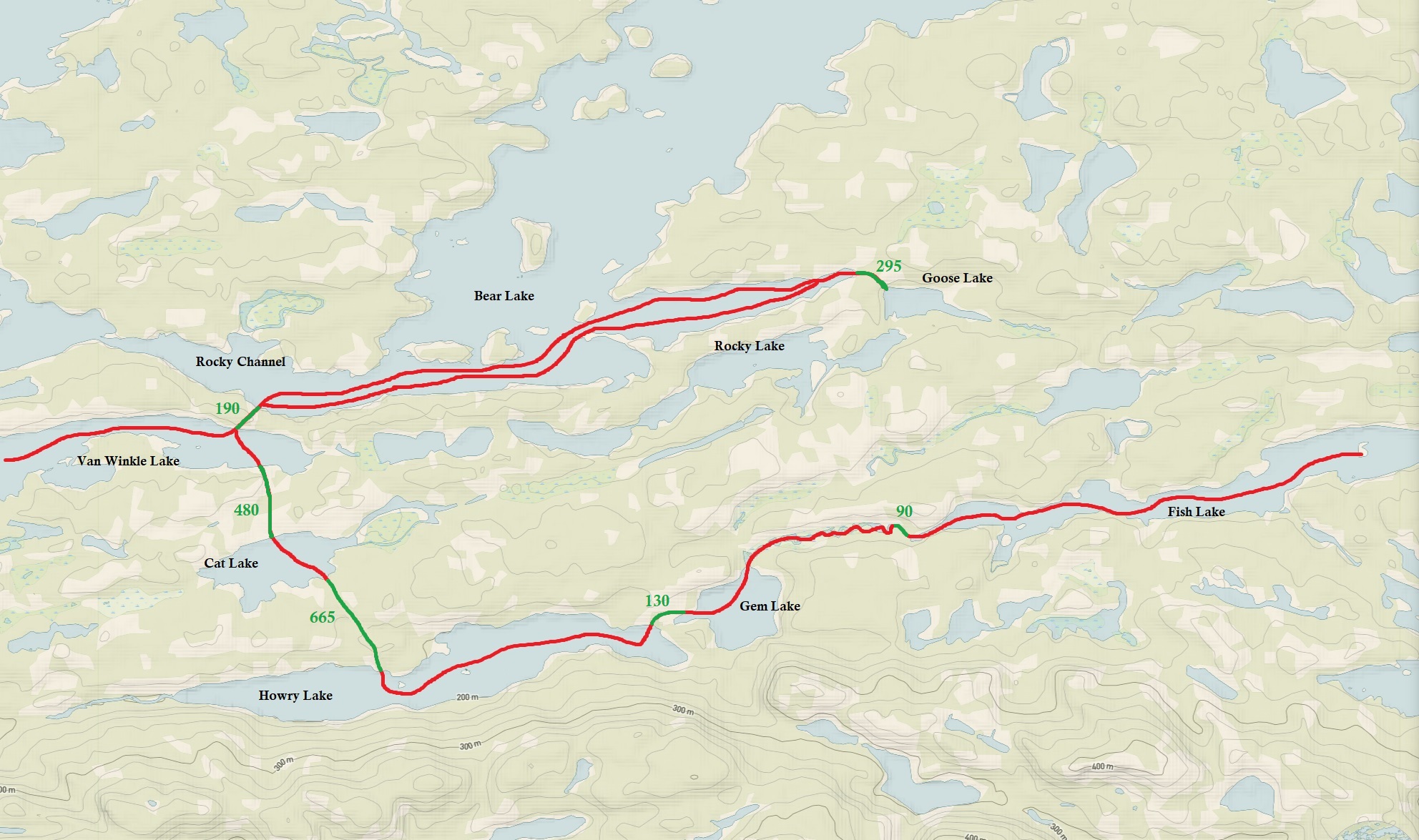
topoView USGS. (click image to enlarge)
This morning we woke up to rain showers along with our Whip-poor-will now being accompanied by the distant calls of Sandhill Cranes. After coming out of the tent we heard a “loonie party” on the lake with up to 10 yodeling Common Loons while we made our breakfast consisting of granola with nuts and dried fruit.
Common Loons were a common sight on this trip. (click image to enlarge)
We had a lovely morning paddle! Our destination today was Fish Lake and we skipped quite a few portages by taking the Rocky Channel instead of taking the series of portages that lead through Cat, Howry and Gem Lakes. However, when we arrived at Goose Lake it was literally a mud flat and we couldn’t even find a way to walk along the shoreline without the risk of getting sucked into the marsh muck (though it looked like a few people have tried). There was only one choice in our minds…we had to backtrack. We paddled back to Van Winkle Lake via the 190 metre portage, followed by a 480 metre portage to Cat Lake, a 665 metre into Howry Lake, a 130 metre into Gem Lake, a couple of lift overs, and finally entered Fish Lake after a 90 metre portage. In the end we added an extra 5 hours of paddling and quite a few metres of portages to our day. When we arrived on Fish Lake it was getting late in the day and as we passed one campsite after the other campsite they were clearly all occupied. In fact, a group at one of the sites told us that they were pretty sure both sites on the entire lake were occupied. Obviously someone was staying on this lake that shouldn’t be, though we were too tired to ask to see anyone’s permits. In the end we shared an island campsite (site #154) with a couple of gentlemen from Michigan who have made multiple trips to Killarney. We shared camping stories and enjoyed each others company. Sleeping came easily that night after a long days paddle. We hoped that tomorrow’s surprises are a little less annoying, but that’s all part of backcountry camping, you gotta expect the unexpected sometimes.
Wildlife Sightings: Common Loon, Sandhill Crane, Wood Duck, American Redstart, Canada Goose, Red-eyed Vireo, Broad-winged Hawk, People
Remember to: Call the park regarding portages/low water levels before heading out. Bring a full water bottle on portages especially when it is warm and you have more portages than expected.
DAY # 3:Fish Lake to Threenarrows Lake
Weather: Sunny in the morning with scattered showers and strong winds into the afternoon. High: 20 C Low: 17 C
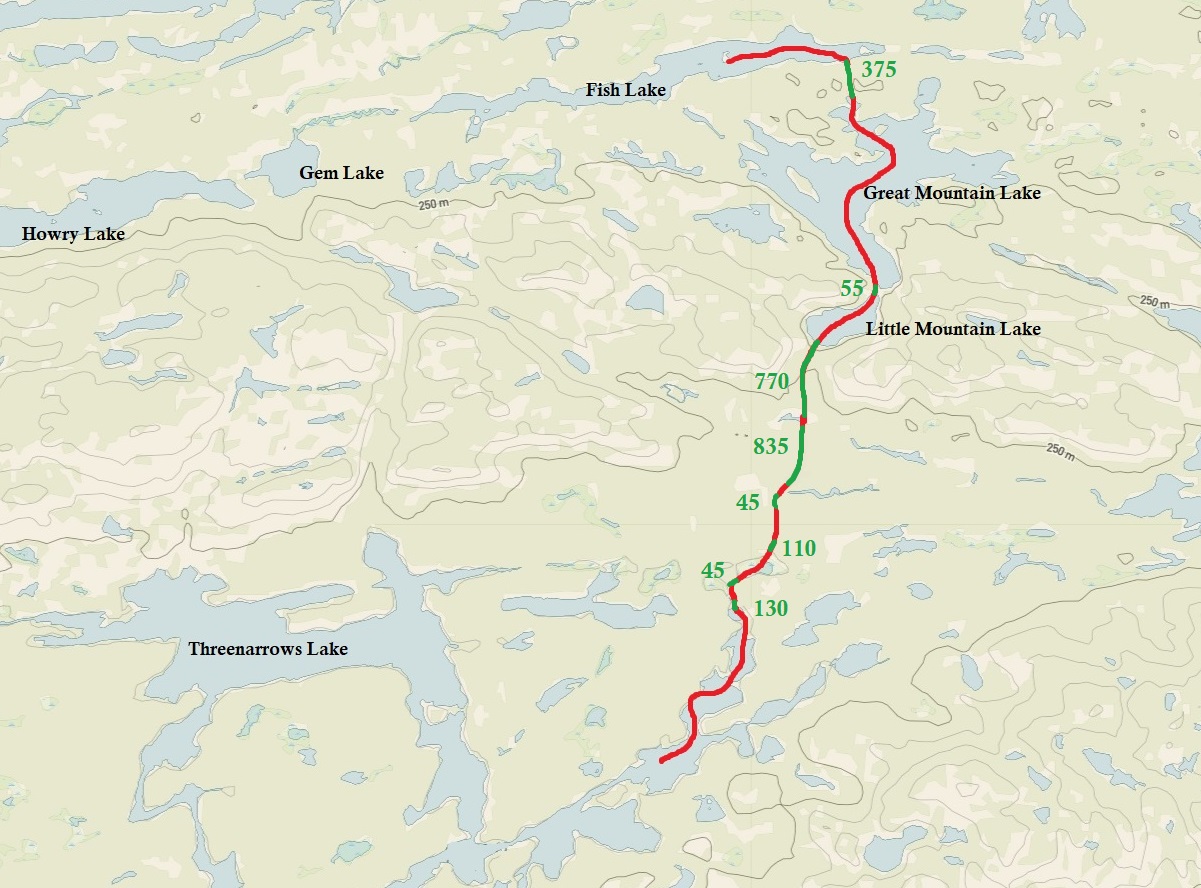
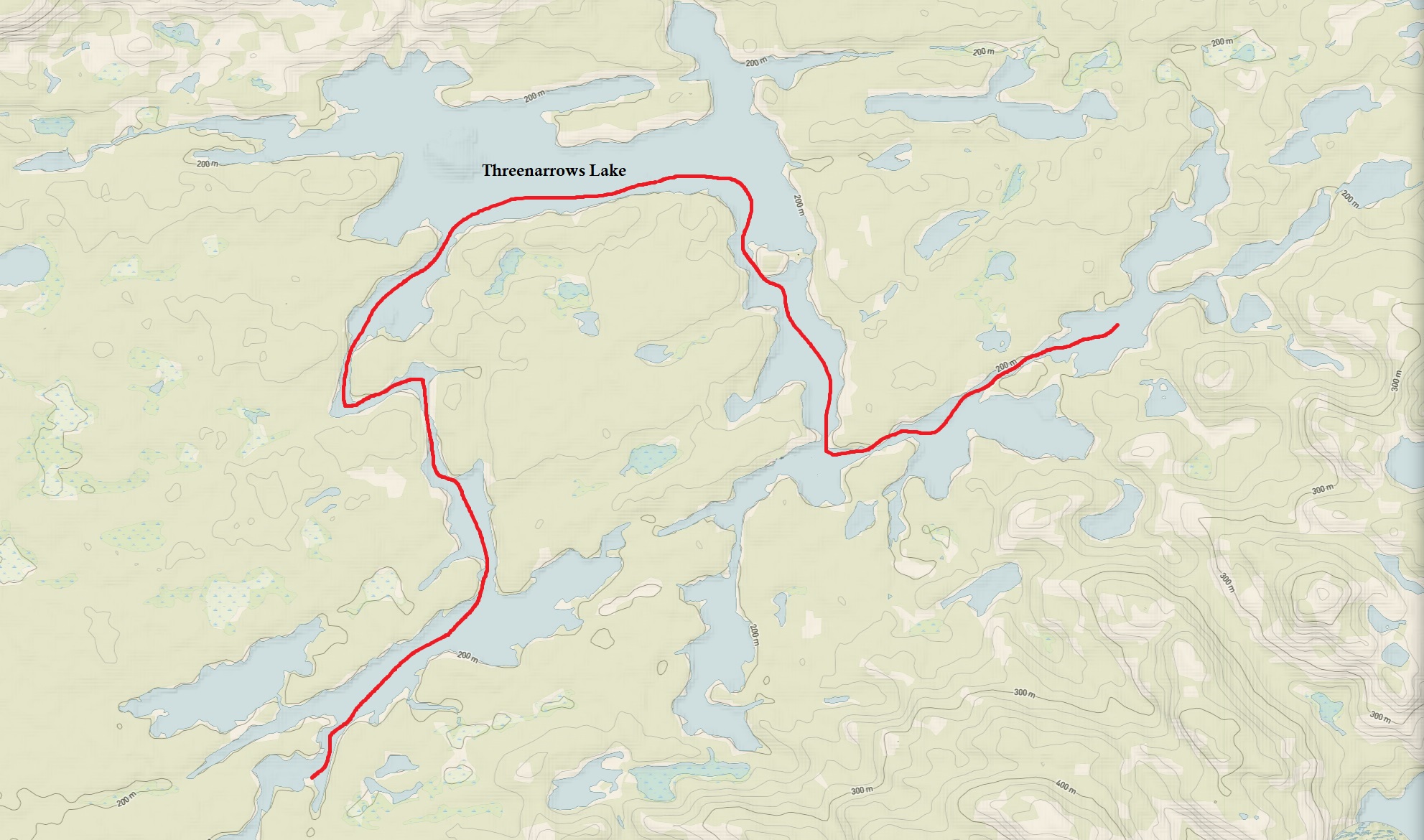
topoView USGS. (click image to enlarge)
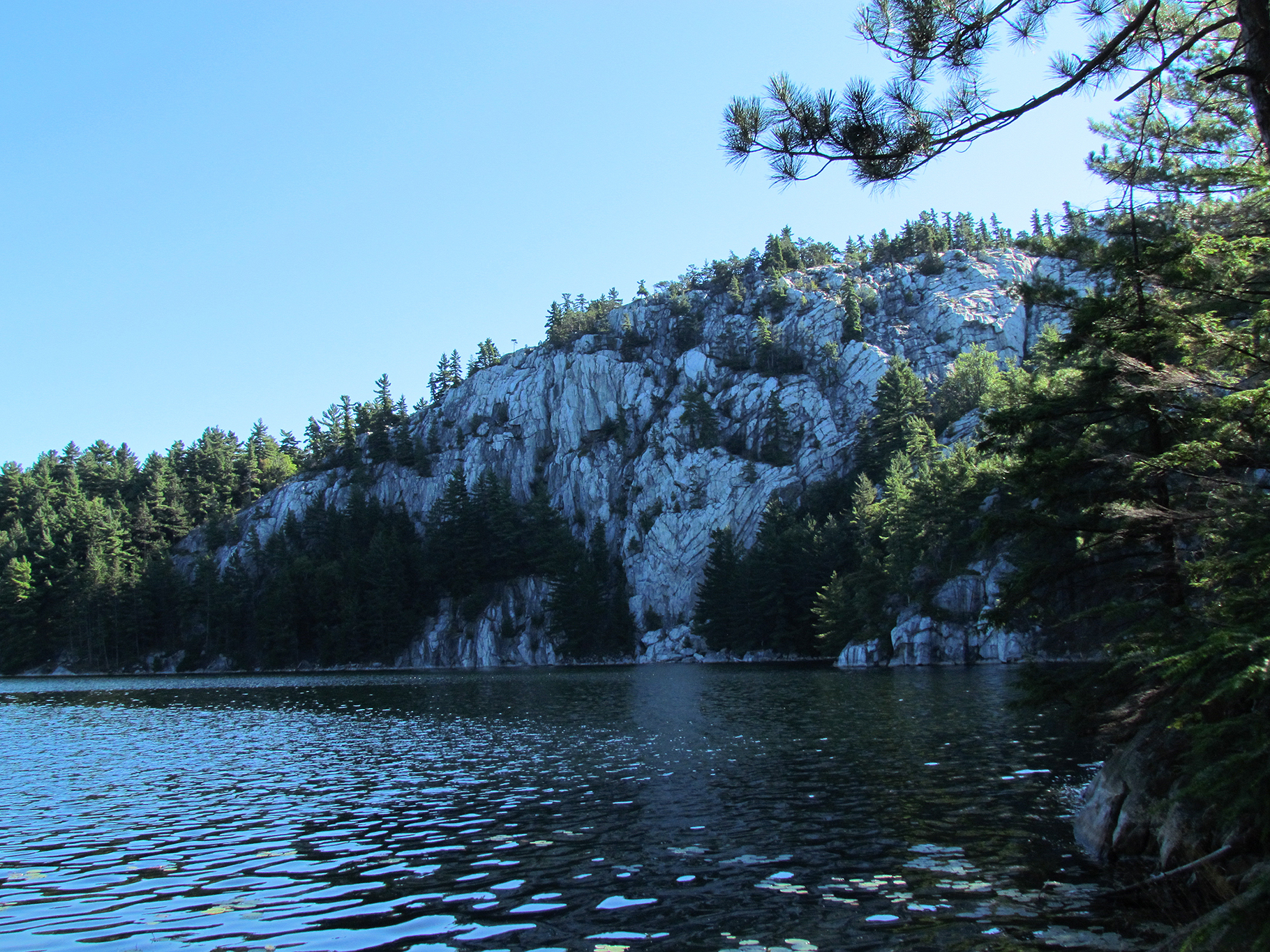
We departed from our island bunkmates and headed south into Threenarrows Lake. The last time we were on this lake was in 2007. As always, today was a mix of paddling and portaging. Great Mountain Lake offered some nice views of the La Cloche Mountains. Little Mountain Lake was a beautiful shade of blue. Looking at the map we could see this lake is nestled in between two quartzite hills so runoff of acid rain probably contributed to a lower pH of this particular lake.
White quartzite at Little Mountain Lake. (click image to enlarge)
After portaging 770 metres and 835 metres, we paddled a winding marsh which reminded us of the Nipissing River in Algonquin Provincial Park. It was along this section we met a group of teenage boys (maybe boy scouts?) that were on their own paddling trip. One kid had duct tape on his shoes which looked to be the only thing keeping them together. Hopefully it doesn’t deter him from enjoying future canoe trips.
When we arrived at Threenarrows Lake we paddled a headwind until we arrived at our third island campsite of the trip (site #42). All we have to do tomorrow is paddle the whole length of Threenarrows Lake which will make for a more relaxing day. Supper tonight was a new one for us which we called “Lentil Surprise”, made up of lentils, tomato, onion and rice. We will probably skip this one on future trips as it only got a 7/10 on the Marianne and Aaron “Tasty Metre”
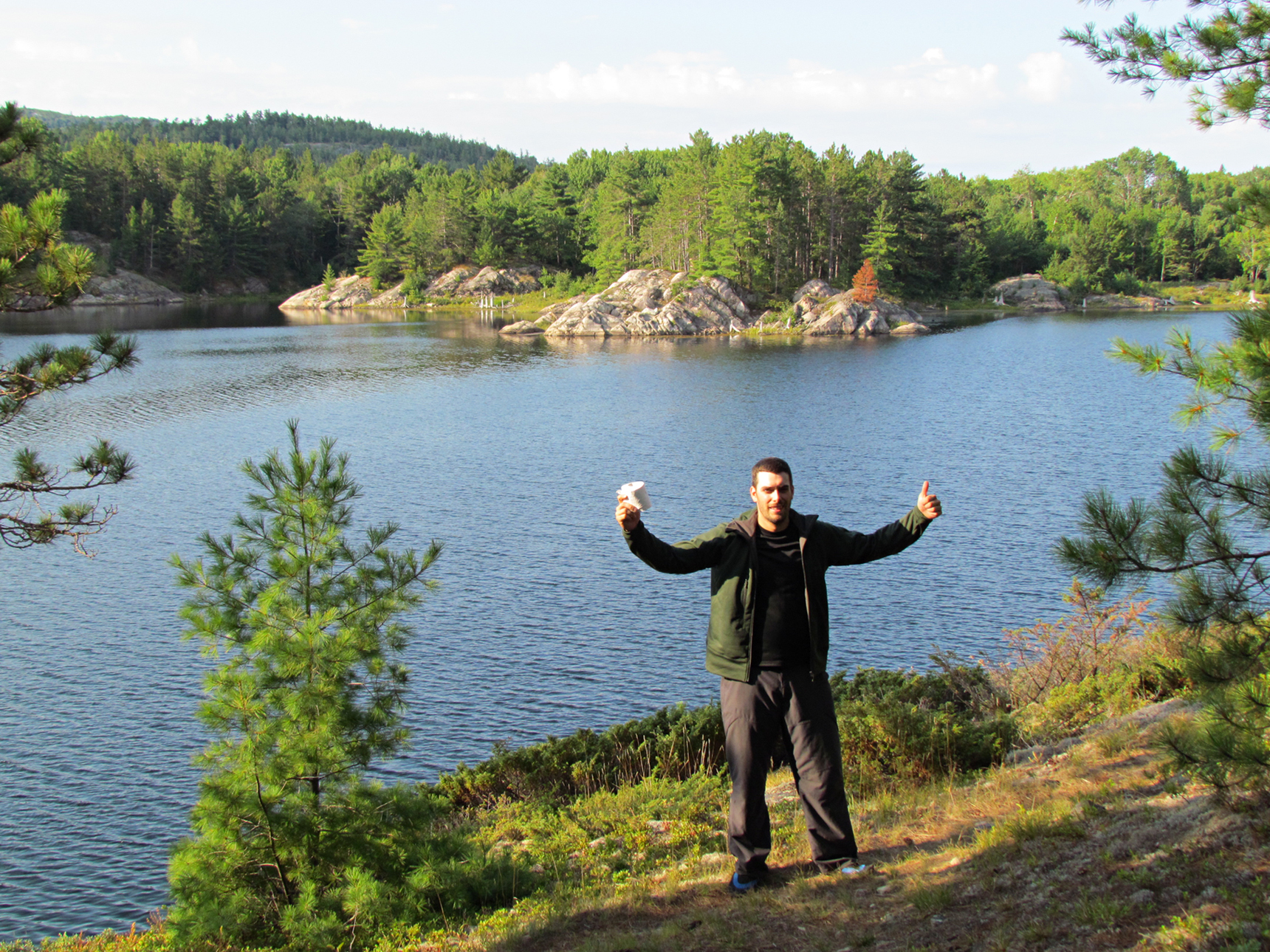
The view from our island site on Threenarrows Lake with Aaron giving the thumbs up after conquering the thunderbox. (click image to enlarge)
Wildlife Sightings: Broad-winged Hawk, Eastern Chipmunk, Red Squirrel, Black-capped Chickadee, Blue Jay, Common Loon, Herring Gull, Red-eyed Vireo, Beaver Dam, Red-breasted Nuthatch, Caspian Tern, Double-crested Cormorant, Wood Duck, People
Remember to: No remember to today! Whoot!
DAY # 4: Threenarrows Lake
Weather: Sunny with strong southwest winds. High: 25 C Low: 22 C
topoView USGS. (click image to enlarge)
This morning we slept in and after a pancake breakfast complete with maple syrup crystals, we started to paddle the length of the lake heading towards its southwest end.
Threenarrows Lake is an interesting lake. Originally it was three separate lakes until a dam was created at the beginning of the 20th century at Kirk Creek which is located near the southwest end of the lake. This was done to aid in logging activities that was ongoing in the park at this time. The result of the dam rose lake levels to around 16 feet transforming it to the one large lake that we see today. The dam was rebuilt again in 1934.
The wind started to pick up around 10:30 am as we paddled. Being familiar with this lake we reminisced of our last trip here in 2007, and we wanted to check out one of our old campsites which was campsite #51. As we approached the site we were shocked by its condition! Trees that looked to be chopped with hatchets, initials carved in trees, while the campsite itself looked a mess! Wish we could have compiled a before and after photo of this site, but paddling into the wind made reaching for the camera in the pack difficult. Looking at this site now I would never want to camp there. It’s a shame that people think they have the right to degrade Killarney, or any provincial park for that matter, with such disregard.
We managed to reach our site in three and a half hours. We have stayed before at this site (site #48) and luckily it was in the same condition as it was when we were previously there. There are a couple of cottages nearby though we cannot view them from our site. The rest of the afternoon was for relaxing and Aaron even had a nap. We finally brought out our fishing rod for the first time on this trip but nothing was biting.
Wildlife Sightings: Common Loon, White-tailed Deer, Common Raven, Beaver, Red Squirrel, Song Sparrow, Blue Jay, Yellow Warbler
Remember to: No remember to today! Yeah!
DAY # 5: Threenarrows Lake to East Channel – McGregor Bay
Weather: Cloudy with showers all day. TORNADO WATCH! High: 20 C Low: 18 C
topoView USGS. (click image to enlarge)
With the sound of wind and rain last night we barely slept, which continued into the early morning. It was thankfully reduced to a light drizzle by the time we broke camp and were out on the water, and later it stopped altogether before we made it to our first portage at Kirk Creek. On our way we passed the notorious portage known as “The Pig” which is an old logging tote road and one of the steepest portages in the park that we did four years ago. Not a good day today for those that have the pleasure of tackling The Pig as it will have loose wet rocks to negotiate. We were not any better off as the series of portages in Kirk Creek were challenging with steep sections, along with it’s own slippery rocks. In Kirk Creek we had to take off our hiking boots and switch over to our sandals while dragging the canoe in a few sections that were too low to paddle. We arrived on McGregor Bay around noon. This section of the park is also quite scenic with some cottages. If we ever win the lottery and a property becomes available we are going to buy up here!
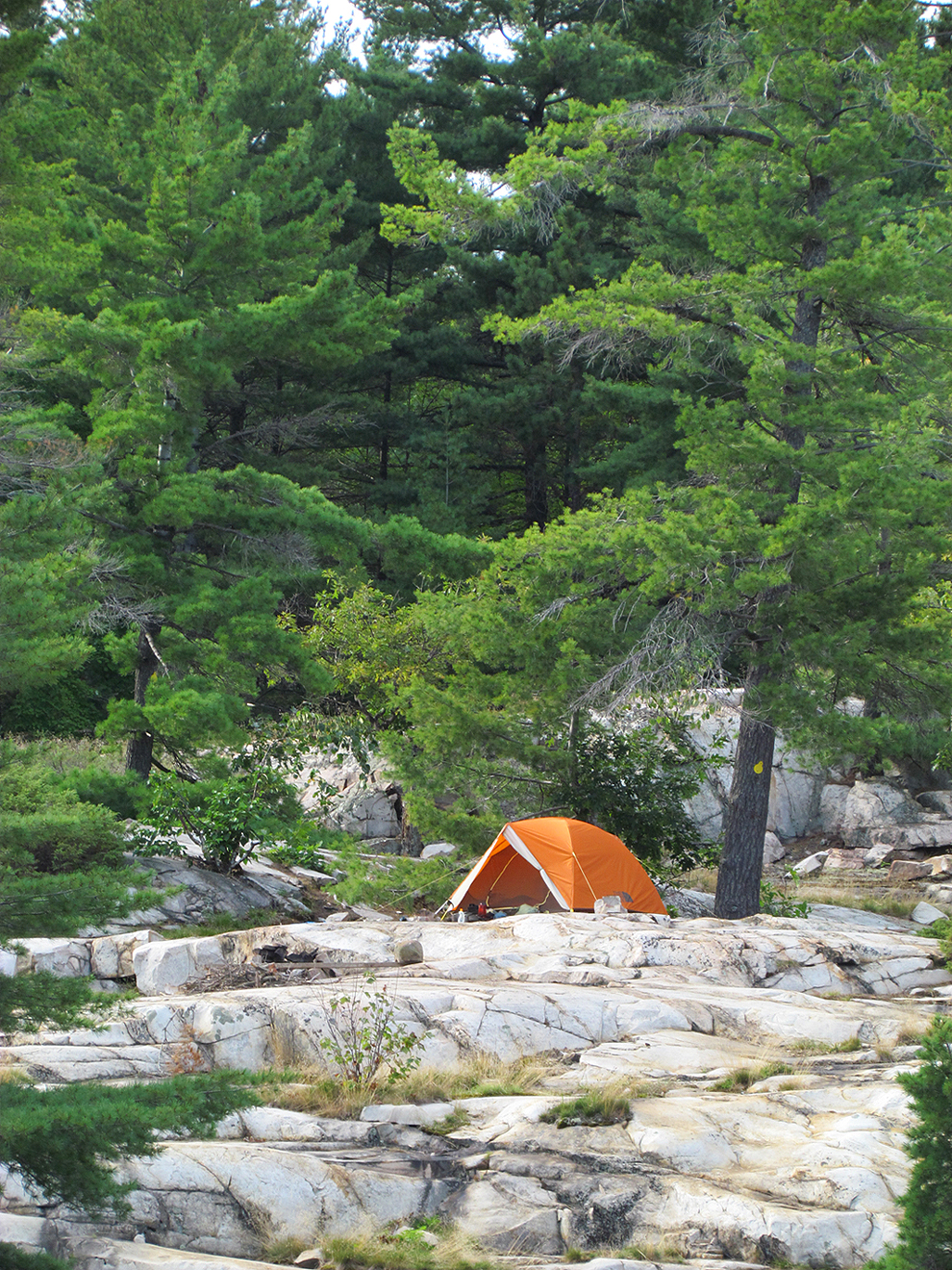
Site #136 on McGregor Bay is on an exposed rock. (click image to enlarge)
After paddling by cottages and observing some boats on the bay, we set up camp on an exposed site (site #136) on a rock overlooking the bay. We heard the distant rumbles of thunder and saw a couple of River Otters bobbing up and down while chattering back and forth in the water. While we relaxed on our rock overlooking the bay we wound up our weather radio and heard that we were under a Tornado Watch! We also learned that two days prior, an F3 tornado ripped through the town of Goderich, 300 kilometres to the south of us. Luckily for us the clouds eventually broke up, leaving us with a lovely calm sunset.
Clouds breaking up just in time for supper on McGregor Bay. (click image to enlarge)
Wildlife Sightings:Common Loon, Double-crested Cormorant, Common Raven, American Crow, Blue Jay, Yellow-rumped Warbler, Black-capped Chickadee, Hairy Woodpecker, White Admiral, River Otter, People
Remember to:Bring mints, or mouthwash…or something. We get bad breath out here!
DAY # 6: McGregor Bay to Low Lake
Weather: Sunny to partly cloudy. High: 25 C Low: 16 C
topoView USGS. (click image to enlarge)Sunshine in the morning is always a great feeling in the backcountry! (click image to enlarge)
Today was an interesting day! We woke up at our campsite and began our day with a pancake breakfast, always a wonderful start in the backcountry! As we began to paddle from McGregor Bay into the East Channel we had a very hard time trying to find where the land narrowed to enter a small gap to the second section of the East Channel. We checked the map, followed the GPS (which we rarely take out) and we knew we were in the right spot but just couldn’t find it! We eventually found the small hidden entryway that was barely wider than our canoe. We also got a little misplaced while paddling a marsh after exiting the North Channel. The marsh was winding and trying to find the yellow portage sign that would lead us into Low Lake was difficult, to the point that we had and to stand up in the canoe to actually find it. The portage from Low Lake to Helen Lake though was easy to find as it was a big wide slab of rock that also had a campsite on it, with the portage itself being a cake walk. As we arrived on Helen Lake we began the search for a nice campsite as we would be spending two nights here. There was one problem though, all the sites looked pretty terrible! We back tracked and ended up staying at the portage campsite between Low and Helen Lake. Though it was a campsite at a portage it was very scenic with a big smooth rock and landscape similar to that of Georgian Bay.
Our Low Lake site. (click image to enlarge)
Surveying a campsite is customary for us (and should be for anyone) and we did locate some bear scat, but it wasn’t fresh. There was one thing about this campsite that we should have expected, though it didn’t even cross our minds, in that it was located at a low spot between two hills. There was bound to be some animal traffic through here, and it started that night with the mice climbing up the side of the tent and a big “SNAP” near our site that was hopefully just a deer.
Calm evening Low Lake. (click image to enlarge)
Wildlife Sightings: Common Loon, Double-crested Cormorant, Red Squirrel, Great Blue Heron, Blue Jay, Common Raven, American Crow, Caspian Tern, Frogs, Dragonflies, Black-capped Chickadee, Yellow-rumped Warbler, People.
Remember to: No remember to today! YEAH!
DAY # 7: Low Lake
Weather: Sunny giving to clouds into the evening. High: 23 C Low: 20C
topoView USGS. (click image to enlarge)
Today we spent the day relaxing at our portage/campsite. The morning started out with a burnt pancake (yuck) and the rest of the morning was spent basking in the sun while listening to CBC Radio on our solar powered windup radio while drinking tea. Marianne observed the courtship flight of the local grasshoppers. When we started feeling warm from the heat rising off the rocks we slowly slipped into the cool waters of Low Lake for a swim. After lunch we returned to the sun again while Aaron took a nap. We also saw a big bass swimming close to shore. Aaron tried to catch it with our fishing rod that we accidently broke a few days prior but the bass didn’t bother.
White quartzite at our site on Low Lake. (click image to enlarge)
Tomorrow we portage up the La Cloche Mountains! We had a nice evening with a Whip-poor-will calling again. Later that night as we stared up at the stars and watched for passing satellites, we heard something crash into the tree beside our tent. Turning on our headlamps and pointing it towards the sound revealed a Northern Flying Squirrel!
Due to the fact that we were lounging around all day we had a hard time falling asleep that night while we listened to more animal traffic around our site. The climax of all this busy movement was a big “BA-Lunk” into the lake followed by something swimming away from shore.
Wildlife Sightings: Common Raven, Common Loon, Blue Jay, Double-crested Cormorant, Mallard, Whip-poor-will, Turkey Vulture, Broad-winged Hawk, Red Squirrel, Black-capped Chickadee, Northern Flying Squirrel, Yellow-rumped Warbler. No people today though we could hear distant boats.
Remember to:Sunscreen……durp.
DAY # 8: Low Lake to Widgawa Lodge launch at Charlton Lake
Weather: Sunny. High: 24 C Low: 18 C
topoView USGS. (click image to enlarge)
This morning Aaron woke up with a terrible sunburn as he didn’t apply any sunscreen the day before while we lounged outside all day. We had two of the longest portages of the trip today. One would be a 2,525 metre from Helen Lake to Nellie Lake that would take us up a section of the La Cloche Mountains, while the other would be a less steep 2,085 metre from Nellie Lake to Grace Lake where we were to set up camp for our last night. The first portage we had to double over by going first with the packs followed by the canoe. The portage had some steep sections and when we arrived at the Nellie Lake end with the canoe we collapsed beside it a little sweaty and hungry, so it was straight for the energy bars. After ripping them open we heard a “snap” followed by a rustling sound of branches very close to us. Walking towards us Marianne barely saw the back of a Black Bear so she grabbed her paddle and banged it on the side of the canoe while yelling to scare the bear off. It slowly lumbered away though we could no longer see it, so we quickly grabbed our stuff, threw it into the canoe, and paddle into Nellie Lake. Nellie Lake is another crystal clear lake, with a 28 metre visibility to the bottom. We decided to pump water here and it tasted different from all the other lakes we pumped water from. We wonder if this lake even has any organisms to filter out?
The crystal clear blue waters of Nellie Lake is the result of acid rain. (click image to enlarge)
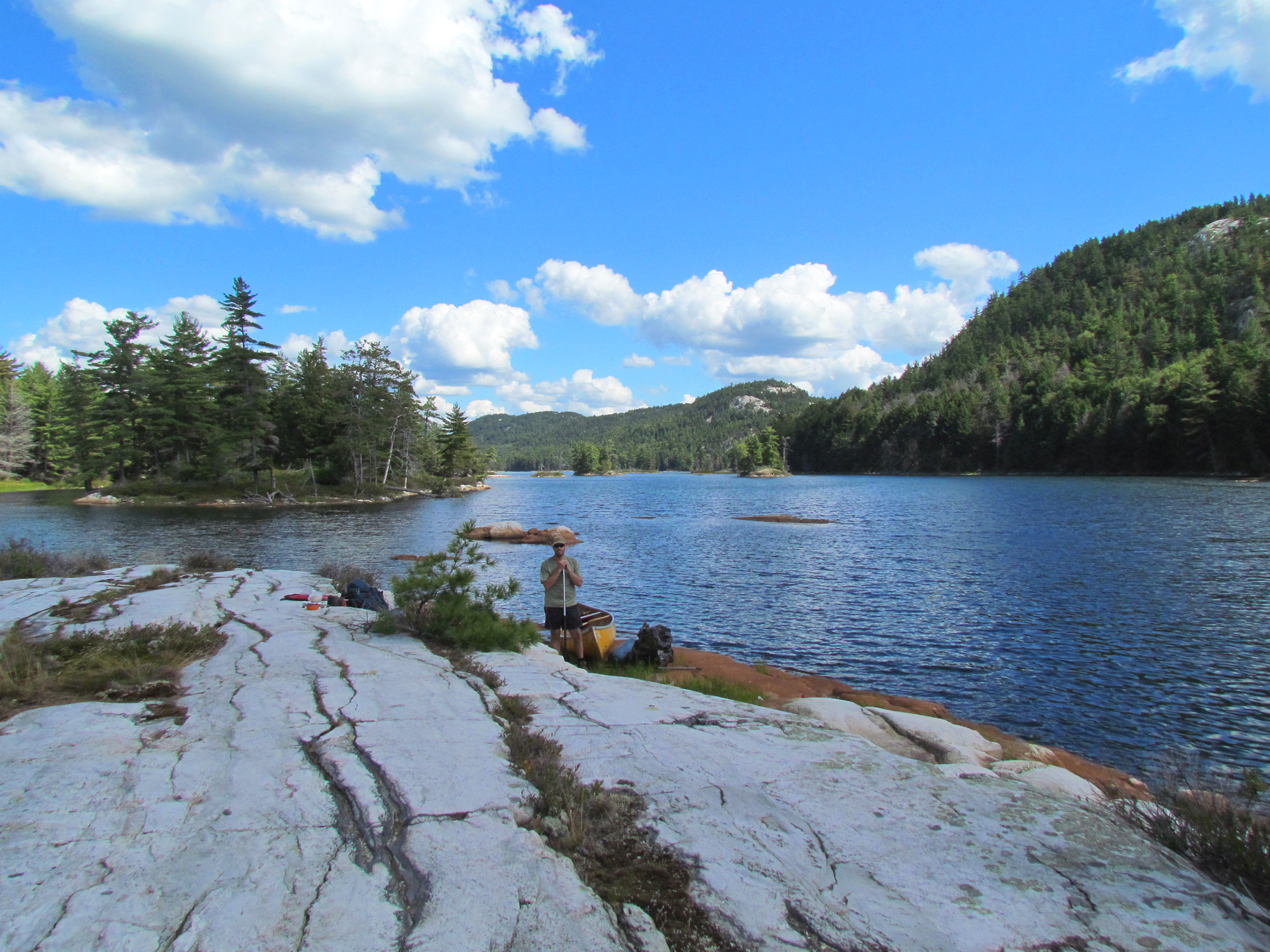
After taking a breather while paddling around the scenic Nellie Lake and viewing the La Cloche range, it was time to head towards Grace Lake. This portage at 2,085 metres was not as steep as our previous portage. It was around here that Aaron’s sunburn was really starting to bother him and we had to make a decision. Our options were should we camp at Grace Lake as his sunburn gets worse, or portage the last 1,745 metres, followed by an almost 12 kilometre paddle out of the park back to the car? After arriving on Grace Lake, which is perhaps the most scenic lake in the whole park, we looked at the time and decided to have lunch on an island and head out. It was a shame looking back on it now that we didn’t spend one more night on a lake that Group of Seven artist A.Y Jackson stayed at while painting such works as “Grace Lake” and “Nellie Lake”. For us, as is the norm when we get close to our car, was visions of real food, a nice long shower and a soft bed. It’s been said that you have to be out in the wilderness for at least three weeks before you loose those wants. We clearly need to take a longer trips.
A small island on Grace Lake. Yes the lake is this awesome! (click image to enlarge)
After completing our last portage of the day, which was a 1,745 metre into Cranberry Bay, it was time to paddle out of the park into Frood Lake. There was a strong head wind and we had no water as we paddled hard all the way back to Willisville, all the while motorboats passed us by with ease.
Arriving back at the launch, we returned our canoe and drove to the Pinewood Inn in Espanola for a real meal as we were thirsty, tired and hungry. We must have been more tired than hungry because we had a hard time finishing our meals. As for falling asleep that night, it was a piece of soft fluffy cake!
This by far was a more epic trip to Killarney over our inaugural trip back in 2007. With improvements to our gear we are beginning to feel more confident as we travel to different locations, while extending the days and kilometres to our routes. Having a digital camera for this trip was nice as well and we could take better photos along with video memories of one of Ontario’s most popular parks! We will be back again Killarney!!
Longest Portage: 1.790 kilometress (Osler Lake to Nadine Lake)
Average Daytime High: 9.5 Celsius
Average Nighttime Low: 1 Celsius
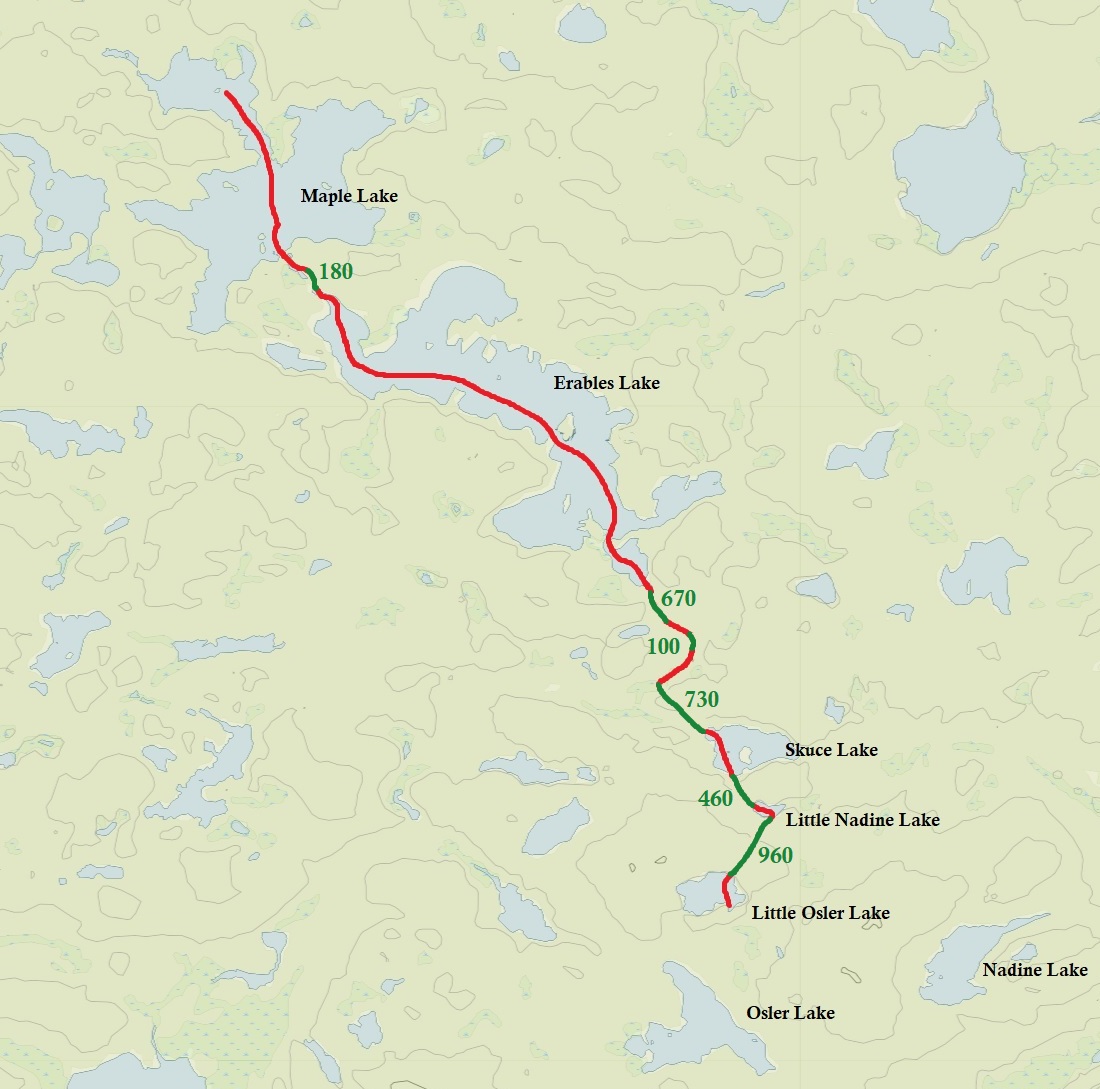
Route: Kioshkokwi Lake – Maple Creek – Maple Lake – Erables Lake – Skuce Lake – Little Nadine Lake – Little Osler Lake – Osler Lake – Nadine Lake – Nipissing River – Cedar Lake – Little Cedar Lake – Aura Lee Lake – Laurel Lake – Little Cauchon Lake – Cauchon Lake – Mink Lake – Little Mink Lake – Kioshkokwi Lake
Maps Used: Chrismar Algonquin 2 (Northwest) and Friends of Algonquin Park Map (2007 version)
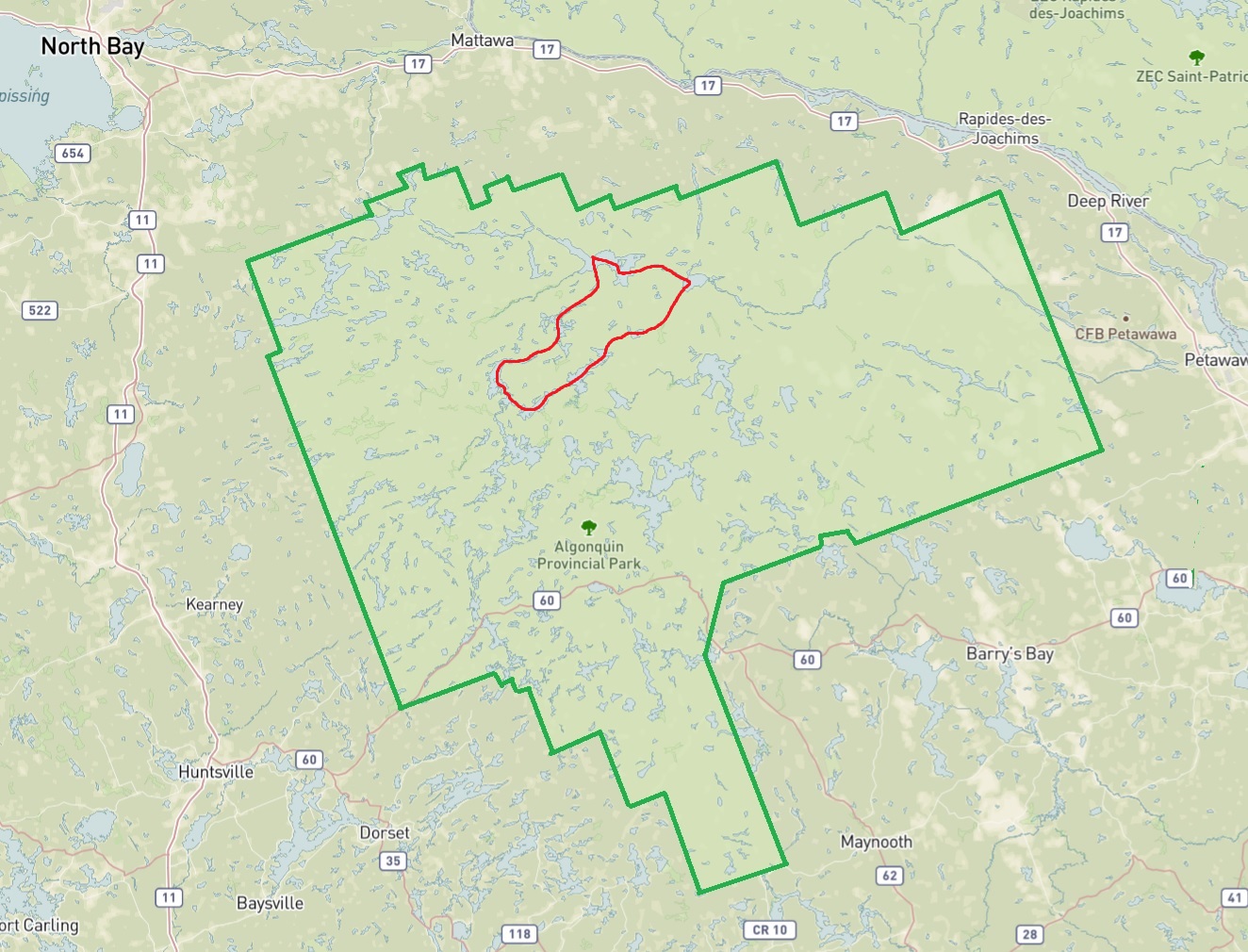
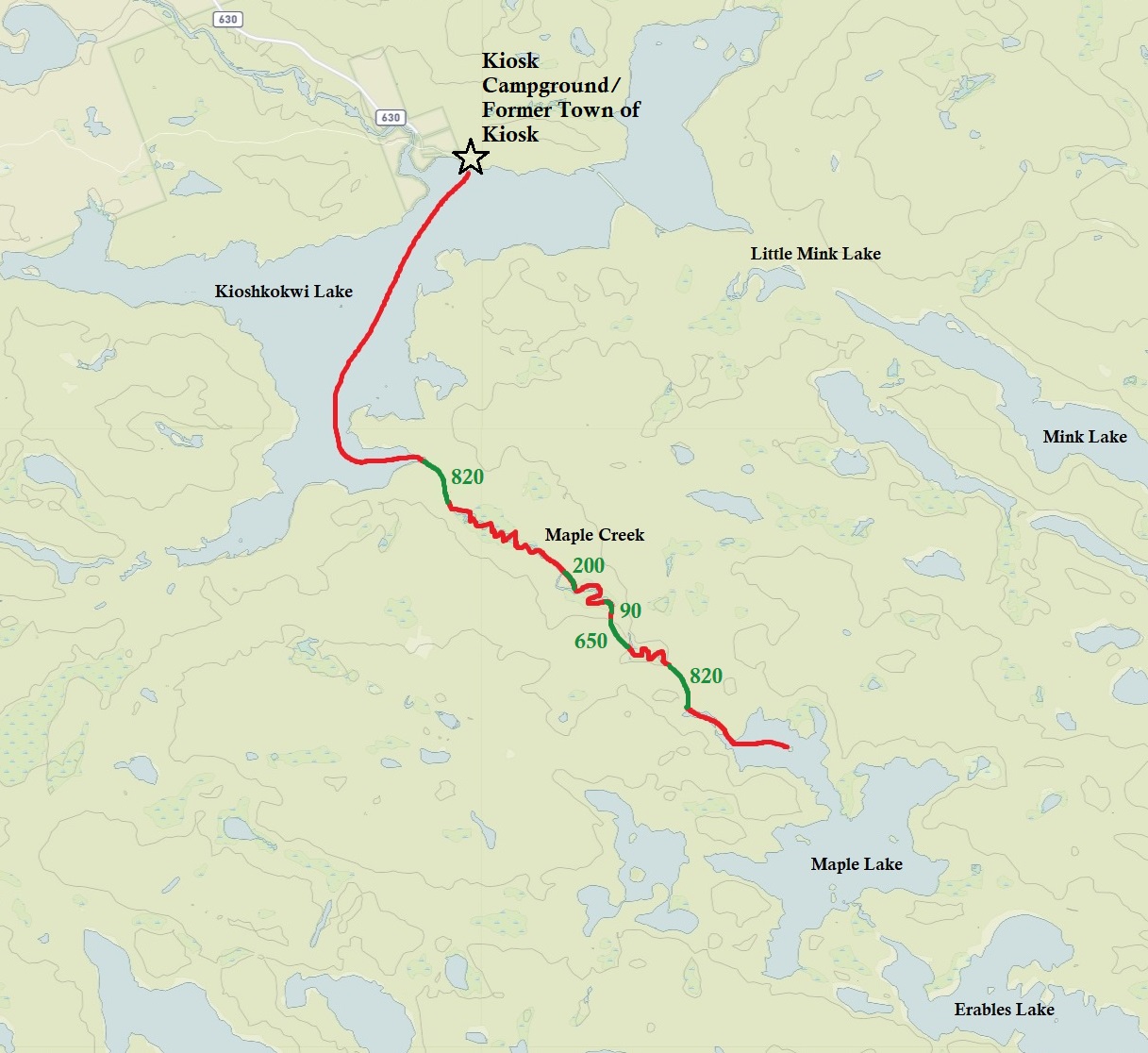
Algonquin Provincial Park with our route outlined in red. (click image to enlarge) topoView USGS.
Algonquin Provincial Park really needs no introduction. It’s Ontario’s largest Provincial Park easily accessible by car, with the majority of provincial residents able to drive there in a day. Though rich in natural history, arguably Algonquin Provincial Park’s human history is even more interesting, and with a little bit of research before heading out you can locate what remains from these relics of the past. Presently family owned cottages still remain on lease remain within the park. Also within the park boundary are a couple of abandoned railways with ghost towns along its route, old roads, dams, log chutes, abandoned machinery and settlements from the logging days, and even POW camps from World War II! Though you can’t see it from the highway, or even from Algonquin’s lakes and portages, logging continues in the park today amid controversy.
Algonquin Provincial Park sets a transitional stage between the deciduous forests of the south and the coniferous forests of the north where larger mammals such as Moose, White-tailed Deer, Beaver, and Fisher make their home. Birds include some Boreal forest species like Spruce Grouse, Black-backed Woodpecker and Boreal Chickadee. The park is also one of the oldest provincial parks in Canada, founded in 1893.
We decided to try a fall camping trip this year with the hopes of taking in some fall colours, some cooler temperatures, and hopefully less canoe traffic.
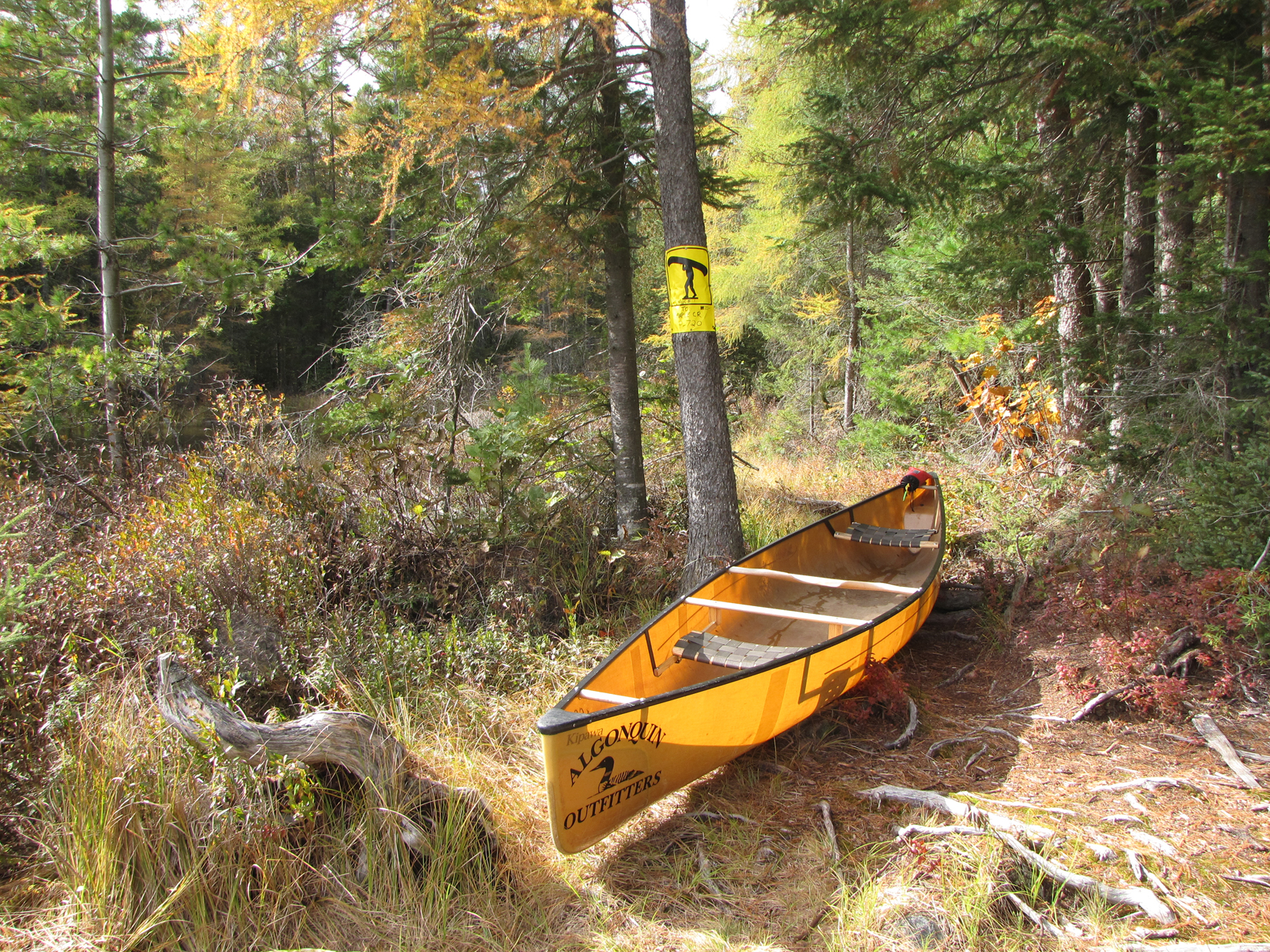
We headed up to the beautiful city of Huntsville and over to the Algonquin Outfitters to pick up our canoe. Our canoe this year is a 42 pound Kevlar based Swift Kipawa at 16.5 feet long. Unfortunately, it was at the outfitter that we realized we forgot our PFDs and strappings at home. Fortunately for us they are both provided by the Algonquin Outfitters.
Turning right at North Bay, we headed east down highway 17 on our way to enter the park from the north end. We turned south down road 630 for 24.5 kilometres to the Kiosk campground and arrived at our car camping spot at around 5:15pm. We quickly made camp and supper before it got too dark and realized that while planning for this trip we forgot to consider how soon it gets dark now in October, by 6:45pm. Hopefully it won’t affect the trip too much.
DAY # 1: Kiosk Launch to Maple Lake
Weather:Sunny and windy. High: 15C Low: -2C
topoView USGS. (click image to enlarge)
Happy Thanksgiving!
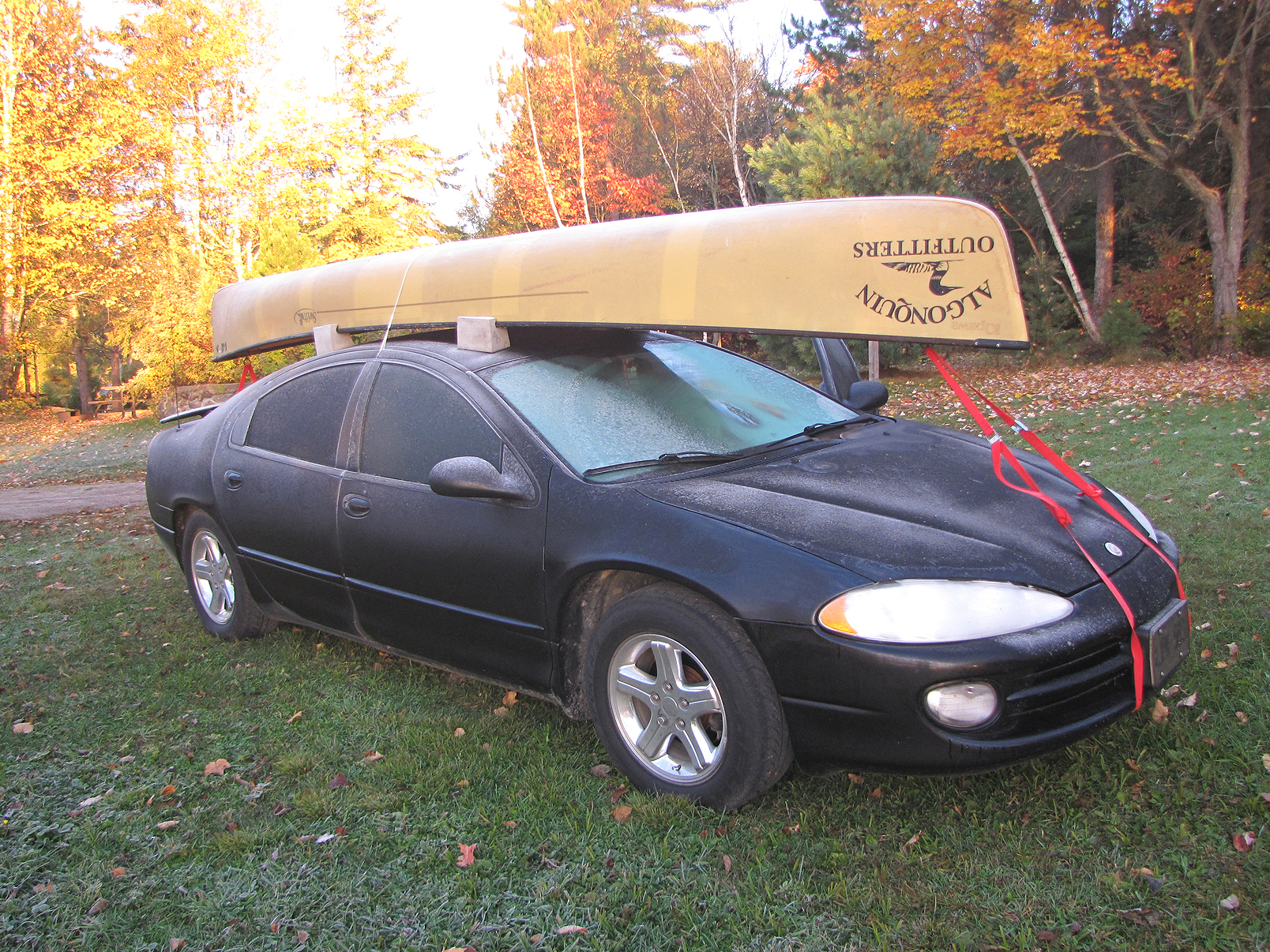
We woke up many times during the night, tossing and turning and listening to whatever was walking by our tent. The morning revealed frost on the car along with the canoe that was still strapped on top. We made a fire to warm up and had our breakfast which was a homemade dehyde consisting of oats, apples, apricots and blueberries. As we were making our way to the launch we noticed a sign stating that the big game hunt was starting soon and that paddlers should wear bright coloured clothing……we definitely didn’t have any packed.
A frosty morning at the Kiosk campground. (Click image to enlarge)
We launched pretty late this morning at 10:15am on Kioshkokwi Lake (the name meaning “lake of many gulls” in Algonquin) and was it ever windy! We had to paddle pretty hard to get any forward momentum while the bow of the canoe kept bouncing off the waves. Once we reached Maple Creek it got a lot calmer.
Today’s portages were fairly simple with 6 in total. Along a portage we met a group of six more canoeists who were on their way out. We also saw a male Ruffed Grouse displaying along the portage.
Portage signs in Algonquin are large and bright yellow. Portage lengths are shown in metres. (click image to enlarge)
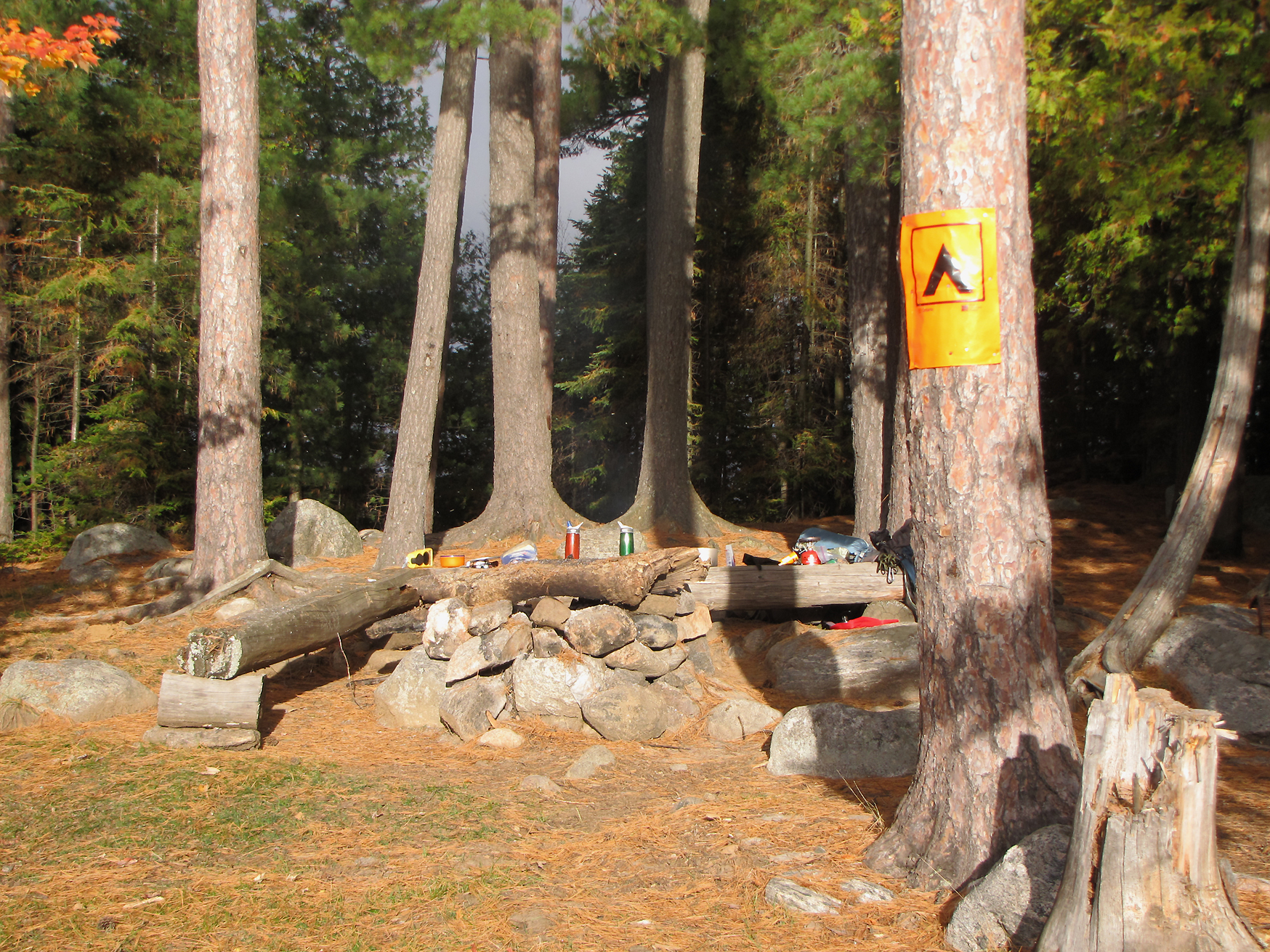
We arrived at our site, which was on a small island on Maple Lake at around 5pm. This gave us time to pump clean water and make another great fire for the evening with spaghetti on tonight’s menu.
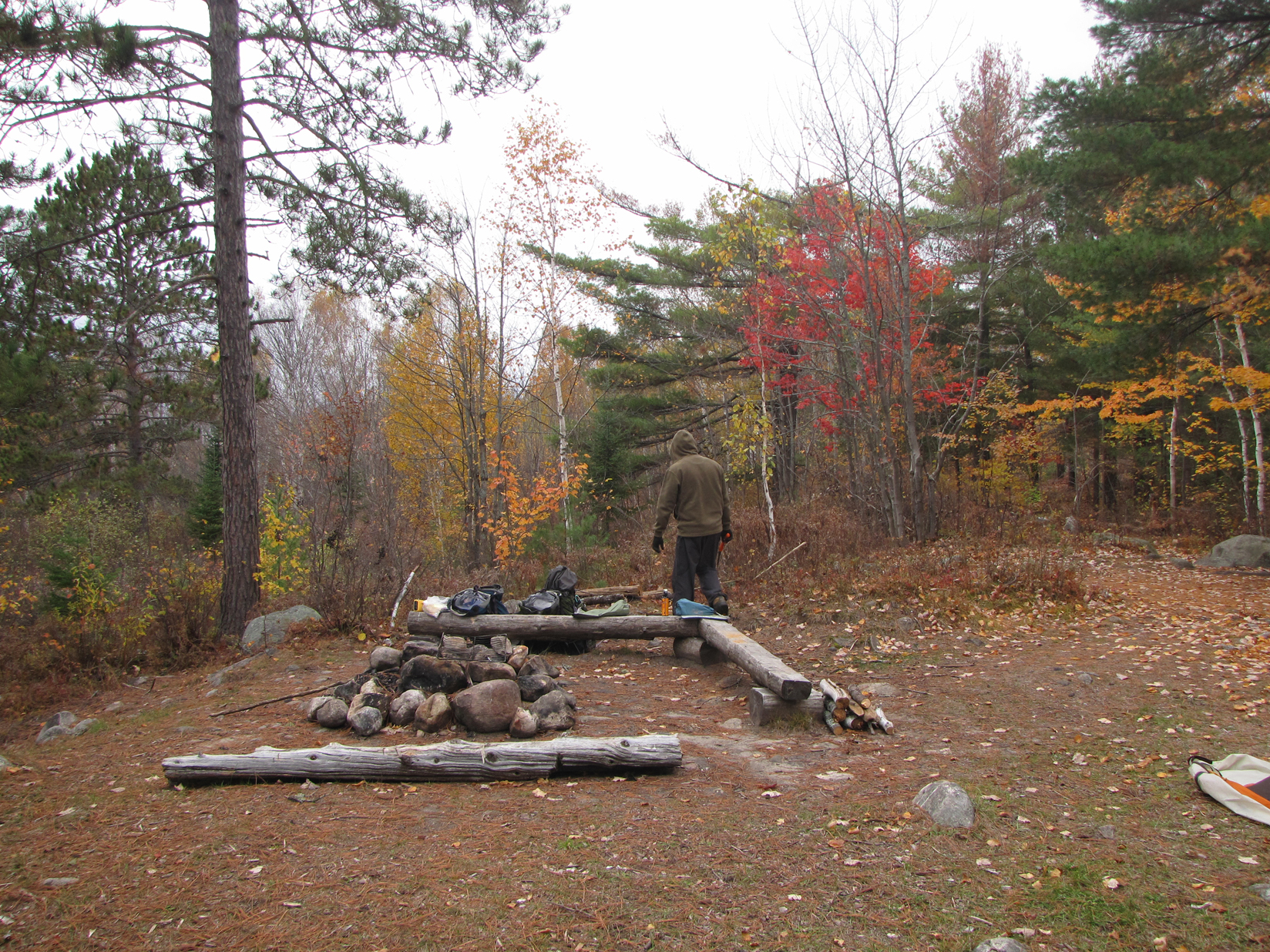
The island site on Maple Lake is one of our favourite sites in Algonquin Park. (click image to enlarge)
Weather: Sunny in the morning, cloudy in the afternoon. Calm. High 13C Low: 5C
topoView USGS. (click image to enlarge)
While we had breakfast this morning we heard the call of a moose. Moments later, a fair ways out in the distance we observed three. One of the Moose even crossed the lake.
We had a nice paddle through Maple Lake, and then into Erables Lake (Erables meaning “maple” in French).
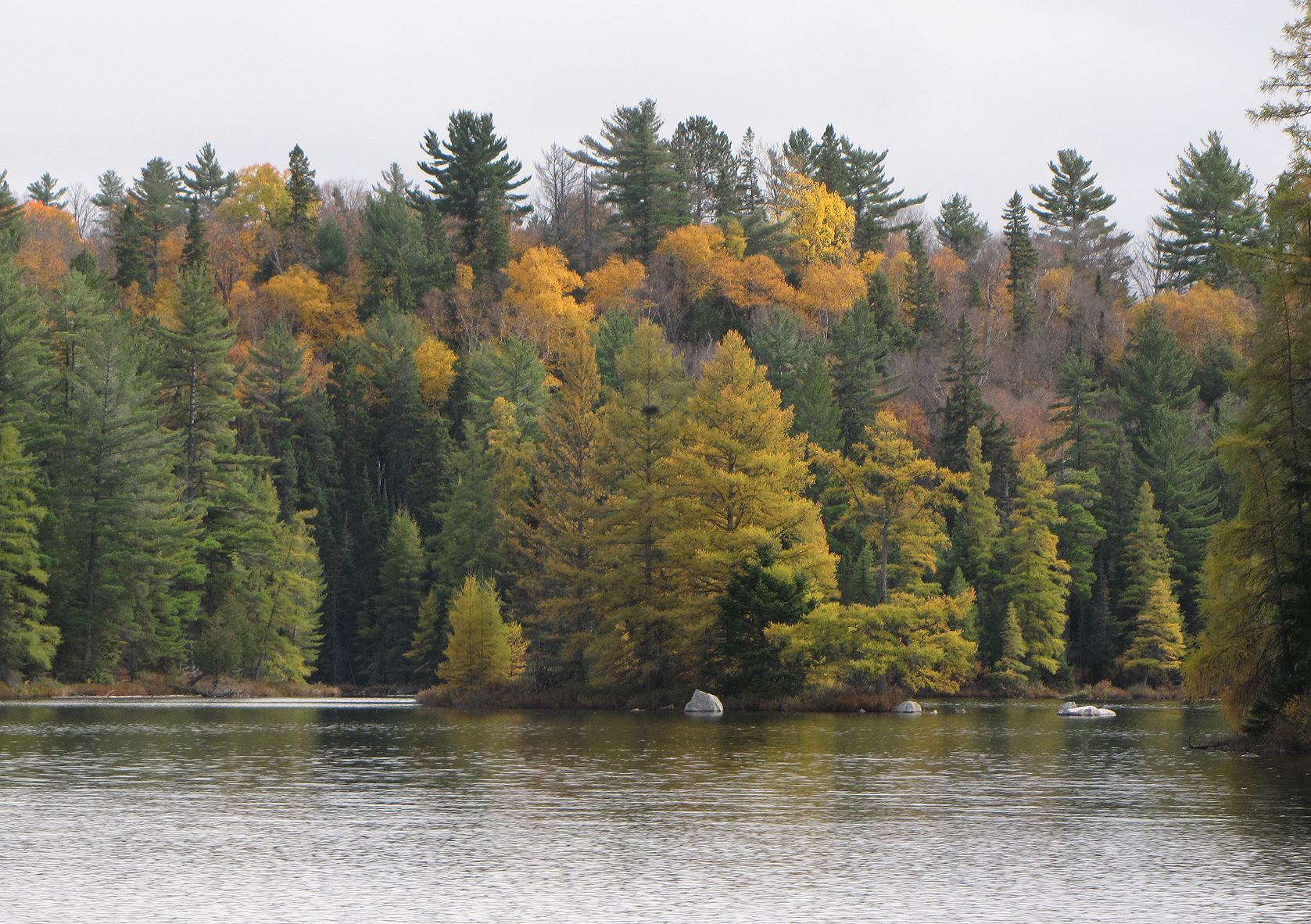
Fall colours Skuce Lake. (click image to enlarge)
The portages today were many including one steep and grueling one at 1,230 metres that went from Little Nadine to Little Osler. Through all this excitement, Marianne went above her ankles in muck at the beginning of the portage which filled her boots and soaked her socks.
Ready to enter Skuce Lake after protaging from maple creek. (click image to enlarge)
We got to our campsite on Little Osler Lake later than we expected (which would become routine on this trip) with just enough time to gather firewood, put up our tent, and hang our pack. Marianne tried to dry her soaked socks over the fire but instead she burned them to death. Oops!
Wildlife Sightings: No people, Moose, Common Merganser, Black-capped Chickadee, Grey Jay, Pileated Woodpecker, both Kinglet species, Hairy Woodpecker, Red Squirrel
Remember to: Check the elevation of the portages before we leave on a canoe trip.
DAY # 3: Little Osler Lake to the Nipissing River
Weather: Sunny. High: 9 C Low: 0C
topoView USGS. (click image to enlarge)Our site on Little Osler Lake. (click image to enlarge)
We decided to get up a bit earlier today at 7:00am because we were a little behind our scheduled route due to yesterday’s somewhat brutal portages.
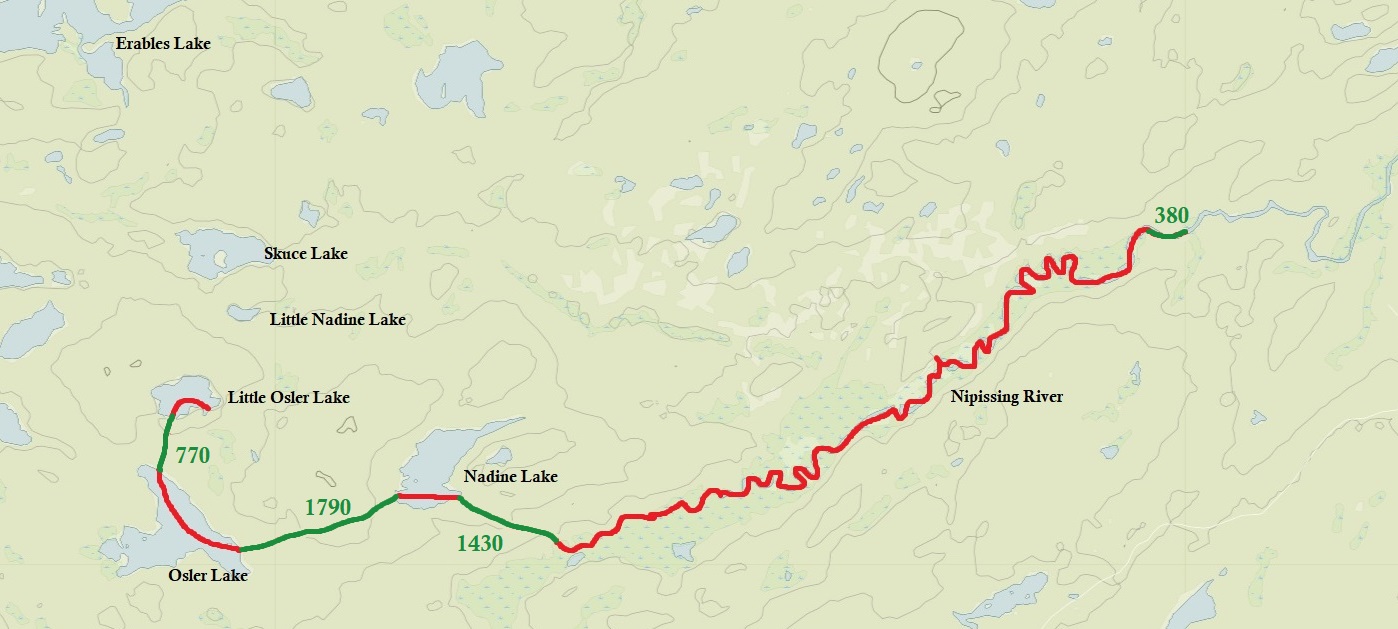
We got onto the water just after 9:00am ready to take on three portages that included the two longest for the whole trip at 1,790 metres and 1,430 metres.
The first one at 1,790 metres was a little rough while the second one at 1,430 metres was actually a cake walk. Unfortunately, during this portage Aaron tripped on something and the canoe came down on top of him. Luckily he was okay.
We reached the Nipissing River around 4pm. The river had many MANY twists and turns that the map doesn’t do justice for. You basically keep going left and right and right and left, and sometimes you feel like you are not making any forward progress. Along the way we saw three cow moose right along the shoreline which offered spectacular views! The water was very clear (and quite cold!) and we saw a beaver come out along the bank of the river, and a Pileated Woodpecker flew overhead. Looking up we noticed ahead of us some leaves getting blown in a circle above our heads and then the water rippled across the surface similar to a fish…It was actually a mini waterspout (if you can even call it that) and we paddled through it! Of course we cheered and said that we went through a waterspout like it was some big fish story.
Sunset approached and we continued to wind right and left and left and right along the Nipissing River. Every so often we noticed a log sticking out of the water, creating dead heads to bang you canoe off of. All the logs were of the same circumference and pretty much at the same angle. Maybe they were logs that got stuck during the logging days? There was also a Great Blue Heron which continued to fly ahead of our canoe as we rounded a few turns, like it was guiding the way for us.
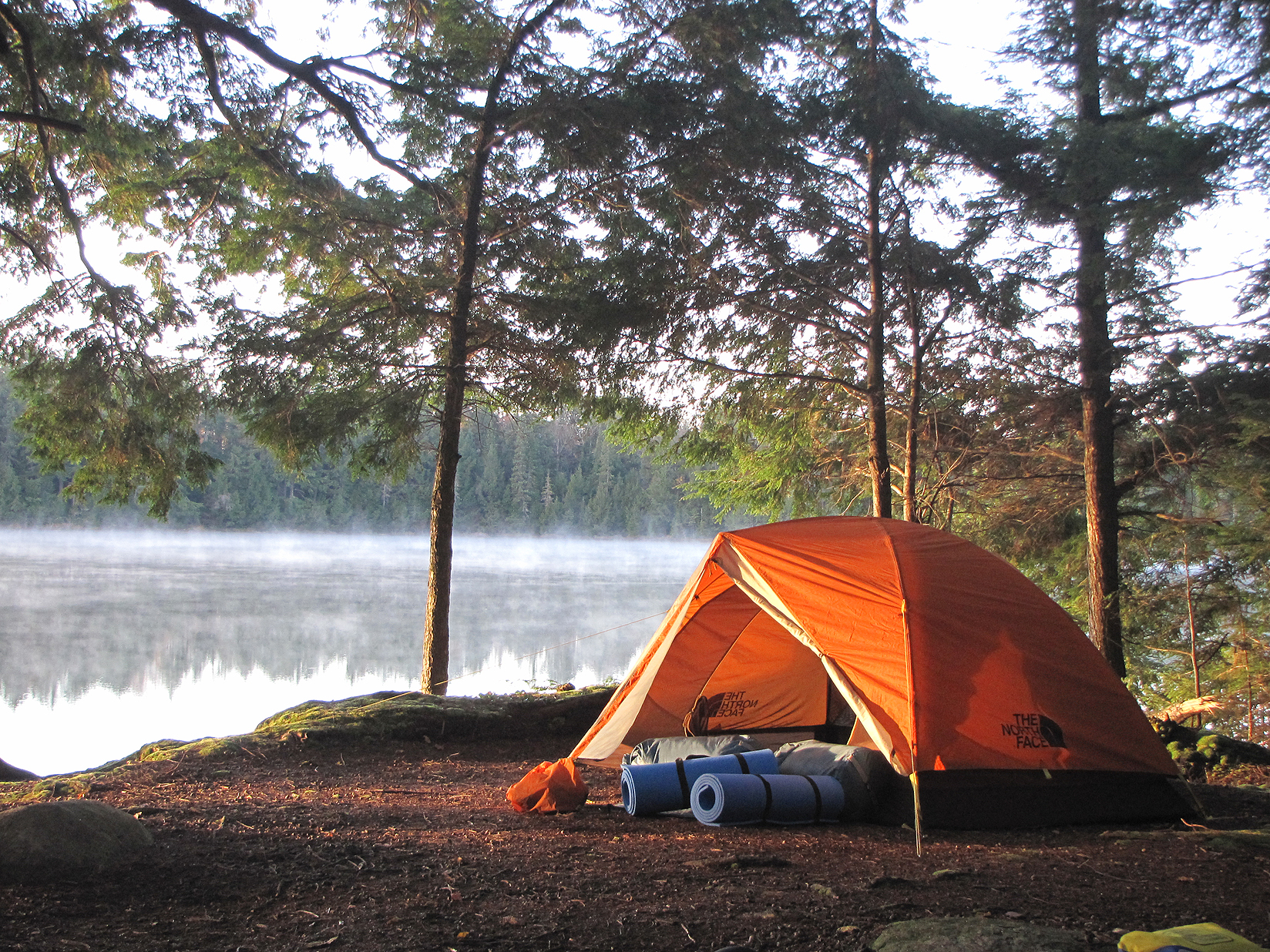
We passed a few campsites right along the river but decided to continue on as we didn’t like the looks of them. It was almost dark when we portaged 380 metres and came to a site at a man made dam and set up camp. The site itself was very dark, felt quite damp, and was even a bit spooky. Curled up in our sleeping bags with the sound of rushing water was the opposite of last night’s dead calm. There isn’t even an insect to sing you to sleep in October.
Wildlife Sightings: Moose, Golden-crowned Kinglet, American Robins, Blue Jays, Hairy Woodpecker, Pileated Woodpecker, American Pipit, Beaver, Muskrat, Great Blue Heron, No people.
Remember to: Plan for less paddling and more time for relaxing at our campsite!
DAY # 4: Nipissing River to Laurel Lake
Weather: Clouds in the morning followed by afternoon showers. High: 7C Low: -7C
topoView USGS. (click image to enlarge)
This morning we woke up at 5:15 am and could not get back to sleep! It was a chilly night next to the dam along the historic Nipissing River. At the very crack of dawn we came out of our frost covered tent. We were both quite cold as it was -7 Celsius beside the cold river. When we went to our packs to get the fuel and the water pump we saw that they were both frozen! Aaron had to put the stove in his rain coat to warm it up so we could actually make ourselves a breakfast.
We shivered while having breakfast and then began to pack up which was nice as we were moving around to keep warm. The sun came out when we slid the canoe back in the Nipissing River. A pair of River Otters checked us out and we would observe their heads appear above the current, disappear, and then reappear again a little farther downstream. Within an hour after launching from our site we arrived at another site that was a lot drier than ours, and we even had a fire which we couldn’t even attempt earlier. We got out the stove again and had a hot tea which warmed us to our toes and we felt a lot better as we were cold! As we continued down the Nipissing River we saw yet another moose as the clouds rolled in. Rain was in the forecast for today.
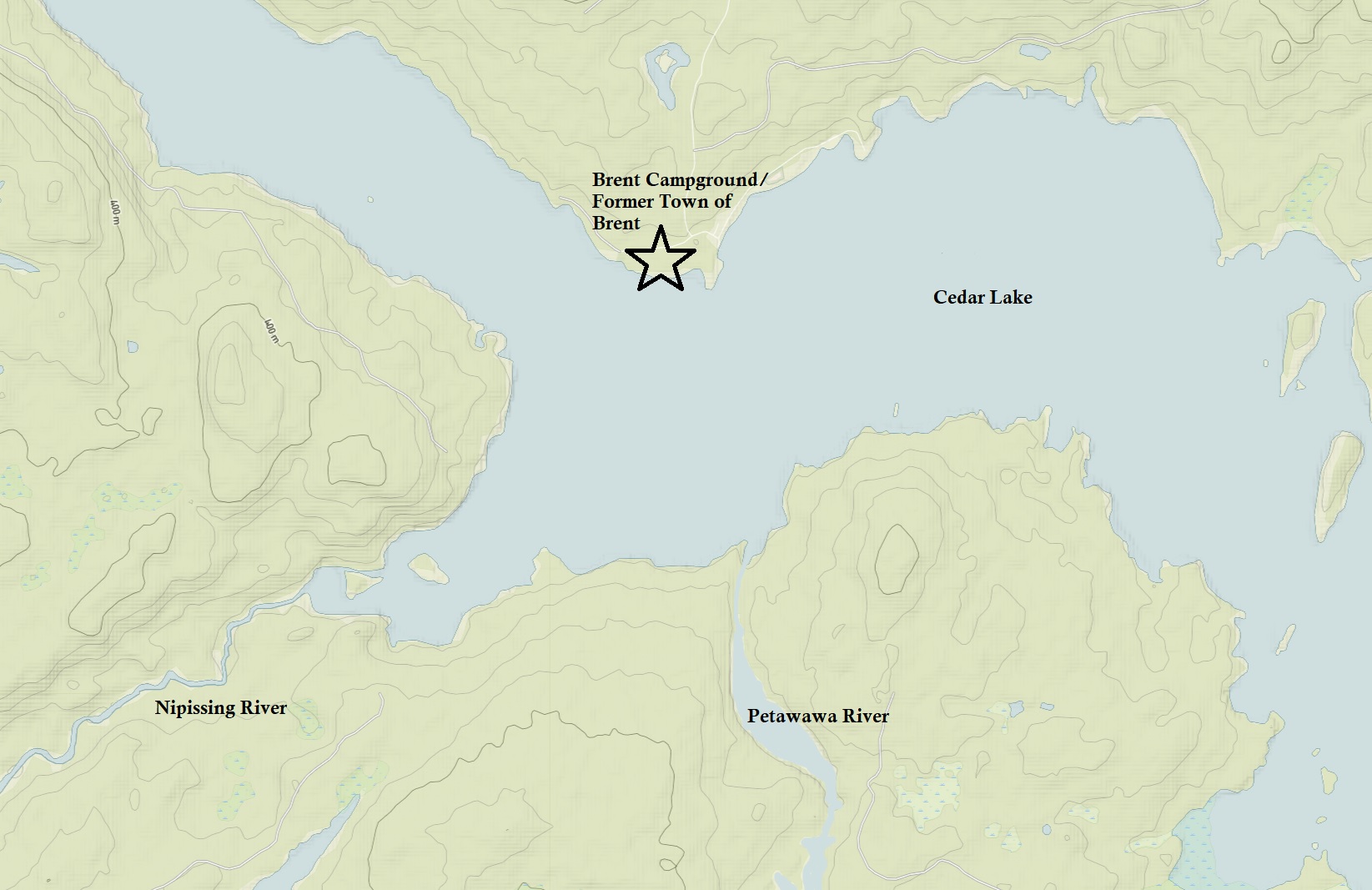
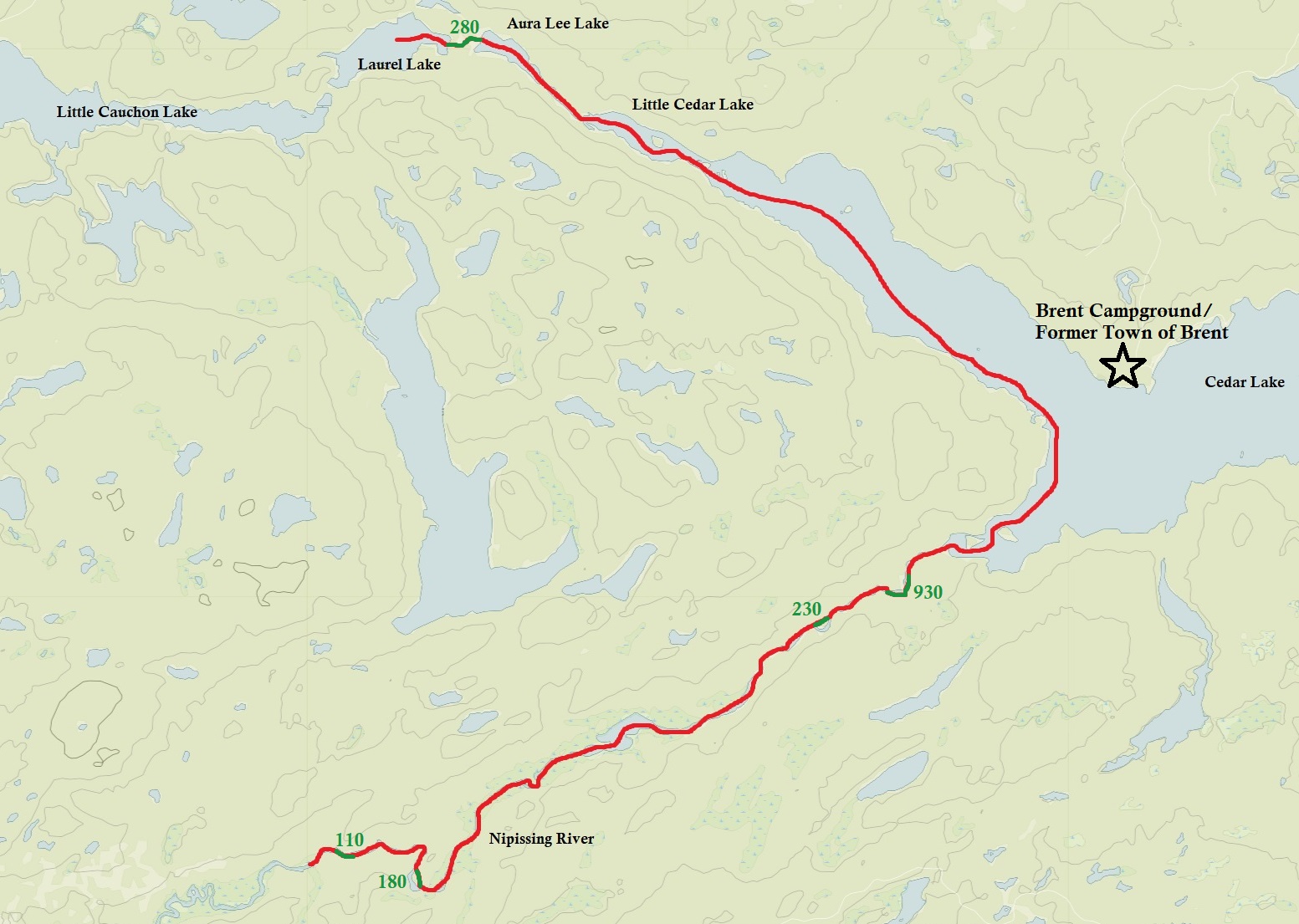
After a few more portages, including our last one at 915 metres, we exited the Nipissing River and entered the large expanse of Cedar Lake when it began to sprinkle a bit. Across the lake we could just make out a few cottages at the former town of Brent. Brent has some interesting history to it. It was once occupied by lumber companies, was the location of a depot farm, and had a station on the now removed Canadian National Railway. Today there are a few buildings still standing including some cottages. The Brent campground is similar to the Kiosk campground with no hydro or showers, and there is an Algonquin Outfitters store for supplies. We were thinking of making our very first visit to Brent today, but instead chose to stay close to shore where we could seek refuge in case it poured.
We ended up finding a dry spot under a tree at a site on Cedar Lake and shared a freeze dried meal plus some rehydrated butternut squash from our garden. The squash was really delicious and sweet!
Continuing in a northwesterly direction we could see to our right the now abandoned Canadian National Railway. This railway was in service from 1915 to 1995 with the tracks removed in 1996 and 1997. After a 275 metre portage we entered Laurel Lake. Tonight we camped on the small island on this smaller lake. The thunderbox was located on the very top of the island, possibly providing the most scenic views ever while we pooped. The site itself was a nice change to last night’s cold and damp river site.
Wildlife Sightings: River Otter, Hairy Woodpecker, Ducks sp., Common Loon, Ring-billed Gull, Pileated Woodpecker, Red-breasted Nuthatch, Moose, American Robins.
Remember to: Bring items into the tent at night that have the chance to freeze such as the fuel and the water pump.
DAY # 5: Laurel Lake to Mink Lake
Weather: Cloudy. High: 7C Low: 5C
topoView USGS. (Click image to enlarge)
Another grey sky greeted us this morning along with the sound of a gun going off as the big game hunt continued in the park. We agreed that we would be a little more vocal on the portages for the rest of the trip.
Today we had more paddling and less portaging as we continued west using the abandoned railway as a landmark. We passed some cottages where the ghost town of Daventry remains. We also saw someone out in a pickup truck, our first human sighting in a few days. Perhaps a hunter?
Like previous days, the fall colours were in full swing. Our last portage of the day was a 440 metre from Cauchon Lake into Mink Lake that crossed the abandoned railroad track. We paddled alongside the railbed until we came to a site right beside the railbed on Mink’s eastern shore. We can only imagine what it would’ve been like to camp out here if the train went by in the middle of the night.
Our site beside the abandoned CNR Railway on Mink Lake. (click image to enlarge)
While making camp we had the minor annoyance of a few Blackflies. We made a big fire and as we enjoyed our last night in Algonquin we heard the call of a moose in the distance. Tomorrow we paddle back to the Kiosk launch.
Sunset at Mink Lake with the old CNR railbed barely visible above the shoreline. (click image to enlarge)
Wildlife Sightings: Red Squirrel, Common Raven, Common Loon, Red-breasted Nuthatch, Belted Kingfisher, People, Golden-crowned Kinglet.
Remember to: No remember today!
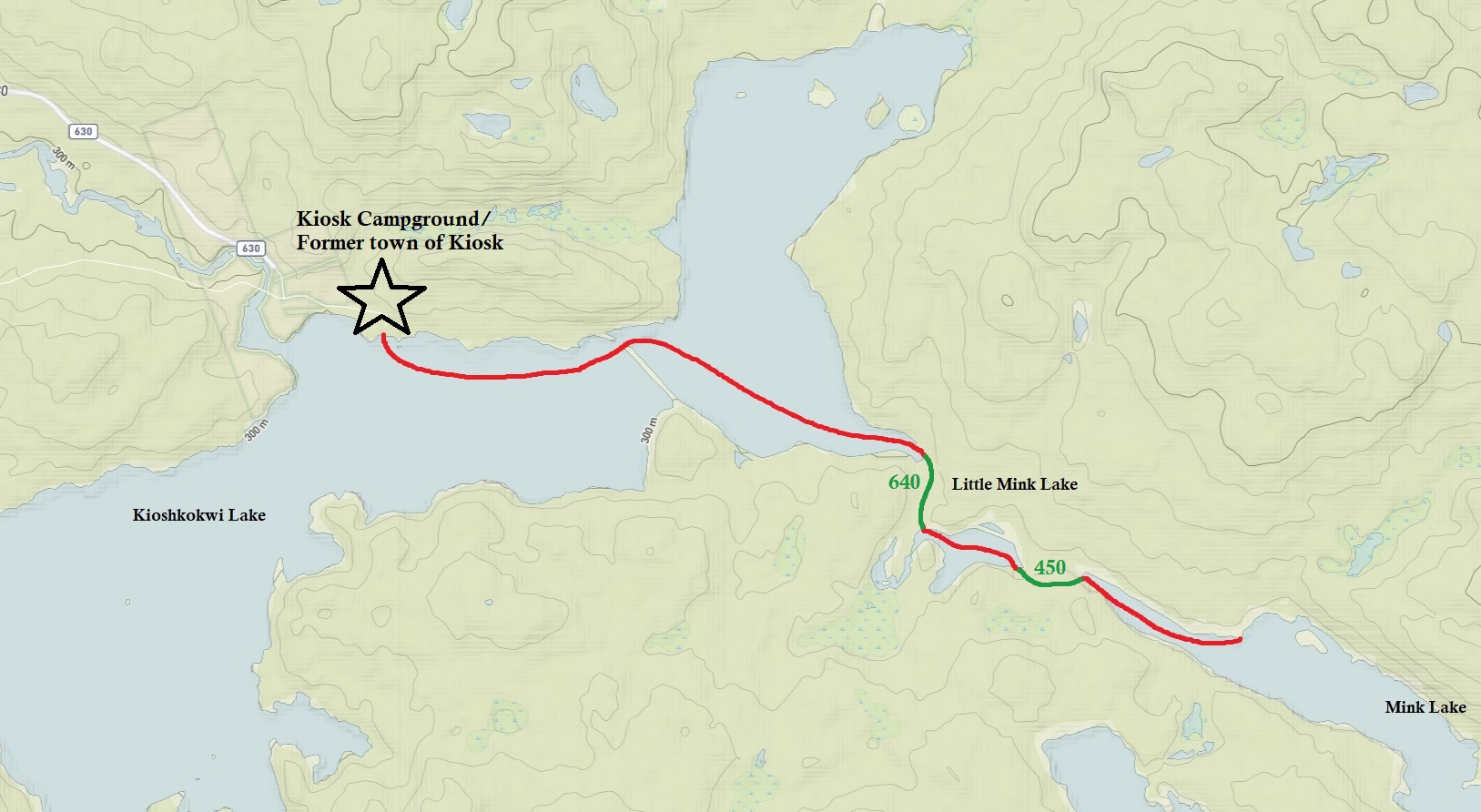
DAY # 6: Mink Lake to Kiosk
Weather: Sunny. High: 6C
topoView USGS. (click image to enlarge)
We didn’t sleep well last night because we were leaving today, and of course emotions are mixed as we don’t want to leave but at the same time we were getting pretty antsy being this close to the launch and not wanting to get wind bound.
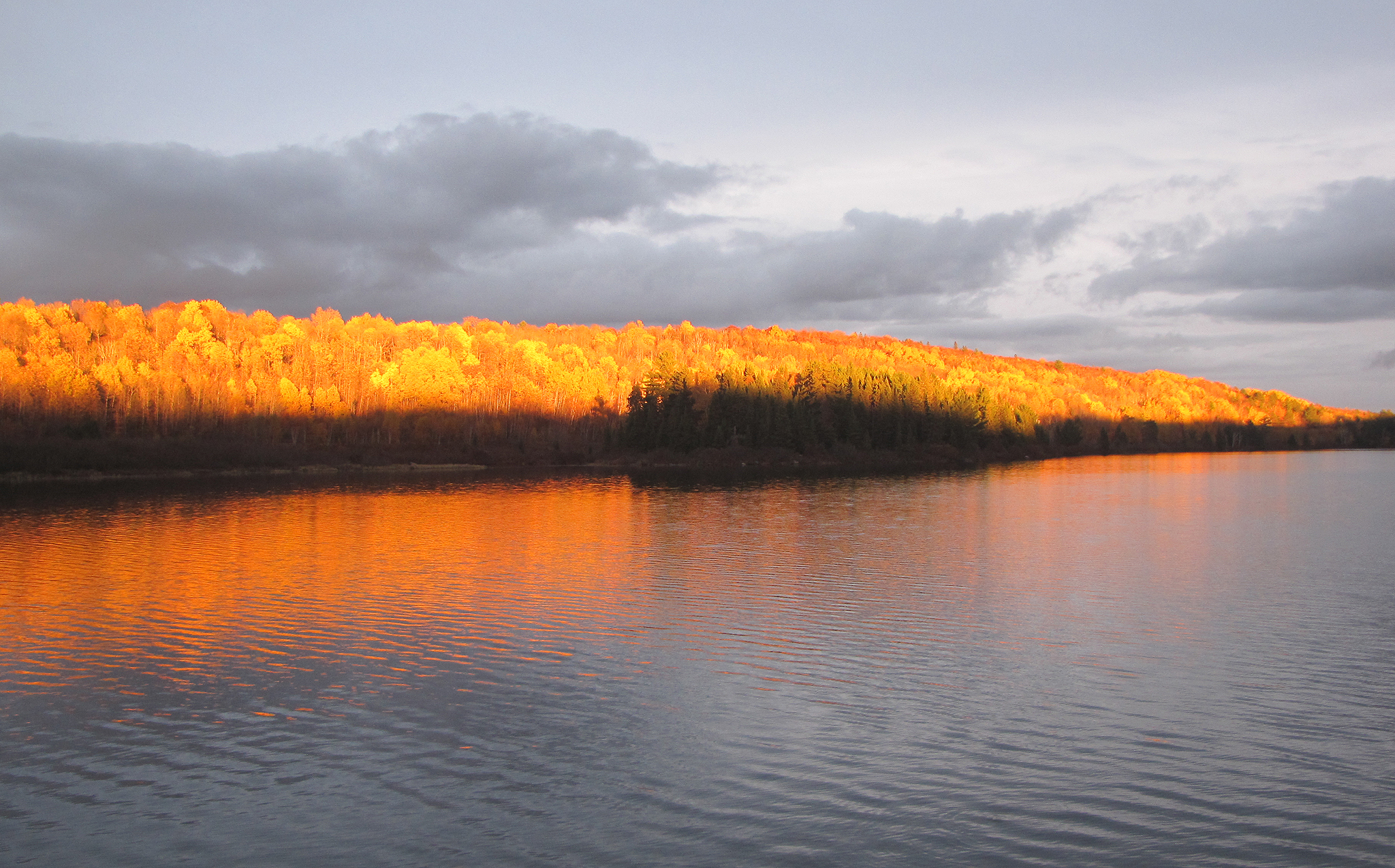
We paddled to the western end of Mink Lake and after a 450 metre from Mink Lake to Little Mink Lake and a 635 metre from Little Mink Lake to Kioshkokwi Lake we finished our last two easy portages of the entire trip. As we entered Kioshkokwi Lake we were happy to see that the winds were not bad at all while the morning sun lit up the fall colours all around us. We wished we could stay out a few more days and our strokes slowed down a bit to soak in as much as we could before arriving back at the Kiosk campground.
It turned out that fall is definitely our favourite time of year to backcountry camp! You don’t sweat as much, there are less bugs, and you can have a more leisurely paddle instead of racing to campsites like you may have to in the summer. In fact, on this whole trip we didn’t see one site occupied! It felt like the whole park was ours! We will be back Algonquin!
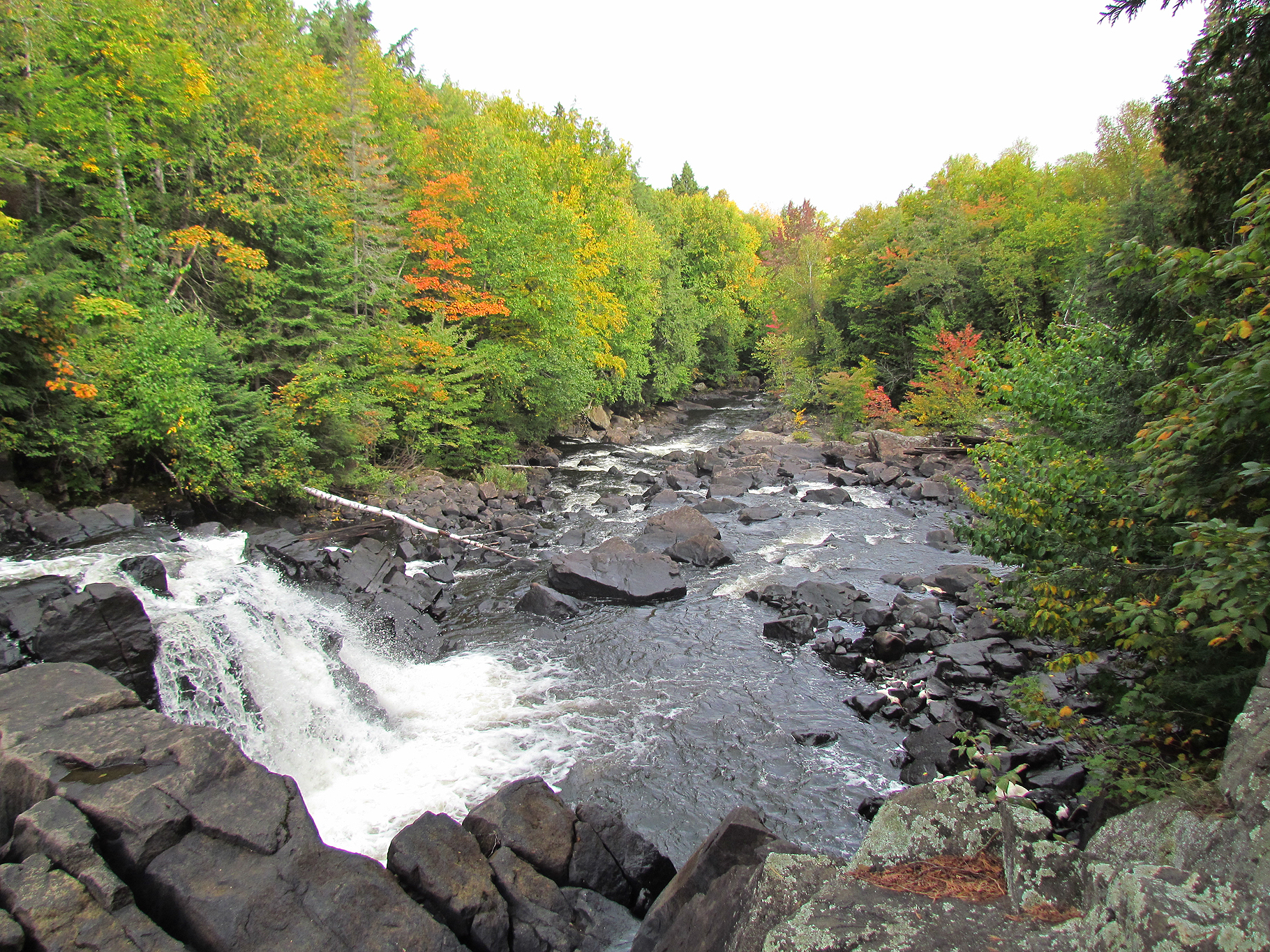
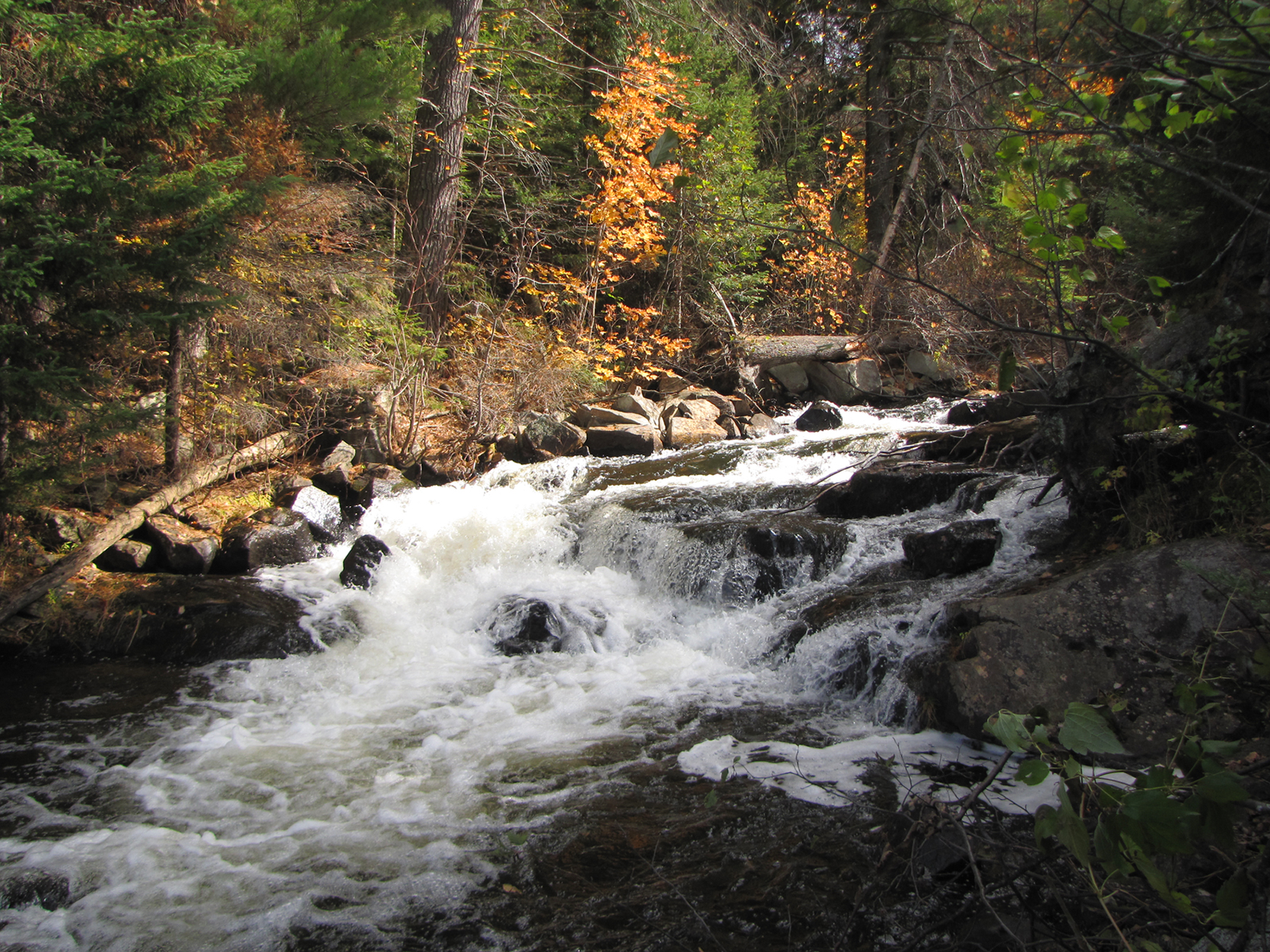
Rapids along Maple Creek. (click image to enlarge)
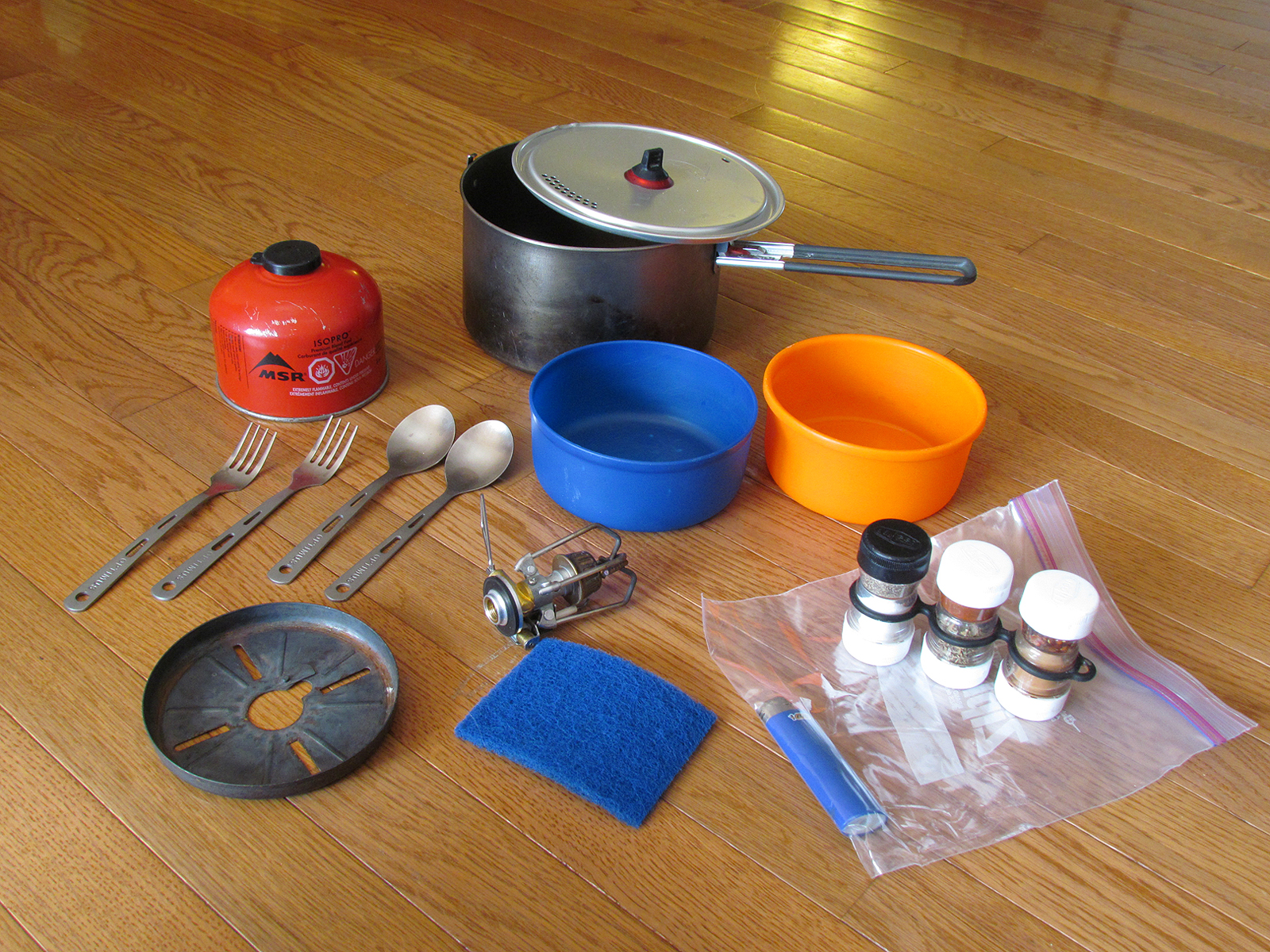
All of our cookware conveniently fits into the handled pot. (click image to Enlarge)
When we first started backcountry camping we barely owned any gear. Before our very first trip we bought a lot of stuff including items we regret purchasing. Since then we have made a lot of changes in what gets stuffed into our backpacks. Our number one goal is to bring as little as possible and yet remain comfortable both physically (like a moisture wicking polyester shirt for those sweaty portages) and mentally (like a deck of cards for a rainy day). We are by no means minimalists though we do find that the fewer items you lug along, the smoother the trip goes.
Here is a list of what we currently bring for a week long trip:
Backpacks (2), rain covers for packs (2), Tent, Ground sheet, Tent pegs (12), Sleeping Bags (2), Sleeping bag sheets (2), Self inflating sleeping pads (2), Patch kit and valve kit for sleeping pads, Tarp, Cooking stove (2), Pot Gripper, Fry pan, Wind shield for stove, Fuel (3), Water Filter, Maintenance kit for water filter, Water purifying tablets (6 per day minimum), First Aid Kit (2), Spare shoe laces (2), Headlamps (2), Small flashlight, AAA batteries (8), 4L Water bladder, 1L water bottles (2), Small bottle of camp suds, PFDs (2), Whistle attached to PFD (2), Paddles (2), Collapsible saw, Multi tool (2), 6″Hunting Knife (2), Birthcontrol, Stool Softeners, Inhalers, Ibuprophen, Compass (2), Watch, Thermometer, Paddling Gloves (2 pairs), Map of area (at least 2 different copies if available), Waterproof map case, GPS (plus extra lithium ion AA batteries), Dry bags (2 for clothes, 2 for sleeping bags, 2 for self inflating sleeping pads, 1 for tiolet paper), Pot with lid, Pot scrubber, Bowls (2), Fork (2), Spoon (2), Pot scrubber, Sunscreen, Tooth brush (2), Container for toothbrush (2), Toothpaste, Mouthwash, Compact binoculars, Rope (pack hanging rope with hook + 50 foot nylon rope), Hats (2), Amphibious shoes (2), Rain gear (pants and jacket), Towels (2), Toilet Paper (2 double rolls), Camping log book with 2 pens, food (freeze dried, dehydrated, bars), Spice rack (salt, pepper, cinnamon, paprika, red pepper flakes, oregano), Olive Oil, Brown sugar, Block of Parmesean cheese, Pack of beef jerky, Tea (24 tea bags), Gatoraid, Garbage bags (to wrap food in), Hiking boots (2), Bug spray, Bear Repellent (2), Bear Bells (2), Bug net (2), Bug jacket (2 if needed), Lighters (3), Waterproof matches (2), Magnesium flints (2), Duct tape (4 small rolls), Sunglasses (2), Weather Radio, Waterproof case (for cellphones, batteries etc.), Camera, Camera bag with plastic bag to cover it, Mini SAS survival guide, Mini playing cards, and mini Uno.
When we split up all these items between two packs we always keep in mind the “what if” situation, mainly if our canoe flips and one of our pack gets washed away never to be seen again. That is why each pack has a canister of fuel and a stove. Each pack also has a first aid kit, a magnesium flint, waterproof matches, and of course each pack has a map and a compass. We obviously don’t bring two tents, so one pack has the tent while the other has a tarp that could be used as a shelter.
Clothing
For a seven day trip in the fall, here is what we generally bring for clothes:
4 to 5 pairs of underwear, 2 pairs of polyester pants, 1 pair of shorts (if forecast requires), 3 pairs of socks, 2 polyester t-shirts, 1 lightweight polyester long sleeve, 2 mid weight polyester long sleeve, 1 warm fleece/hoodie.
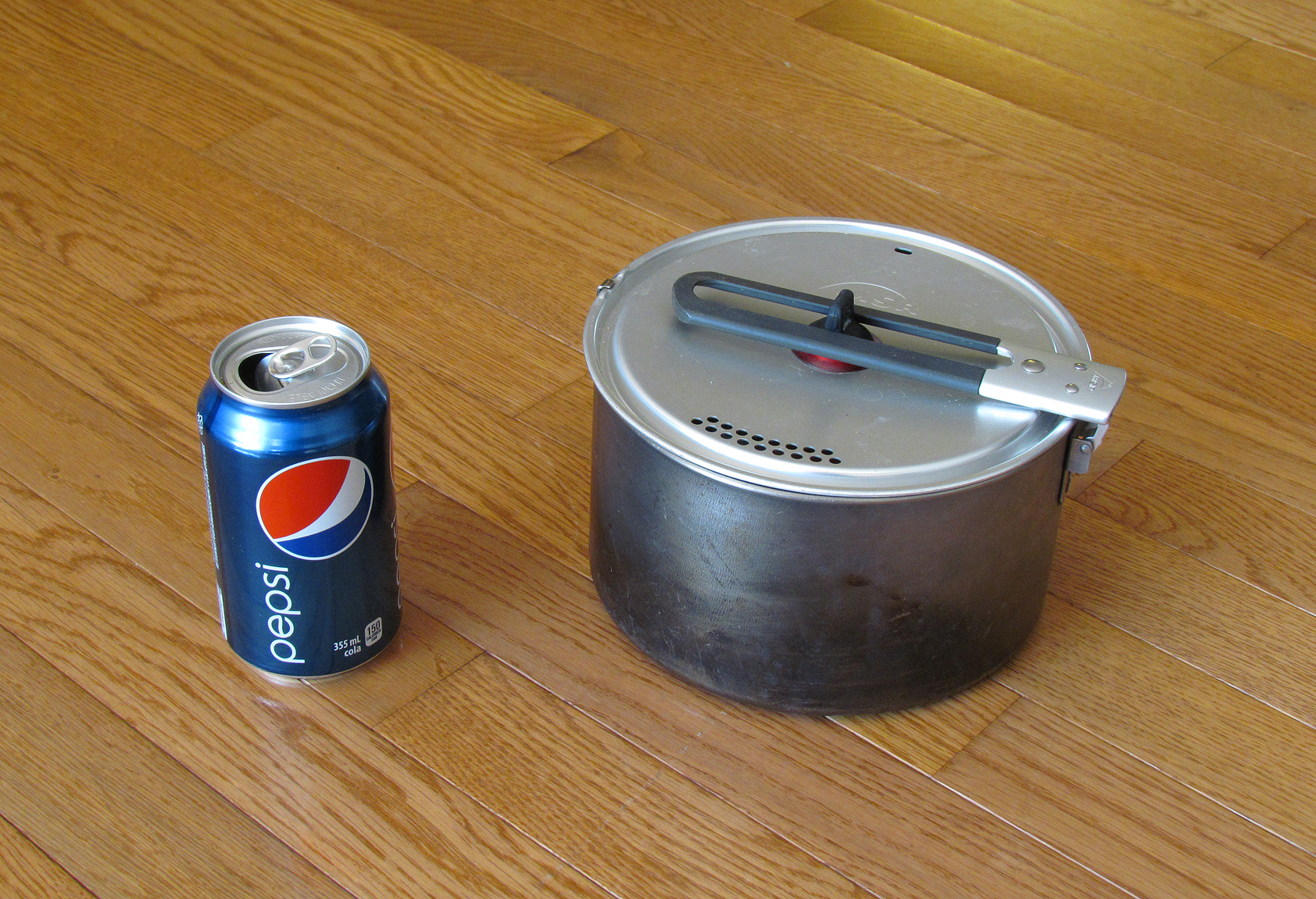
When we stuff it all in it pays to be creative so it takes up less space in your pack while still being able to access related items relatively easy. For example, here is our kitchen set (with a pop can for size comparison) that we always place at the bottom compartment of our pack for easy access.
Yup that’s it! But when you open it up you can clearly see everything is neatly placed inside.
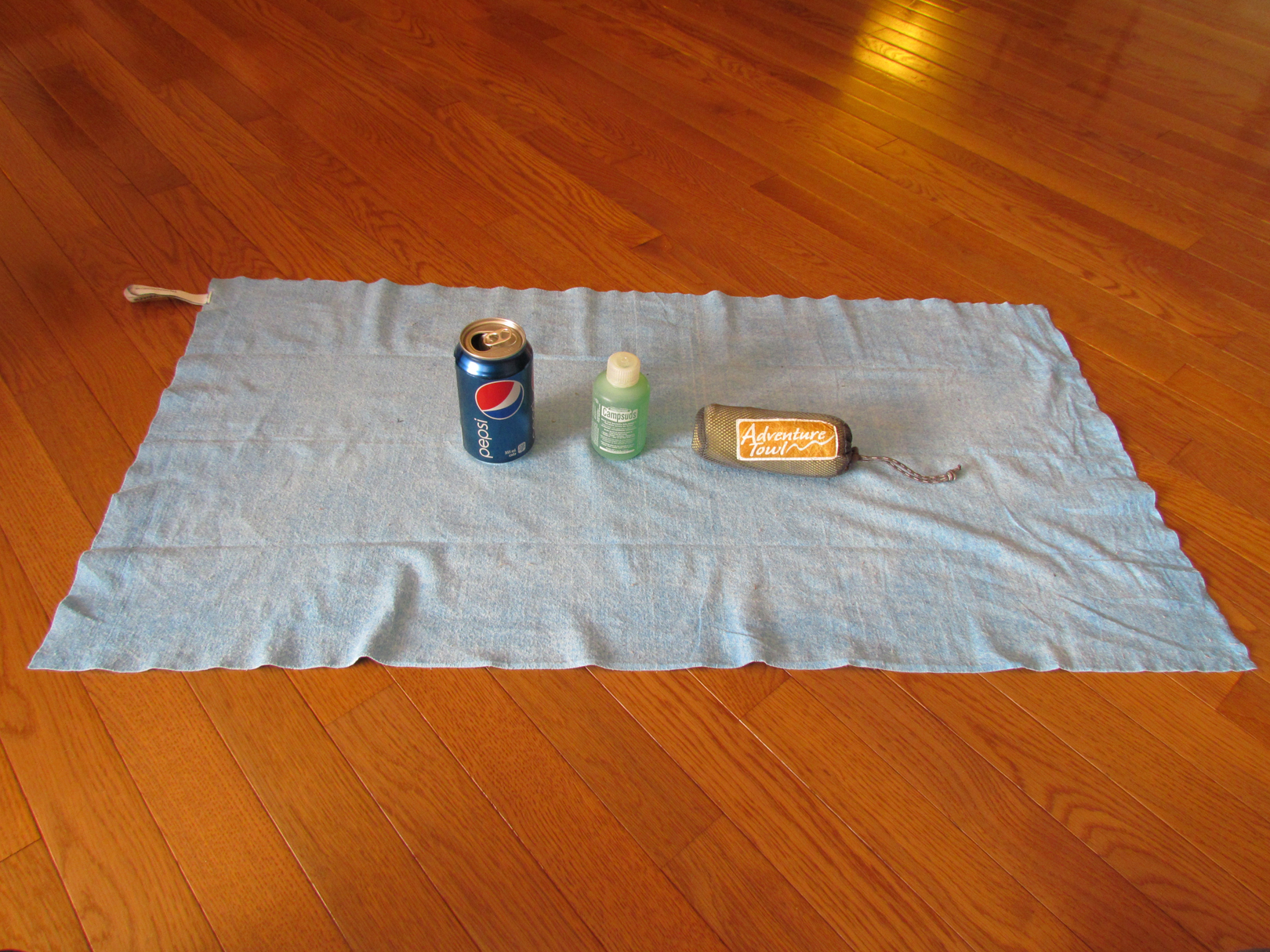
Here is what we bring to bath (with a pop can for size comparison)
The Little Things
We find we have to bring a few things to give us emotional comfort sometimes. These are the items for mental well being rather than physical aid.
TEA: We bring tea rather than coffee. Our tea of choice right now is Twinnings Black Irish Breakfast Tea. This beverage definitely warms you up on those cold mornings, earning it the nickname “Morale Tea”.
DECK OF CARDS: Either a plain ol’ deck of cards or UNO. Both are available in a mini size to take up less room in our packs. Cards are great for a rainy day in the tent. Rainy days are also those days we write in our camping journal, look at a map, or read the mini copy of the SAS Survival Guide. Some Ontario Parks also offer you a newspaper which is also great for those rainy days.
CAMPING JOURNAL: If you don’t write it down you will have a hard time remembering your adventures, or making a blog about it for that matter.
MOUTHWASH: We bring just enough for the trip. For some reason we get pretty bad breath out in the backcountry. Mouthwash is of course only temporary but it is another one of those mental comforts.
SOLAR POWERED WINDUP RADIO: This is probably first, if not second on the list after the camping journal for the top mental comforts. We like to get the local weather band so we know what the forecast may bring (which is NOT always accurate). We also like to see what local radio stations we can get in. A lot of people go back country camping without a radio, but for some reason this has become habit for us.
What We Don’t Bring
HATCHET/AXE: A lot of people swear by bringing a hatchet or lugging an axe around. We find that a collapsible saw takes up less room in a pack…and is safer.
CAMPING PILLOWS: Sure they are smaller than your average pillow and many are compressible, but your clothes bag can be turned into a pillow while being tucked under your sleeping bag.
CAMPING CHAIR: Though not advisable, we often sit on our PFDs while at camp.
HYDRATION PACK: Someone asked us once if we bring these while camping. I have no idea how we would even wear one when you already have a 60 pound pack on your back with a water bottle conveniently clipped to it.
HAMMOCK: Perhaps if we were stationed for a week somewhere we may bring a hammock, but for now it is not on our list of essentials to bring.
MOSQUITO SHELTER: We have learned the hard way to stay out of the woods in Ontario in June. That’s why most of our camping trips are in late summer, or better yet, in the fall. Bug nets over the head and some bug repellent does the trick.
There is really no right or wrong way to pack all your gear. If anything there is a smart and comfortable way and you just have to figure out what works best for you.
Frontenac is a semi wilderness park located north of the city of Kingston in the province of Ontario. The park includes your typical features that make up the lower Canadian Shield such as white pine, birch, beaver dams and the ever present “trees and rocks and rocks and trees”.
This was a spur of the moment trip during the Easter long weekend. We both had the Friday off so we quickly went through all our gear (1st mistake), grabbed what we thought we needed (2nd mistake), and threw a bunch of stuff in the car (third mistake).
So what were the mistakes that we made?
Mistake #1: “We quickly went through our gear”. This is not a good idea. Luckily this was not a backcountry camping trip but just a long weekend trip. We didn’t take inventory of our gear or even test it out to make sure everything worked. Most of our gear is pretty brand new so it should be in working order…….right?
Mistake #2: “We grabbed what we thought we needed”. Again we assumed everything was in our gear container so why make a list of what you think you need……right?
Mistake #3: “We threw a bunch of stuff in the car”. Just frantically grabbed clothes, extra hiking shoes etc. etc. Everything else for a road trip should already be in the car (road map, windshield washer fluid, plastic bag for garbage…..or vomit….)…..right?……right?
…wrong………
On April 1st we were on highway 401 and drove all the way to Kingston to stay overnight in a motel. It was only the beginning of spring so there was still some standing snow present. By the next day we arrived at the gates of Frontenac Provincial Park around 11:00am and found it unusually warm and sunny. It actually got up to 23 Celsius, and being the first big warm up of the year it felt HOT! Not only that but we were over dressed, or at least Marianne was. Unfortunately, we also forgot to pack sunscreen (refer to Mistake #2). Marianne not wanting to get a sunburn, wore her hoodie while we hiked the Slide Lake Loop Trail. This trail, at 21 kilometres, had our reserved campsite almost halfway down its length. Our plan was to get to our campsite before dinner and then complete the trail the next day which were to include a scenic view of a gorge and a series of waterfalls.
Aaron playing along the trail. (click image to enlarge)
Walking down the trail we observed a few species of herptiles, some perhaps making their first appearance this spring such as Spring Peepers, Leopard Frogs, and four Garter Snakes. We also saw three White-tailed Deer, Red Squirrels, Eastern Chipmunks, Canada Geese, Wood Ducks, American Robins, Northern Ravens, Black-capped Chickadees, White-breasted Nuthatch, Golden-crowned Kinglets, and a Red-shouldered Hawk.
Our campsite was located at Site #4 which had four spots (labelled A-D). Our campsite was 4C, but clearly someone was already there (probably not even using the park’s reservation system. We did see an unoccupied site so we took our chance there. Soon it was time to pump water and ready the stove for supper. One problem…we forgot to pack our water pump (refer to Mistake #2). Luckily we didn’t forget a lighter so we had to boil our water to make our supper. Not a big deal but it kind of made you feel unprepared (and a little stupid).
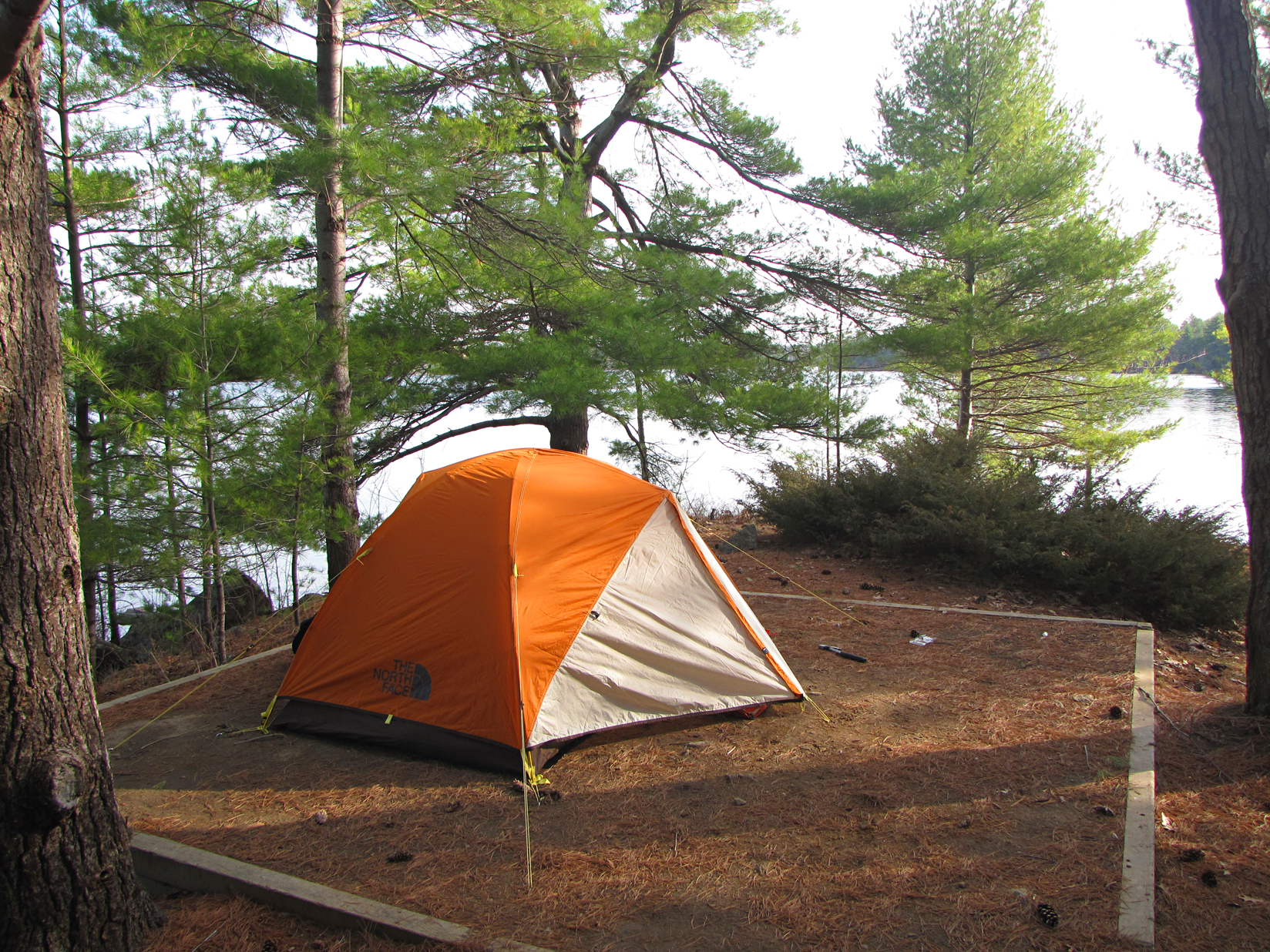
Our site. (click image to enlarge)
After setting up camp it was time to relax for the evening. We looked forward to tomorrow’s hike and some great photo opportunities.
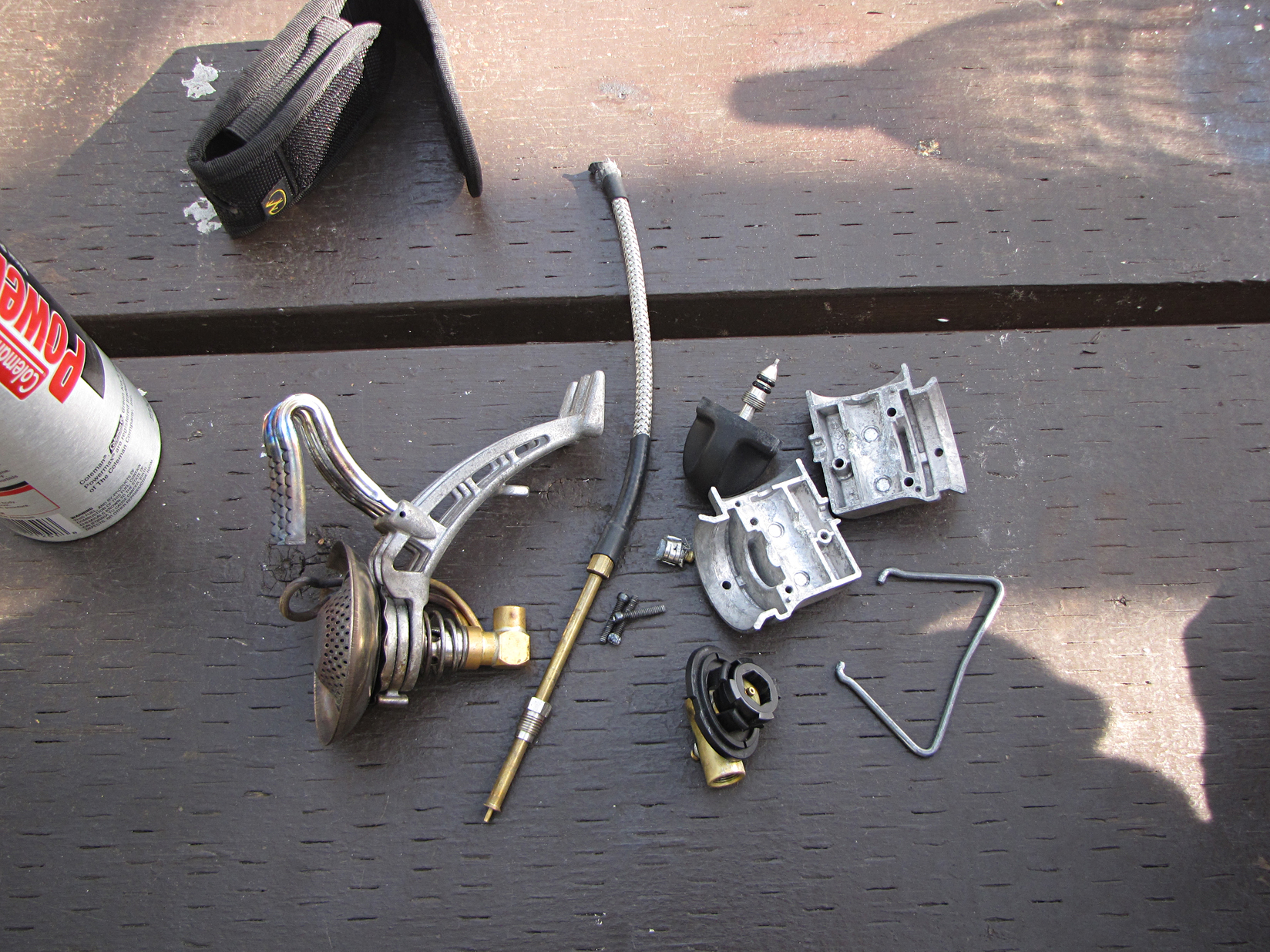
The next day we were ready to go exploring!! We took out our homemade breakfast that included granola, dehydrated strawberries and bananas, along with some powdered milk. Of course we had to boil our water again, but now we had an even bigger problem….our camping stove broke! (refer to Mistake #1). Now we had no stove and no clean water. We ended up using what we had left in our water bottles to add to our breakfast which didn’t taste that great cold. More importantly we were faced with a decision…….Do we finish the rest of the loop, or take the shortcut back to the car? We now didn’t have a stove to boil water, or a pump to clean water, and we forgot to even pack snacks for in the car (refer to Mistake #3). In the end we decided to begin the hike back to the car and go home defeated.
Our now broken stove. (click image to enlarge)
Around the halfway point back down the trail Marianne was getting a headache. Luckily we didn’t forget Tylenol and she took a couple with only a sip of water on an empty stomach.
We finally reached the car, packed our stuff in the trunk, and we were soon on our way down the winding road from the park gates. Before long Marianne was not feeling well, but this time she felt incredibly nauseous and dizzy. We didn’t have a plastic bag in the car (refer to Mistake #3) and Aaron had to pull over so Marianne could fall on her knees and puke up the dissolved Tylenol. After a few dehydrated apples and some more water, she felt 100% better.
So that was it! That was our long weekend camping trip! We still relatively enjoyed it, but it just goes to show how a spur of the moment decision can sometimes be a bad thing. We did learn a few things, such as to make a camping list, check it over before we go, along with checking our gear to make sure everything works. Since our trip to Frontenac Provincial Park we bought two camping stoves so we have a backup if one breaks.
Quetico Provincial Park with a rough outline of our planned route. (click image to enlarge)
Planned Route
Total Days: 5.5 days
Total Kilometres: 98 kilometres
Total Portages: 25
Total Length of Portages: approx. 7.768 kilometres
Longest Portage: 705 metres (Maria Lake to Jessie Lake)
Route: Nym Lake – Batchewaung Lake – Little Batchewaung Bay – Maria Lake – Jesse Lake – Oriana Lake – Quetico Lake – Conk Lake – Jean Lake – Burnside Lake – Rouge Lake – Sturgeon Lake – Lonely Lake – Walter Lake – Elizabeth Lake – Jesse Lake – Maria Lake – Batchewaung Bay – Little Batchewaung Bay – Batchewaung Lake – Nym Lake
Actual Route
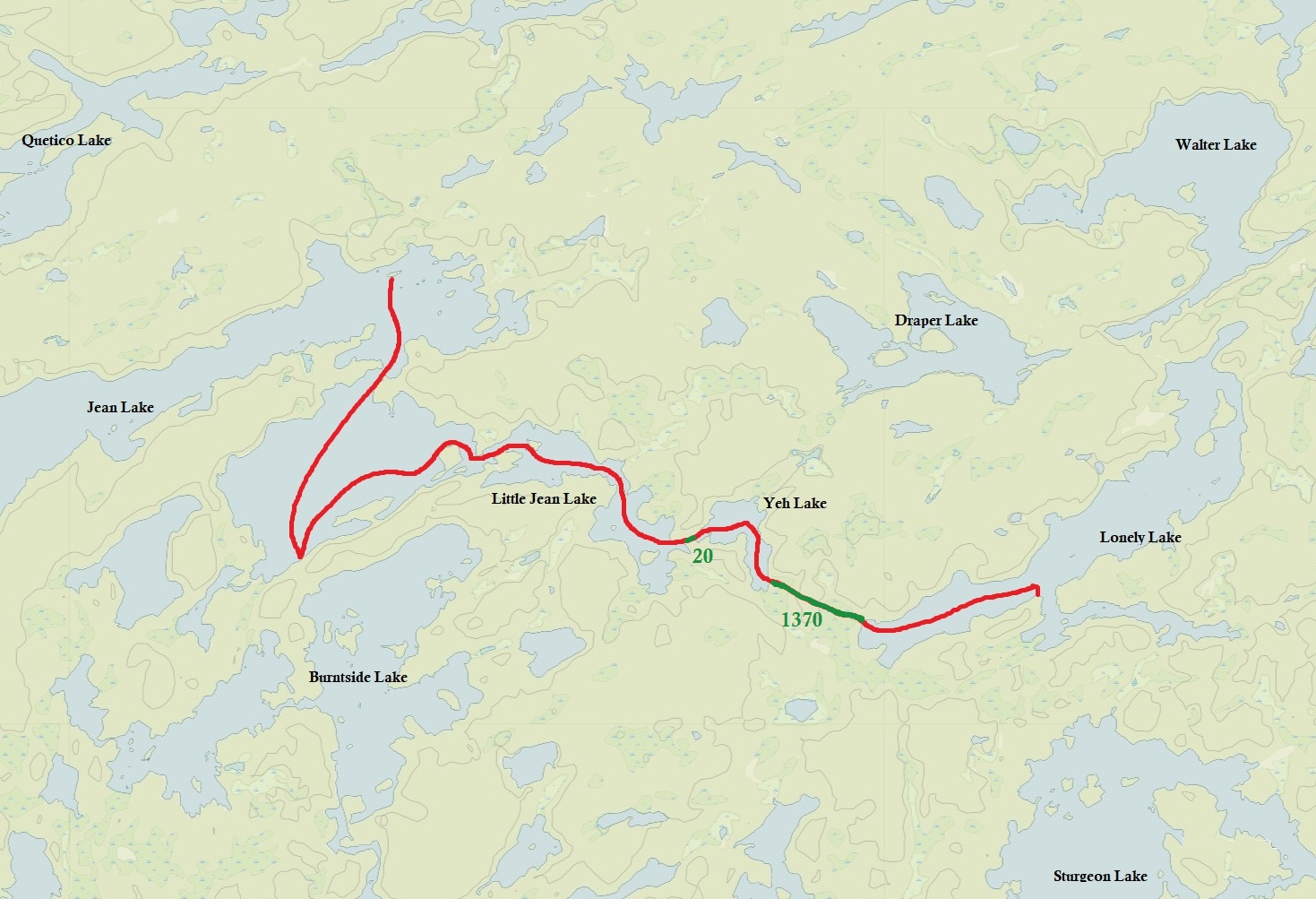
Total Days: 4.5
Total Kilometres: 79 kilometres
Total Portages: 20
Total Length of Portages: 7.807 kilometres
Longest Portage: 1.425 kilometres (Yeh Lake to Lonely Lake)
Route: Nym Lake – Batchewaung Lake – Little Batchewaung Bay – Batchewaung Bay – Maria Lake – Jesse Lake – Oriana Lake – Quetico Lake – Jean Lake – Little Jean Lake – Yeh Lake – Lonely Lake – Walter Lake – Elizabeth Lake – Jesse Lake – Maria Lake – Batchewaung Bay – Little Batchewaung Bay – Batchewaung Lake – Nym Lake
Maps Used: Fisher Maps (numbers F-29, F-24, F-28)
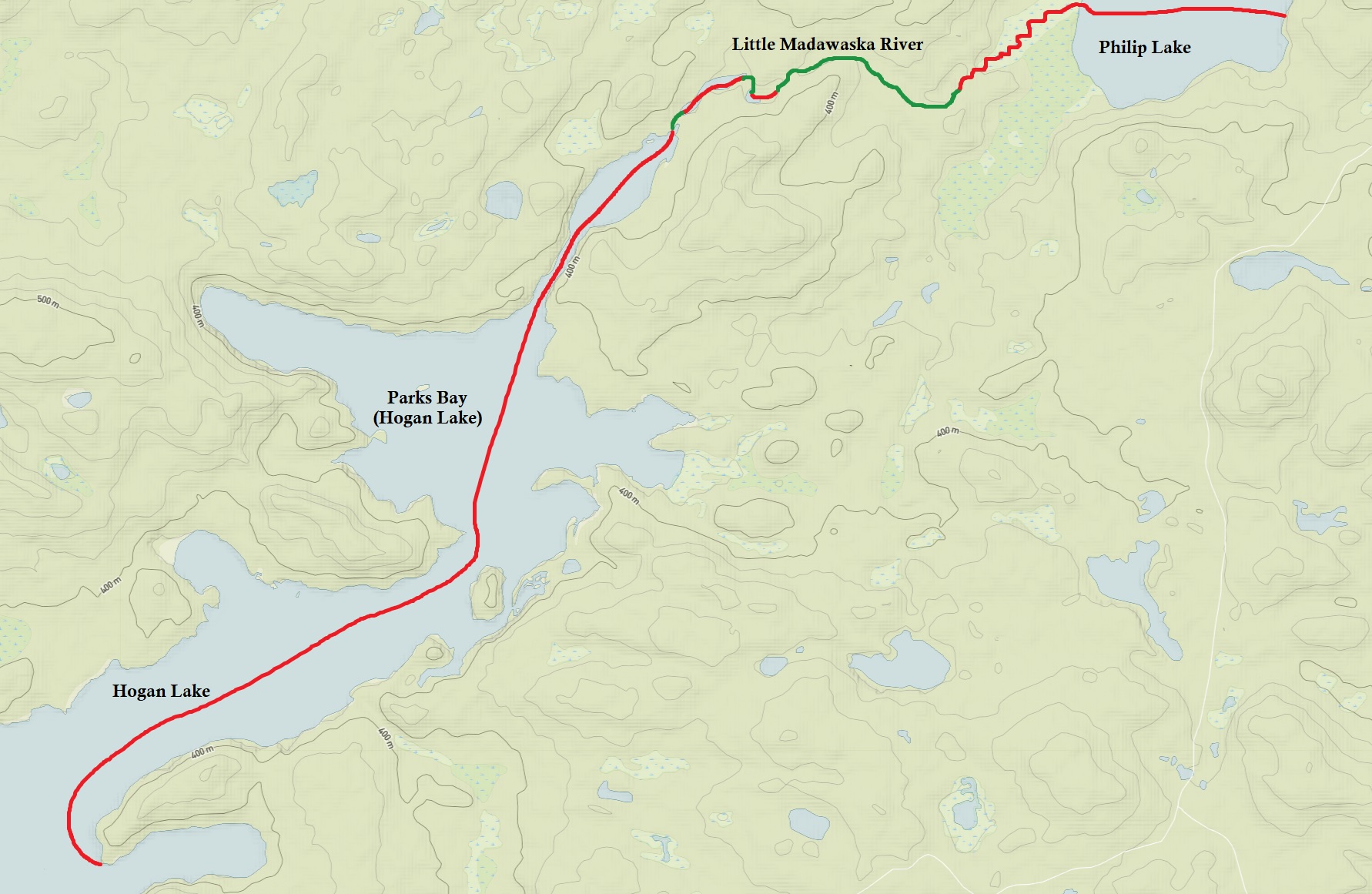
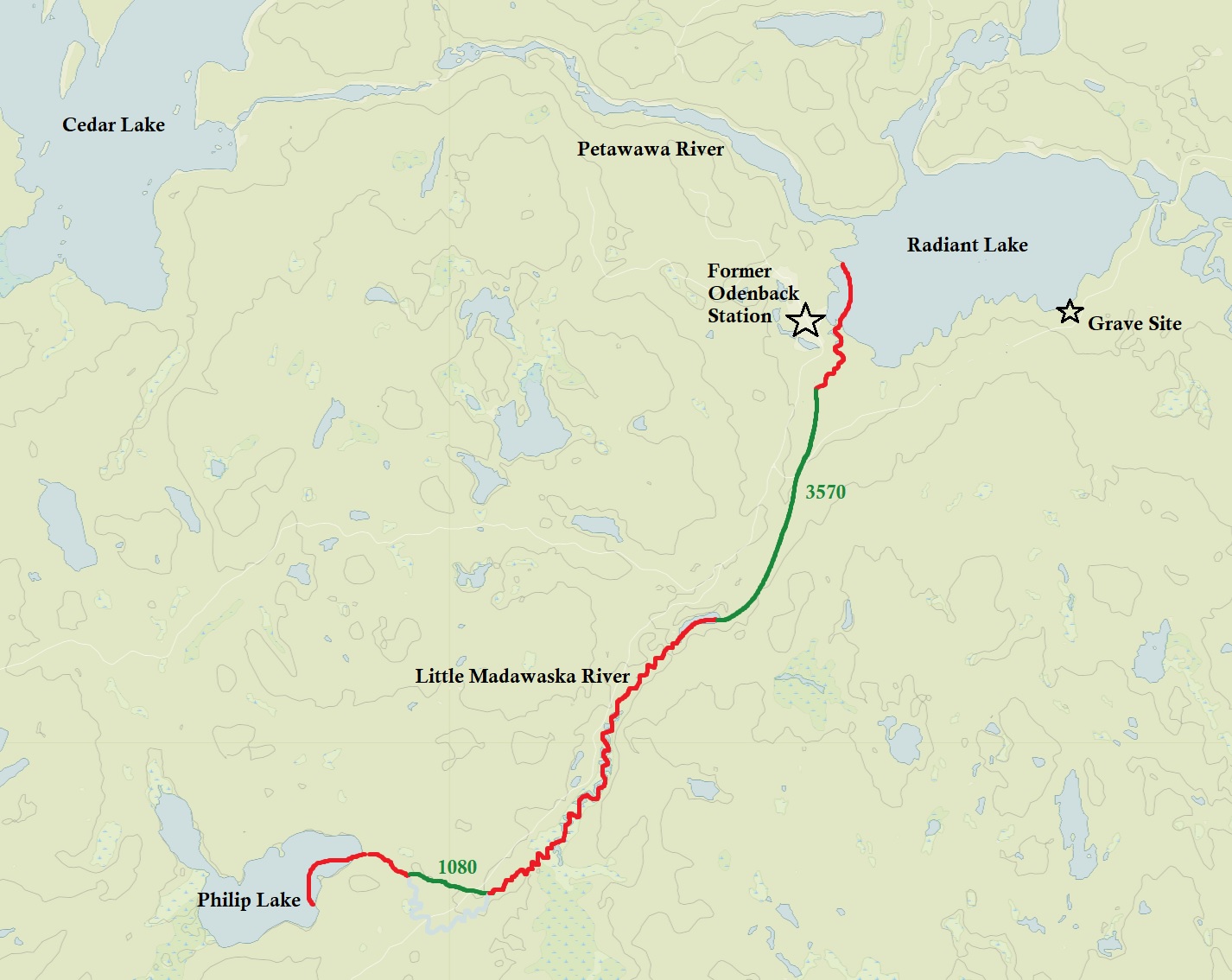
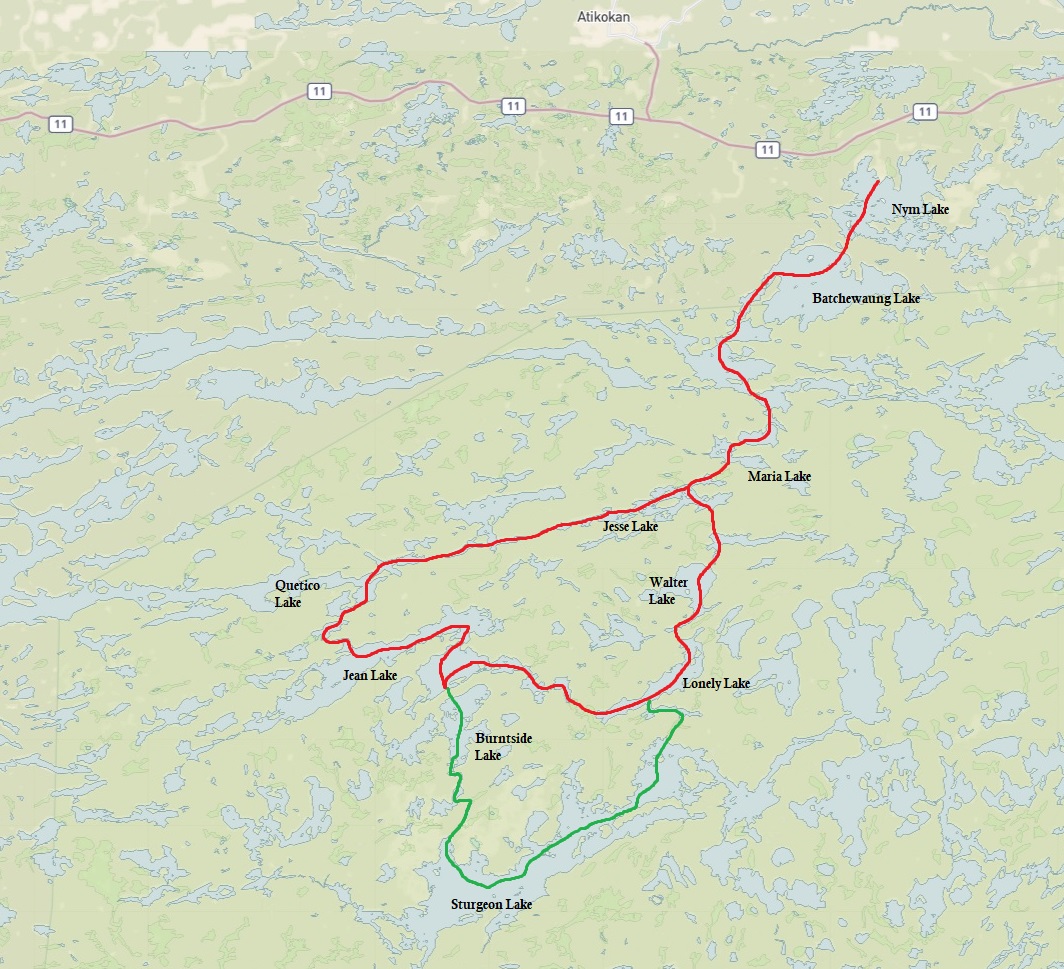
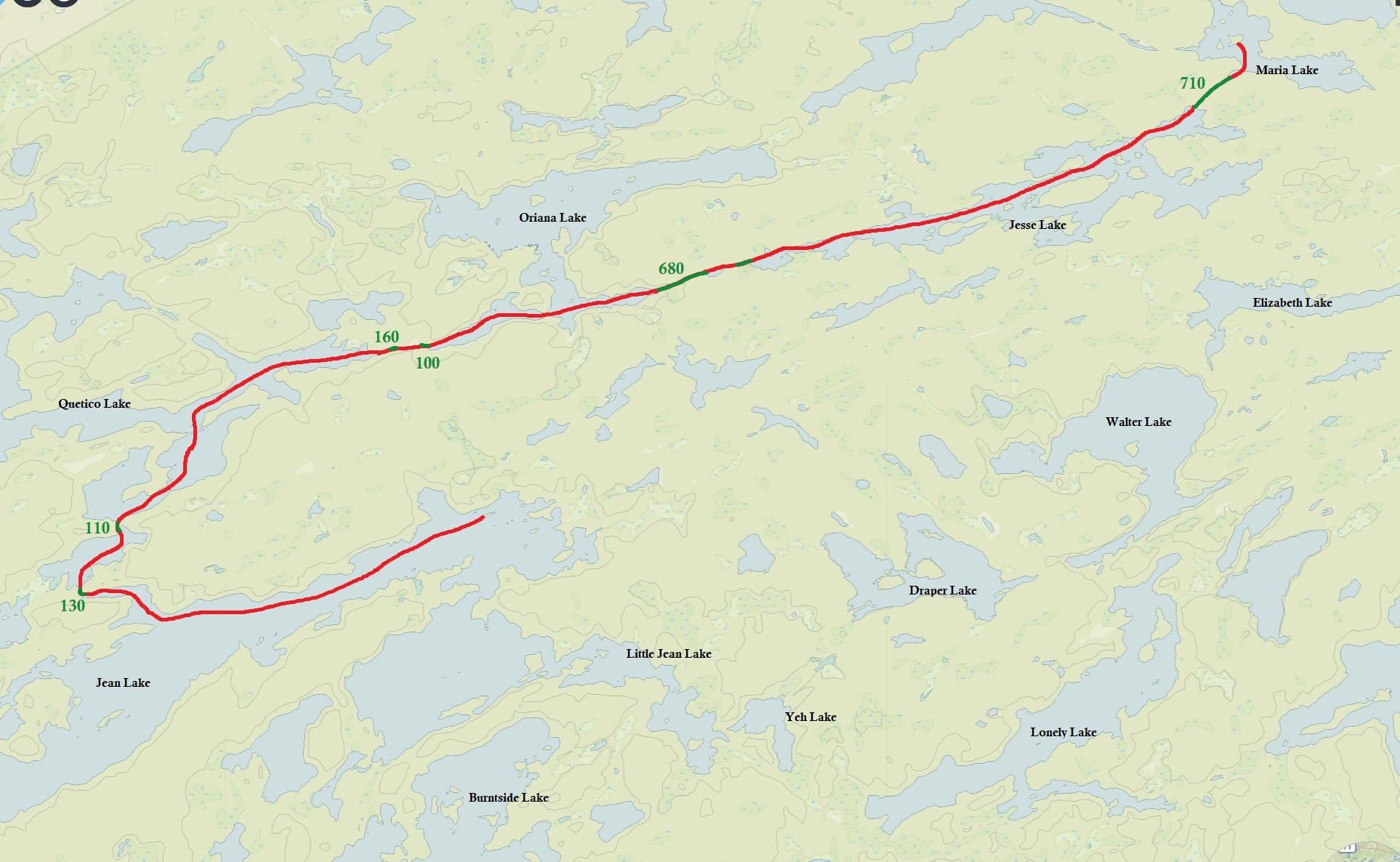
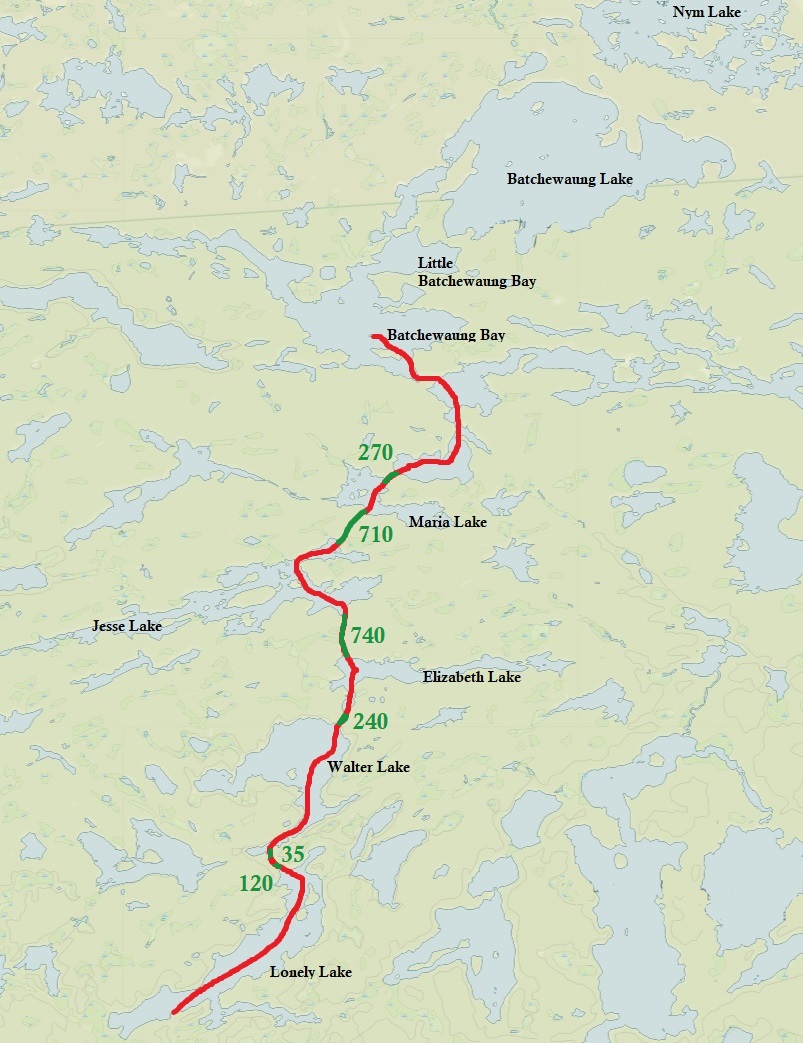
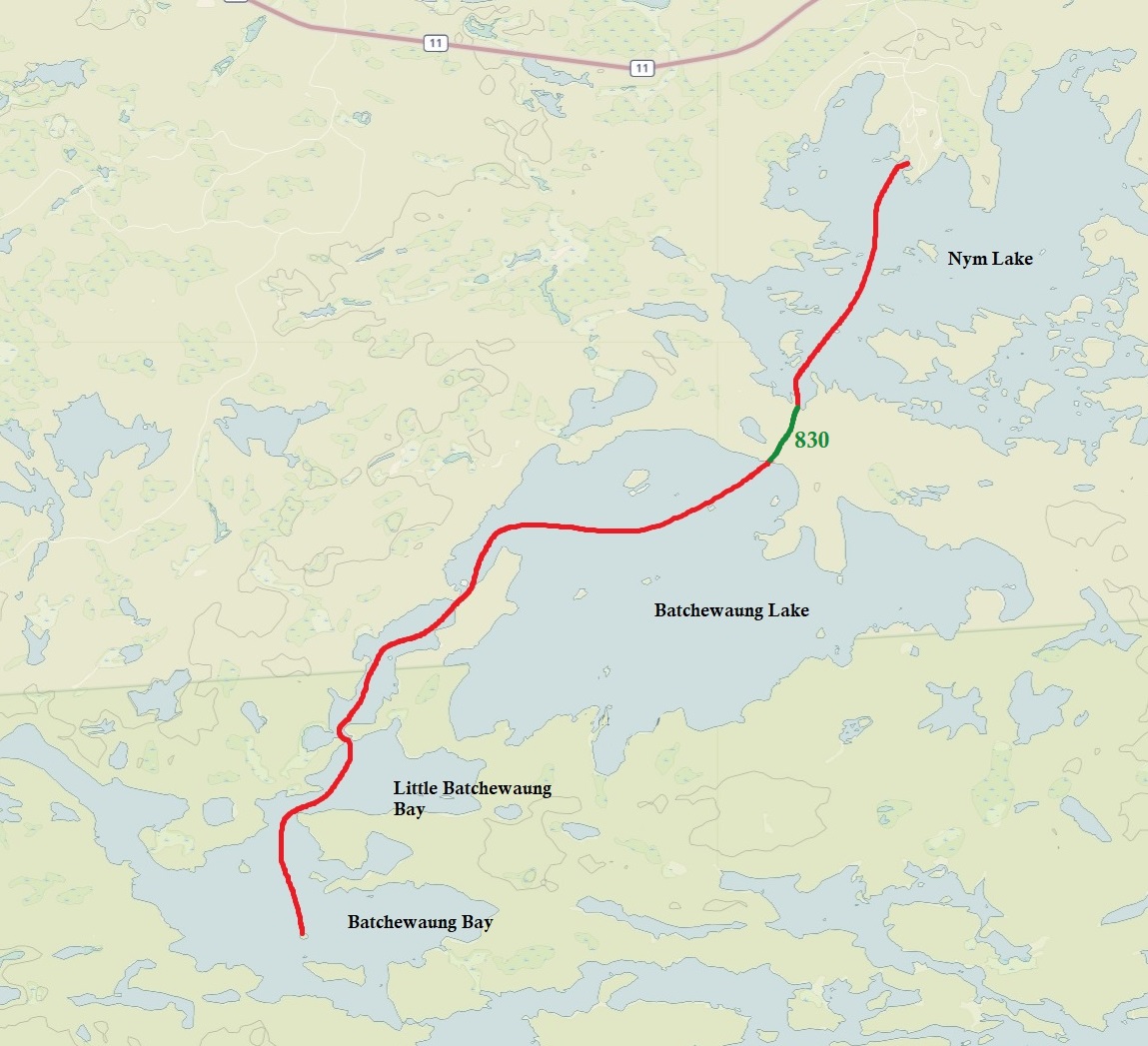
Our route. The red line represents the route we actually paddled/portaged, while the green line represents a section of our planned route we couldn’t complete. (click image to enlarge) topoView USGS.
Quetico Provincial Park is around a two and a half hour drive west from Thunder Bay, Ontario. Like Killarney Provincial Park, Quetico is set up as a “wilderness park” though unlike Killarney, there are no signs indicating portages or campsites. Back when we did our route we had to buy the Fisher Maps as those were the only maps we knew that actually indicated known campsites and labelled portages in rods. Since our trip in 2009, Chrismar has also produced a map covering Quetico with portages in metres, while the internet has tons of info including sites taken from the knowledge from other paddlers.
DAY #1: Kingsville, Ontario to Lake Superior Provincial Park, Ontario
We left just before supper on September 10th, and after a two hour nap before Sault Ste. Marie in Michigan along Interstate 75, we crossed back into Ontario and headed north on Highway 17. After a short drive we decided to pull off in Lake Superior Provincial Park for another nap until sunrise. Not an exciting time, just a lot of driving.
DAY #2: Lake Superior Provincial Park to Atikokan, Ontario
We woke up wishing we were already sleeping on the ground instead of in the car which was really uncomfortable. We continued to drive northwest on Highway 17 that included a stop for a late breakfast in Wawa, a stop to stretch our legs in Marathon, and supper in Nipigon at the Husky House. We made it to Atikokan, known as the “Canoe capital of Canada”, in the early evening and checked in at the Quetico Inn for a bed to sleep in.
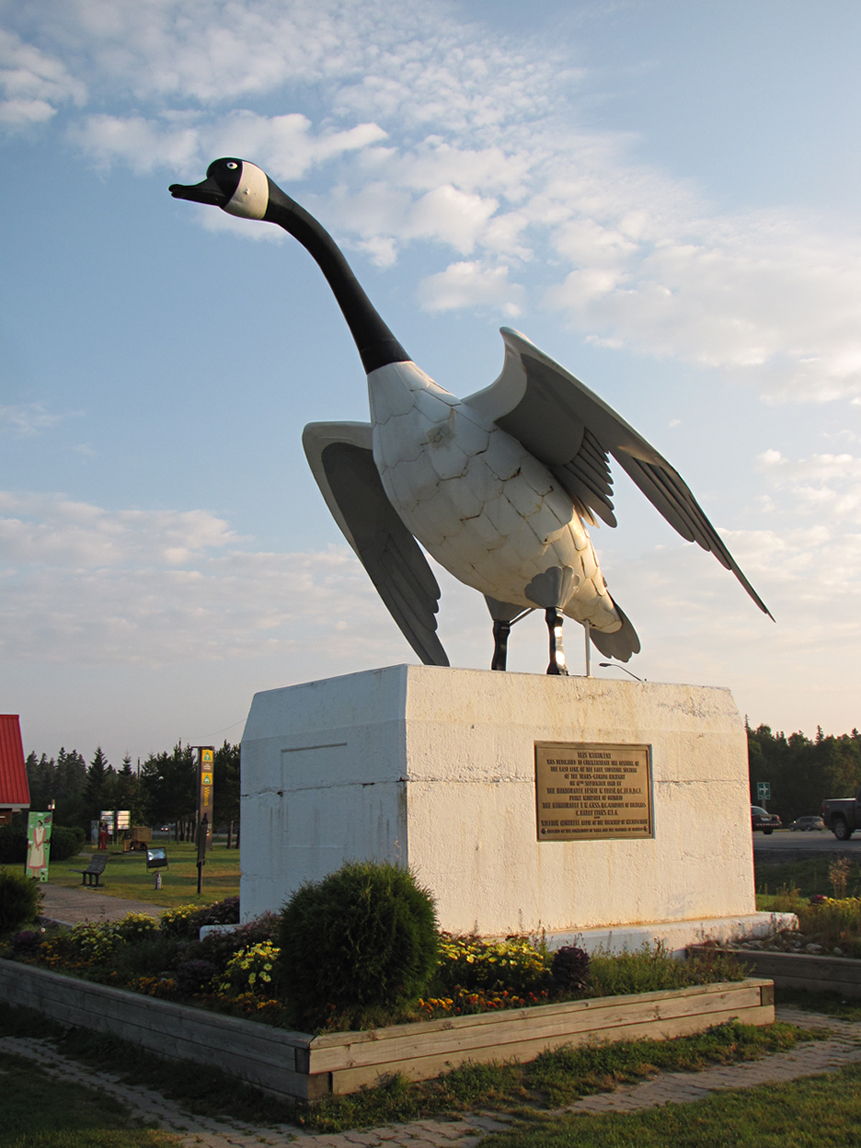
The giant Canada Goose in Wawa is worth the stop. There is a nice view as well. (click image to enlarge)
DAY #3: Nym Lake to Maria Lake
Weather:Sunny. High: 23C Low: 18C
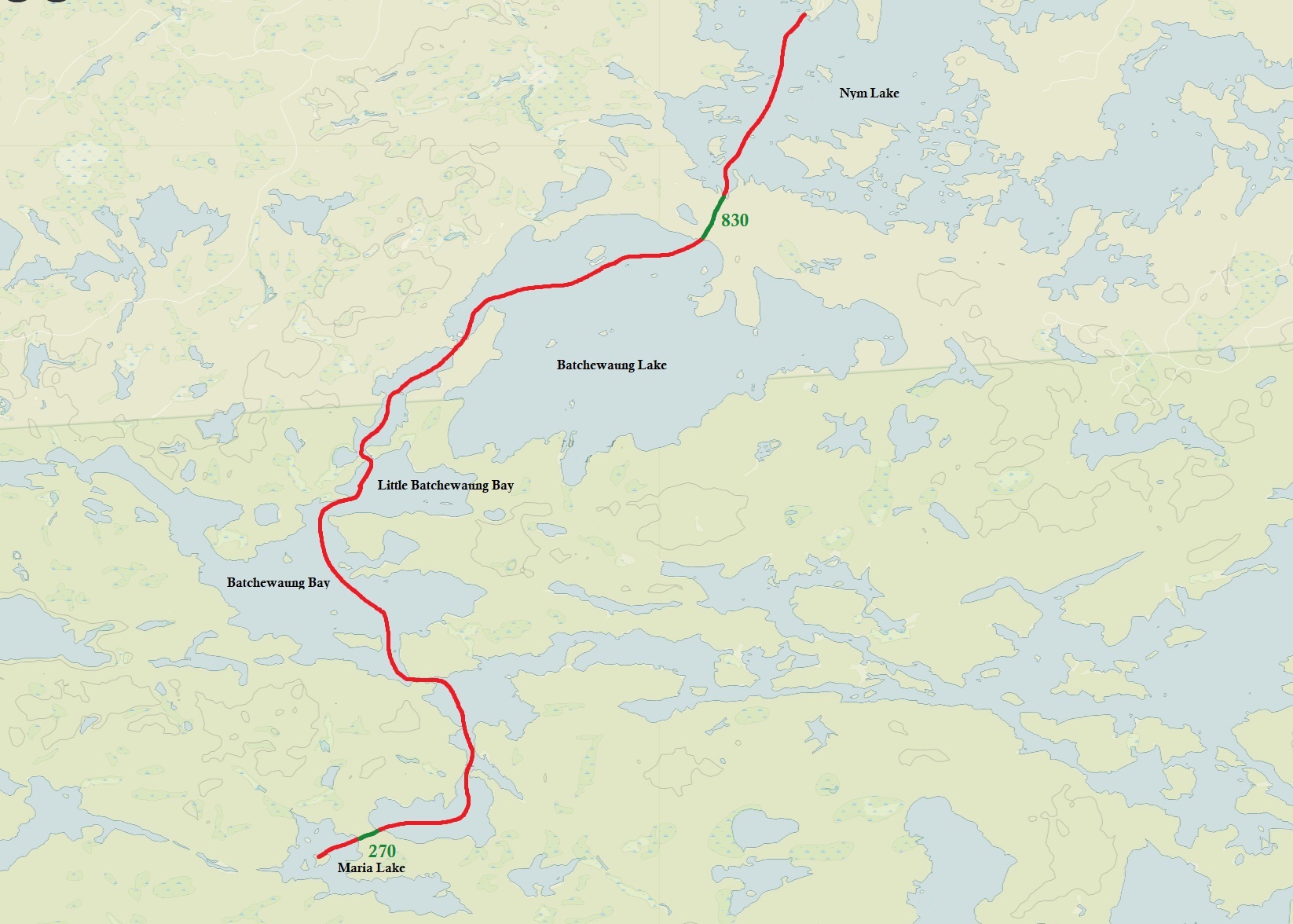
topoView USGS. (click image to enlarge)
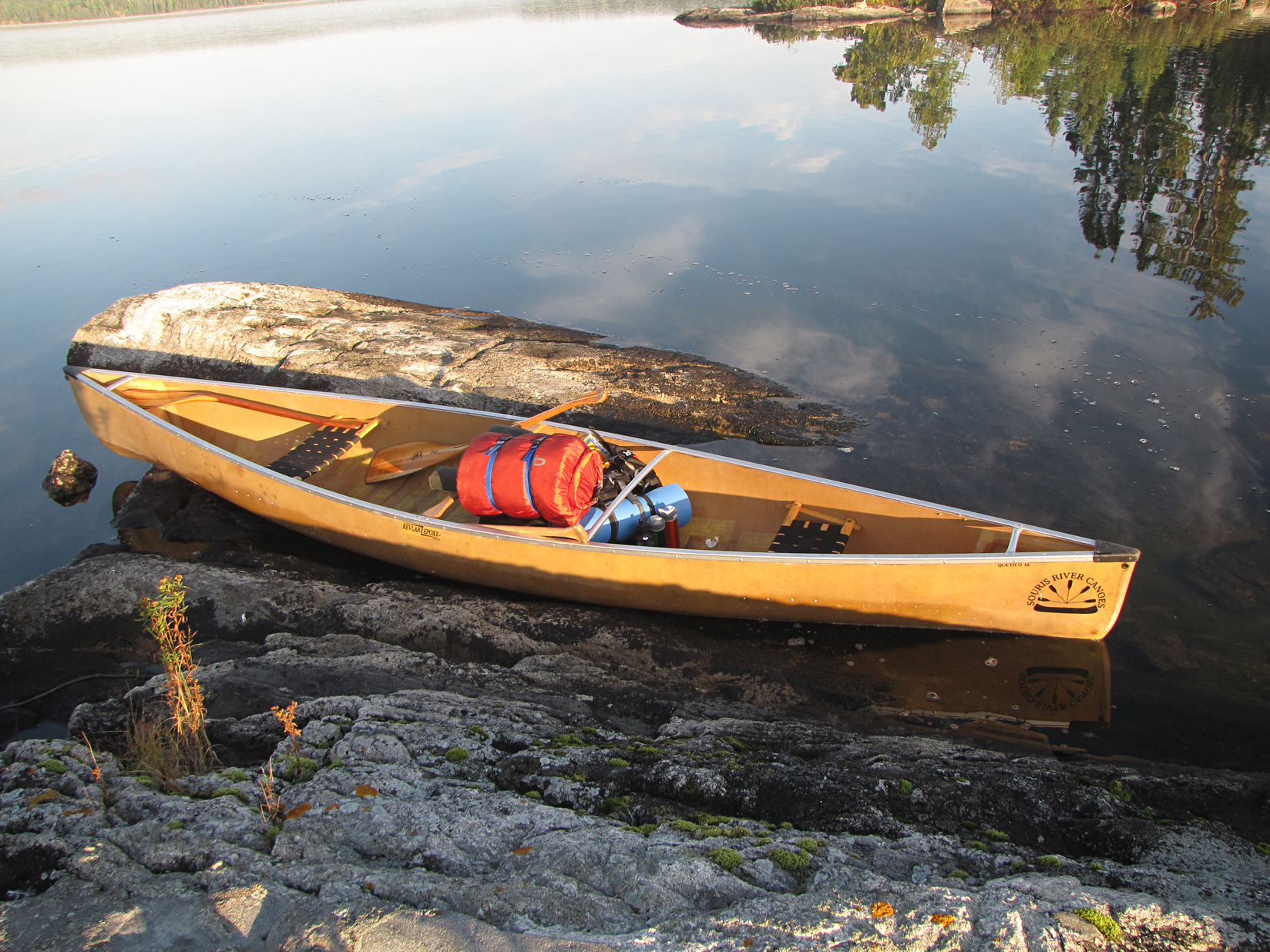
We got our permit this morning at the ranger station located in Atikokan, and also picked up our canoe. Our canoe this year is a Souris River Kevlar Quetico 16. We had it delivered to the Nym Lake launch from the outfitter which was handy.
Our canoe for this trip, a Souris River Quetico 16. (click image to enlarge)
The Nym Lake launch is not in Quetico Provincial Park. We actually had to paddle into the park, but of course nature knows no boundaries and you would never be able to tell the difference between the Crown Land and the park itself….except for the cottages on the Crown Land.
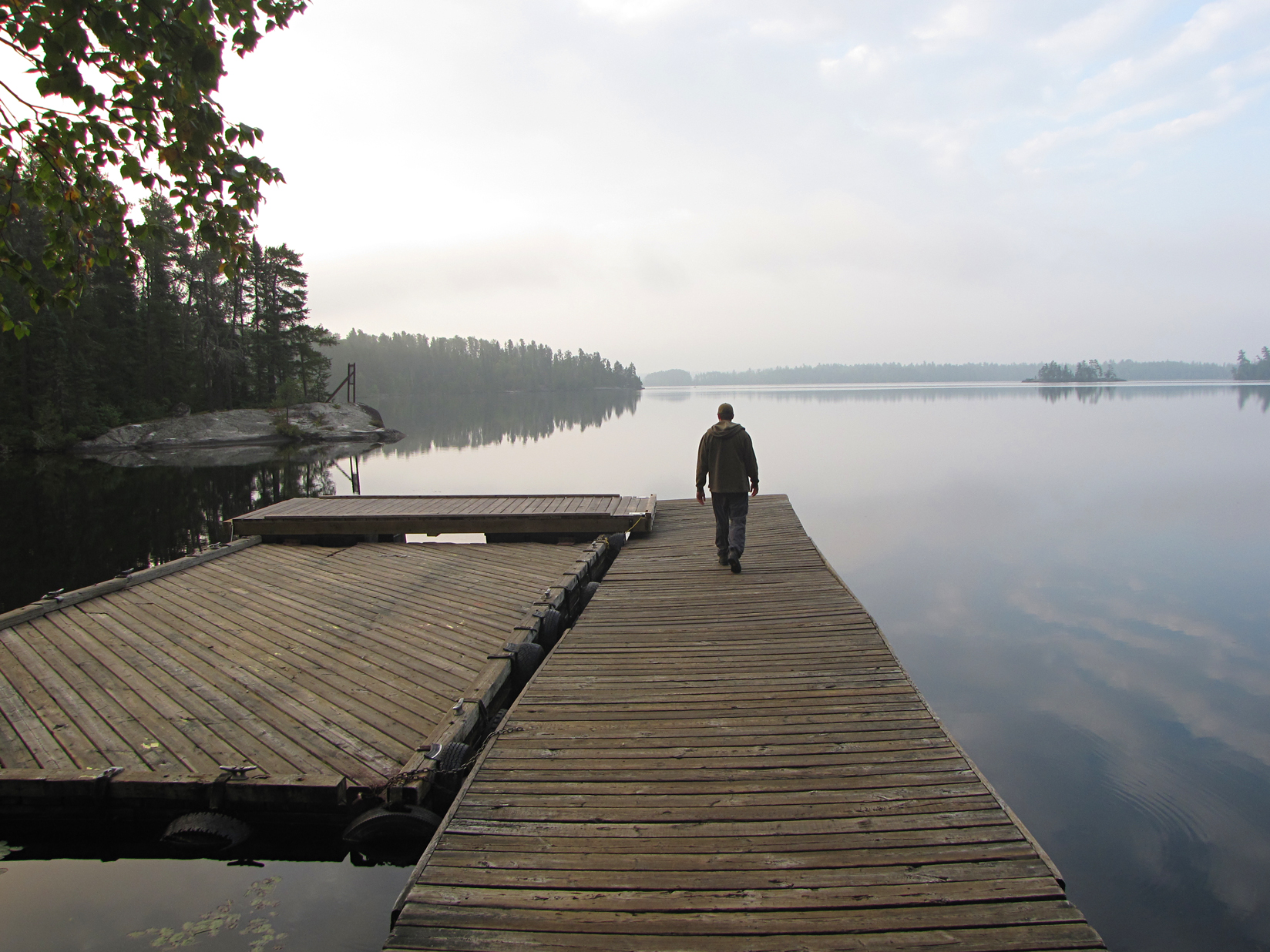
The launch at Nym Lake. (click image to enlarge)
It was a cloudy morning and one of the first things to greet us was a pair of Common Loons. Today we had 2 portages, the first was a 830 metre from Nym Lake to Batchewaung Lake, while a 270 metre after that lake lead us into Maria Lake.
On our way to Maria Lake we remembered reading about a set of rapids that you had to line your canoe through. We braced ourselves (and more importantly our gear) but it ended up being a light current. Maybe in the spring there are rapids?
Approaching what we thought were going to be rapids was a piece of cake. (click image to enlarge)
We arrived at a nice island campsite on Maria Lake, however their was the faint scent of human feces when the wind was in the right (or rather wrong) direction.
Before supper we decided to hop back in the canoe and paddle around looking for firewood as the island was pretty much picked clean. Marianne found a nice log and tossed it in the canoe, but unfortunately it was kind of rotton and it exploded on impact. Aaron flipped the canoe to dump out the shattered log, but in the process he hit the yoke off a rock and broke it. We are off to a great start! Aaron fixed the yoke with a stick and duct tape (never leave home without it) and we collected some wood to bring back to our site. After some freeze dried meals we sat and enjoyed our first night in the park.
Wildlife Sightings:Black Bear (seen on the drive along Highway 17 the day before), Red Squirrel, Common Loon, Black-capped Chickadee, Red-breasted Nuthatch, Northern Raven, Garter Snake, Green Frog, Magnolia Warbler, American Redstart, American White Pelican, White-throated Sparrow, Swainson’s Thrush, Ruffed Grouse, People.
Remember to:Bring our Gatorade crystals (we forgot to bring it! There goes a tiny bit of moral)
DAY #4: Maria Lake to Jean Lake
Weather: Sunny. High: 25C Low: 18C
topoView USGS. (click image to enlarge)
After cleaning up camp we set off into the fog. It was a nice peaceful morning. Our first portage was 710 metres into Jesse Lake. Jesse Lake is a longer narrower lake than the others we have seen so far. We broke for lunch in a marsh. Marianne went exploring, only to end up to her knees in marsh muck, leaving her hiking boots not as waterproof as they once were. We had a difficult time finding our next portage which was 680 metres near a waterfall on Oriana Lake. It ended up being on the opposite side of the waterfall than what was indicated on the map. The information on our Fischer Maps were taken from a 1979 survey, so perhaps the location of the portage has changed.
After a couple of shorter portages (100 metres and 160 metres) we paddled a short section of Quetico Lake. Another 110 metre and a 130 metre portage later we headed south into Jean Lake. It was approaching later in the afternoon and we still had the length of Jean Lake to paddle to get to the island campsite that we had in mind. We finally arrived at the lake’s east end just before sunset. After setting up camp, we had supper, a camp fire, and went to bed exhausted.
Wildlife Sightings: Yellow-rumped Warbler, Dark-eyed Junco, Common Loon, Ring-billed Gull, Red Squirrel, Garter Snake, Green Frog, Crayfish, Grey Jay, Northern Raven
Remember to:Canoe less. (nice to stretch your legs once in a while even if that means more portaging).
DAY #5: Jean Lake to Lonely Lake
Weather:Sunny. High: 25C Low: 17C
topoView USGS. (click image to enlarge)
After we cleaned up camp, we decided to have breakfast out on a flat rock that was a short paddle away from our site. The morning was bright and very calm as we slid the canoe into the glass like water. It was so calm that we could actually hear our ears humming as we sat on our small island. If it wasn’t for seeing the mist rising off the water, we could have sworn that time had stopped! It was a humbling experience.
The view from our rock we had breakfast on on Jean Lake. (click image to enlarge)
Breakfast was the highly recommended Backpacker’s Pantry Cinnamon Muesli and Milk. This pre packaged meal actually serves 2 people! We noticed that with most freeze dried meals that state “Serves 2” really only serves 1 hungry person. Our flat rock also seemed to be the local hang out spot for Canada Geese as poop littered the island, though not enough to deter us.
Preparing breakfast on Jean Lake. (click image to enlarge)
We had a route planned out for today. We were to paddle down Jean Lake into Burntside Lake, followed by a few portages after Rouge Lake that would bring us into Sturgeon Lake. From there we would paddle Sturgeon Lake, and end the day at Lonely Lake. A pretty solid day!
We arrived at our first portage of 400 metres at the southern end of Jean Lake, or at least it should have been right there. We looked up and down the area we thought for sure was the location of the portage. After a solid half hour it was getting to the point that if we kept this up we wouldn’t have enough daylight for our planned route! In the end we decided to back track and head east into Little Jean Lake, followed by a small 20 metre portage into Yeh Lake. After Yeh Lake we were faced with what was now our longest portage of the trip. As we approached the portage it was a little odd as there were logs apparently blocking it. Maybe it just wasn’t cleared so we attempted the portage anyway with just our packs while we left the canoe at the shore. This “portage” was brutal as it went through a swampy area and we really had to watch our footing. As we made it to what we thought was the end we breathed a sigh of relief. However, as we glanced to our right we saw our canoe resting on the shoreline only 100 metres away! The only thing we accomplished was making a U-turn! We then turned around and slogged back the way we came, put our packs back in the canoe and paddled further down the shore to find the real portage. Luckily we found it though it was a challenging 1370 metre portage of hills, and a swampy section which required walking on some placed down logs as we made our way from Yeh Lake to Lonely Lake.
We arrived at our site on Lonely Lake with time to relax and enjoy the rest of the afternoon. After a late lunch we moved the fire pit as a 40 foot dead tree with a broken limb was leaning over the original spot. We also felt pretty gross so we decided to jump into the cold lake which is always a heart pounding experience, but man do you ever feel refreshed when you dry off in the warm sun!
We enjoyed a nice evening and didn’t see any other paddlers today.
Drying out our damp clothes on a rock at our site on Lonely Lake. (click image to enlarge)
Remember to: Clothes don’t dry overnight, they take all day to dry
DAY #6: Lonely Lake to Batchewaung Bay
Weather:Sunny and windy. High: 25C Low: 18C
topoView USGS. (click image to enlarge)
Early morning in Quetico on Lonely Lake. (click image to enlarge)
After a big bowl of oatmeal we began to paddle north, slowly making our way back to the launch. We had some portaging to do today including two short portages to Walter Lake, a 740 metre portage from Elizabeth Lake to Jesse Lake, and then back to the familiar 710 metre to Maria, followed by the 270 metre portage back to Batchewaung Bay. Along some of these portages we observed moose tracks. One of today’s highlights while paddling was hearing a big snap followed by a CRASH as we saw a tree fall in the forest near the shoreline. (how poetic). When we arrived back on Batchewaung Bay the dreaded winds that can plague the larger lakes in Quetico began to pick up and we were met with headwinds, sideways winds, and even a lovely tail wind.
Our site tonight on Batchewaung Bay was a tiny island that we could easily see from one end to the other. It was still windy after we arrived and we managed to make a fire for our last night in the park. Tomorrow we paddle back to the Nym Lake launch. We don’t wanna go home!
Wildlife Sightings: Common Loon, Red Squirrel, moose tracks
Remember to: Bring clean clothes for the drive home (we just remembered that we didn’t bring any clean clothes and will have to drive home in our body odour infested camping clothes.)
DAY #7:Batchewaung Bay to Nym Lake launch
Weather:Sunny and windy. High: 20C Low: 15C
topoView USGS. (click image to enlarge)Wouldn’t recommend camping on this tiny island. (click image to enlarge)
This morning was the chilliest morning of our trip. Marianne woke up to a surprise find of shredded toilet paper in her pack that she left partially unzipped.
Breakfast was Mountain House brand scrambled eggs and bacon, and we both agreed that rehydrated freeze dried eggs wasn’t our cup of tea. Our other rehydrated meal was Natural High raspberry granola and milk which tasted a lot better than the eggs. After cleaning up camp it was time to make our way back to the launch.
When we arrived on Batchewaung Lake the north winds met us head on as we paddled this, our last lake in the park. As we arrived at the last portage, at 830 metres into Nym Lake, we took one last look over the open waters and Quetico. Paddling in the headwinds we slowly made our way to the Nym Lake launch, arriving back to the car by 11:30 am.
Quetico Provincial Park was a challenging step up from our first trip in Killarney. We learned a few things while on this trip, and we actually returned home somewhat defeated that we couldn’t stick to our original route. We will return some day to Quetico hopefully with some different, more practical gear, and more preparation.
We’ll be back Quetico! (click image to enlarge)
Wildlife Sightings: Common Loon, Red Squirrel, Northern Raven, Wood Duck, People
Remember to:Make our own dehydrated food for future camping trips as the pre packaged ones are too expensive and take up too much room in a pack. Also, carry less weight for future camping trips. Lastly, 1 double roll of toilet paper is plenty for a week long trip.
Early dawn in Quetico Provincial Park. (click image to enlarge)
Longest Portage: 3.160 kilometres (between Killarney and Threenarrows Lake)
Average Daytime High: 15 Celsius
Average Nighttime Low: 10.5 Celsius
Route: George Lake – Freeland Lake – Killarney Lake – Three Narrows Lake – Artist Lake – Muriel Lake – O.S.A. Lake – Killarney Lake – Freeland Lake – George Lake
Maps Used: Friends of Killarney Provincial Park map (2004 version)
Killarney Provincial Park with our route outlined in red. (click image to enlarge)
This was our first official backcountry camping trip as a couple, and what better introductory trip than in scenic Killarney Provincial Park! Since this trip we have made a few modifications in our camping gear and eventually bought our own canoe. We have also ventured further into the backcountry in the beautiful province of Ontario, extending our trips to almost 2 weeks. We hope our first trip inspires others to get out and enjoy the beauty and rewarding challenges of the outdoors!
Note: All photos were taken with a cheapo throwaway camera we purchased last minute, hence the really poor quality in photos.
The entry to the George Lake campground off highway 637. (click image to enlarge)
DAY # 1:George Lake to Killarney Lake
Weather:Sunny. High: 18C Low: 15C
topoView USGS. (click image to enlarge)
After a long drive from Barrie, we arrived in the beautiful town of Killarney around 11:30am for lunch and stretch our legs while we explored the waterfront. Soon we drove to the Killarney Outfitters to pay for our rental canoe, a Souris River Kevlar canoe at 39 pounds. It was then onward to the George Lake launch to pick up our permit, unlock our canoe, and venture out around 1:00pm. Get ready Killarney, we have arrived!
After entering George Lake we gazed in awe at Killarney’s claim to fame as the geographical masterpiece spread out in front of us. Not too far off in the distance the white quartzite of the La Cloche Range became visible, while pink granite made up the islands on George Lake. The landscape here even rivals the Lake Superior coastline so no wonder this is one of the most popular locations in Ontario to paddle!
Paddling George Lake. (click image to enlarge)
Our first portage was at 80 metres into Freeland Lake. This is it! Our first portage!! We took off our sandals, got on our hiking boots, and made sure that our packs were all tied tight and firmly snug on our shoulders and back. That’s when we noticed that the portage was literally 35 to 40 feet in length. If we realized this earlier we could have brought all our stuff over in a couple of trips while keeping our sandals on. Aaron also broke a minor strap on his backpack. We are such rookies!
A nice short paddle on Freeland Lake offered a different experience than the deeper waters of George Lake. This lake was shallower with a lot of aquatic vegetation including pickerel weed. Our next portage, at 455 metres with some elevation, brought us to Killarney Lake. After a short paddle we arrived at our first site for the trip at the northeast end of the lake (site #15). The site was on an island that even had our own little bay to swim in. We also had great views of the pink granite islands and outcrops of the Killarney Ridge.
Wildlife Sightings: White-tailed Deer, Turkey Vulture, Common Loon, Belted Kingfisher, Common Merganser, Red Squirrels, Eastern Chipmunk, American Redstart, White-breasted Nuthatch, Red-breasted Nuthatch, Black-capped Chickadee, Yellow-bellied Sapsuckers, Common Raven, Wood Duck, People
Remember to: Learn how to tie a pack in a tree properly
DAY #2: Killarney Lake to Threenarrows Lake
Weather: Cloudy. High: 12C Low: 9C
topoView USGS. (click image to enlarge)
Like mornings to come, ours began with cleaning up camp. Breakfast for our inaugural backcountry trip was a prepackaged freeze dried meal. All you have to do with these convenient meals is open them up, pour in the correct amount of water, stir well, reseal the package, and then after a directed amount of time you enjoy! Today’s breakfast was a Spinach and Cheese Omelette. After preparing the package we opened it and saw omelette coloured goop. What was going on here? Reading the package more closely, we saw that the next step was dumping the goop on a fry pan which we didn’t have with us. We tried a few mouthfuls straight out of the package but that was all we could stomach.
We left our site at 11:00am and made our way to Threenarrows Lake which would be the location of our next site for the night. To get to Threenarrows we had to portage a 3,160 metre long, but relatively flat, portage. Along this long portage we were right next to the white rocks of the La Cloche range, and we also viewed some beaver dams. At first we attempted a once over with this portage, but Aaron’s pack was uncomfortable so we doubled over most of it. Four hours later and we finally got all our gear and the canoe to the end of the portage. We collapsed here completely worn out and used the last of our water to make lunch as we were very hungry. Unfortunately, while attempting to sit down, Marianne accidentally knocked over the pot of water that was perched on the camping stove, completely dumping all the water out. So much for lunch! In the end we had to settle on splitting an energy bar, while taking what few sips of water that were left in our water bottle. This was definitely the low light of the whole entire trip, and left us both a little miserable.
After another 395 metre portage we now entered Threenarrows Lake and into the heart of Killarney Provincial Park. Threenarrows is aptly named due to the fact that it used to be three separate lakes until a dam was built in 1900 across Kirk Creek causing the surrounding waters to rise. The reason was to help move floating logs during the park’s logging era. Since then the dam has been rebuilt and the lake continues to look as it does today.
We soon arrived at our site on Threenarrows Lake (site #51). It was a larger site than the one from yesterday and it still gave us those spectacular Killarney views! Tomorrow should be a lot more leisurely than today as we only have to paddle to the other end of Threenarrows Lake.
As then sun set and twilight came over us we heard thunder in the distance. Please stay away!
Wildlife Sightings: Huge Snapping Turtle, Northern Raven, Red-breasted Nuthatch, Eastern Chipmunk, Red Squirrel, Black-capped Chickadee, White-throated Sparrow, Canada Goose, Common Loon, Wood Duck, Common Merganser, Yellow-rumped Warbler, Blackpoll Warbler, Red-tailed Hawk, People
Remember to: Bring more toilet paper, bring a pot scrubber, and read those freeze dried food packs more carefully!
DAY #3: Threenarrows Lake
Weather: Showers in the morning, afternoon sun and clouds, evening thunderstorms. High: 11C Low: 9C
topoView USGS. (click to enlarge)
Though we woke to light rain showers this morning, we still managed to make a fire for warmth and even heated up water to bath with. We launched just after 10:30am and paddled towards the southwest end of Threenarrows Lake in hopes to get a campsite close to tomorrow’s portage.
Though lacking the “in your face” scenic vistas of George Lake and Killarney Lake, Threenarrows Lake has a lot of charm to it. We saw around 6 cottages and we wondered how the owners get to them as we were not aware of any roads to the lake.
After a nice paddle, we arrived at site #48. It was a fairly large site and we saw a distant cottage as well as the La Cloche mountain range. In the afternoon we set up camp, made a fire, cooked lunch, and filtered water before the forecasted rain showed up. What better time to have an afternoon nap! As evening approached and the sun appeared again we got into the canoe and had a nice evening paddle while searching for tomorrow’s portage. This portage actually has a name, and when a portage claims a name to their fame you know it isn’t going to be a cake walk! This one is known as “The Pig” and is credited to be one of the most challenging and steepest portages in the park! We will be tackling it tomorrow right after breakfast. We hope it doesn’t rain!
Wildlife Sightings:Dark-eyed Junco, Yellow-rumped Warbler, Blackburnian Warbler, Black-throated Green Warbler, Great Blue Heron, Red Squirrel, Northern Flicker, Blue Jay, Black-capped Chickadee, Common Loon, Wood Duck, Common Raven, Broad-winged Hawk, Red-breasted Nuthatch, White-tailed Deer, People.
Remember to: Dry pine needles burn great!
DAY #4Threenarrows Lake to O.S.A Lake
Weather: Sunny to mostly cloudy in the afternoon. High: 15C Low: 9C
topoView USGS. (click image to enlarge)
A chilly 9 degrees Celsius this morning, and with everything outside the tent very damp from yesterday’s rain we still somehow managed to get a fire going.
We arrived at “The Pig” just after 10:00am. This portage, one of the steepest in the park, is close to 1.5 kilometres in length. It goes over a section of the Blue Ridge range of mountains and was once an old logging road from 1908 to 1927. What remains today of this tote road includes a trail of loose rounded stones of various sizes, so this was definitely a portage that required two carries.
It was slow going, and we took our time. We were very happy that it wasn’t raining which would have made for a slippery situation on all these rocks. Along the portage we came to a junction that connected to part of the La Cloche Silhouette Trail. This is the 78 kilometre backpacking trail that traverses through some of the park’s most scenic landscapes. All in all “The Pig” wasn’t as bad as we thought it would be and we finished it in about three hours.
We arrived on Artists Lake, and after 2 short portages we were soon on Muriel Lake. Our next portage was perhaps the most interesting of the entire trip. We had an option of the 595 metre portage or a short cut along a marsh. We decided to take a risk and try the shortcut. After dragging the canoe through the marsh and mud, getting our pool shoes and also ourselves muddy, we made it to the end of the portage. We were rewarded we views of a Barred Owl, a lifer for Marianne!
After replacing our pool shoes with our hiking boots, it was time to paddle O.S.A Lake. The acronym stands for Ontario Seven Artists, named after the famed Canadian painters, The Group of Seven, who found inspiration for some of their famous works in Killarney’s wilderness. O.S.A Lake is remarkably clear, and at first we thought that the lake was pristine, however we could clearly see to the bottom where logs were stripped of their bark, now just white and bare. This transcended into an almost eerie uneasiness like we were paddling over the large white bones of some underwater creature. No sign of vegetation was seen below the water’s surface, with barely a plant growing along the shoreline. Forget about seeing any fish as none could live here. This was a dead lake. O.S.A Lake, like other lakes lined with quartzite in Killarney Provincial Park, have suffered from the fallout of acid rain with inert lakes too acidic to support much life.
As we paddled across O.S.A Lake, views of the South LaCloche range and the Killarney Ridge were spectacular as both surrounded the lake. We paddled towards the island site in the middle of the lake hoping to stay there, but as we got closer we saw that the trees were almost all dead and a “no camping” sign posted. Guess we won’t be staying here! We continued to paddle east and saw a site that was clearly newly created as it wasn’t on our current map (site #28). This site was quite protected and had barely been trodden on with lichen still covering the ground. As we had a fire we viewed some Canada Geese fly overhead. A sign of shorter days to come as summer draws to a close.
The clear waters of O.S.A Lake caused by acid rain from emissions such as Sudbury’s mining industries that, over the years lowered the pH level of the water. A survey in 2001 revealed that O.S.A Lake had a pH level of 4.9. Being surrounded by inert quartzite, recovery of this, and many other lakes in Killarney Provincial Park may take another lifetime to return to a more normal pH level. Thankfully, local mining industries have reduced their emissions. (click image to enlarge)
Wildlife Sightings: American Pipit, Barred Owl, Canada Goose, Red Squirrel, White-tailed Deer, Deer Mouse, Eastern Chipmunk, Northern Raven, Blue Jay, Green Frog, Red-tailed Hawk, American Robin, Common Loon, People.
Remember to: Bring Exlax
Day #5: O.S.A Lake to George Lake
Weather: Sunny and windy. High: 16C Low: 7C
topoView USGS. (click image to enlarge)
We left O.S.A. Lake early in the day and began to make our way back towards Killarney Lake after a 130 metre portage into that lake, followed by a 455 metre back into the familiar Freeland Lake. Lastly we arrived again to the little 80 metre portage which we remembered from day one as being easy, so we brought all our stuff over in a few very short trips.
We were now back on George Lake and thus making a complete loop. Heading back down George Lake however was grueling! It was incredibly windy and we had head winds to the point that if you stopped to take a break you would immediately be going backwards! After what felt like a crawl down the lake we made it to a site near the George Lake launch (site #3), set up camp, and had a well deserved three hour nap. We later gathered firewood and had our last fire for the trip, finishing the rest our freeze dried meals.
Our site on George Lake. (click image to enlarge).
Tomorrow we head back to the launch, lock up our rental canoe, return our paddles to the outfitter, and head into the town of Killarney for breakfast. We are craving milk and cereal!
Remember to: Bring less fuel. One can of fuel is good for three days.
DAY #6: George Lake to the George Lake launch
Weather: Thunderstorms. High: 15C
topoView USGS. (click image to enlarge)
We both had somewhat of a sleepless night. Maybe it was because we were going home today…..or maybe it was that three hour nap the day before..
It was a good thing that we got up at the crack of dawn because as soon as we left our site to begin our paddle back to the launch we heard thunder! We turned around and saw a thunderstorm heading right towards us! Luck was with us and we managed to lock up our canoe, drive to the George Lake showers, take a shower, and got back in the car right before the sky opened up with pouring rain! We arrived to the town of Killarney for a real breakfast which was wonderful! After returning our gear to the Killarney Outfitters we shopped around the Ontario Parks gift shop for a new sew on crest for our backpack.
Before we knew it, it was time for us to get back on the road and head for home. Killarney Provincial Park was such a great location for our first introductory canoe trip in Ontario and we will return again to its white ranges and beautiful waters.
O.S.A Lake with the south La Cloche Range. (click image to enlarge)